The full schedule, three days flat.
Three trekking days from Pokhara, with a helicopter return from Sidhing on the third afternoon. Day 1 covers what is normally a day and a half. Day 2 combines two standard route stages into one push to High Camp. Day 3 is summit, descent, and lift.
- Day 1
Pokhara → Kande → Forest Camp (Kokar)
- Drive / Heli
- 1.5 hrs (Pokhara → Kande)
- Trek
- 6 – 7 hrs
- Distance
- ~13 km
- Altitude
- Kande 1,770 m → Forest Camp 2,520 m
- Net change
- +750 m
Early start. We leave Pokhara at 06:30 to put us at the Kande trailhead by 08:00. Stone steps from Kande to Australian Camp open the day; the ACAP permit is checked at Pothana around 09:30. Lunch is taken at Pitam Deurali, the junction where the Mardi route splits from the Annapurna circuit path.
The afternoon climbs through rhododendron and oak cloud forest to Forest Camp at 2,520 m, the first overnight on the standard route. The 3-day version skips the standard Pitam Deurali night entirely and pushes straight through, which is why the day is roughly twice as long as Day 1 of the 7-day plan.
Arrive Forest Camp by 16:00 to 17:00. Light dinner, early bed. Tomorrow is the long day.
- Day 2
Forest Camp → Low Camp → High Camp
- Drive / Heli
- —
- Trek
- 7 – 9 hrs
- Distance
- ~10 km
- Altitude
- 2,520 → 2,985 → 3,580 m
- Net change
- +1,060 m
The hardest day. Two standard route stages combined into one push. The trail climbs through the upper cloud forest to Low Camp at 2,985 m, where most groups would stop for the night. The 3-day version pushes through after lunch onto the open ridge to High Camp at 3,580 m.
Acclimatisation is the main risk on this day. Pace must be deliberately slow above Low Camp. We monitor pulse oximetry at the Low Camp lunch stop and again at Badal Danda (3,210 m). Trekkers showing early AMS symptoms are stopped at Low Camp for the night and switched to the standard 5-day plan; the heli return on Day 3 is rebooked.
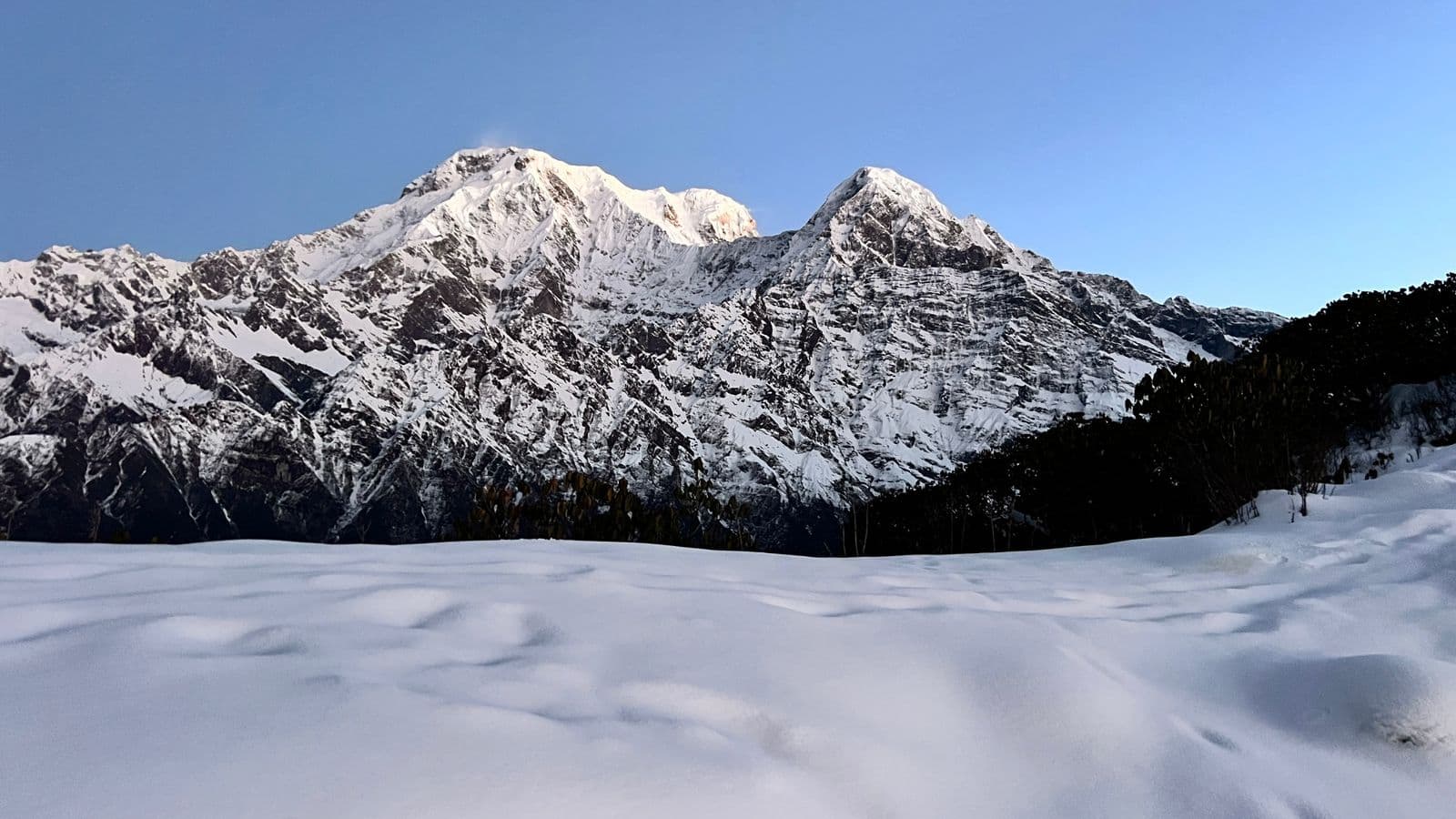
Arrive High Camp late afternoon. Cold dinner, basic plywood-walled rooms. The dining-hall sunset across the Annapurna massif is the moment that justifies the day.
- Day 3
High Camp → Upper Viewpoint → Sidhing → Pokhara (heli)
- Drive / Heli
- Helicopter, 25 min (Sidhing → Pokhara)
- Trek
- 5 – 6 hrs (descent)
- Distance
- ~9 km
- Altitude
- 3,580 → 4,200 → 1,860 m
- Net change
- +620 m / -2,340 m
Pre-dawn ridge climb to the Upper Viewpoint at 4,200 m for sunrise. Headtorches on, deliberate pace. From the viewpoint, on a clear morning, Dhaulagiri appears far to the west and the Annapurna massif fills the eastern half of the sky.
Return to High Camp for breakfast. Descend through Low Camp and the steep forest path to the Gurung village of Sidhing at 1,860 m. The descent takes 4 to 5 hours and is the second hardest stretch of the trek after Day 2's combined ascent. Trekking poles are essential.
Lunch in Sidhing. The helicopter lifts at 14:00 to 15:30 weather permitting, landing in Pokhara 25 minutes later. Hot shower and afternoon nap at the lakeside hotel. Celebration dinner included. The whole trek wraps up by 16:00 on Day 3.
Three versions, one ridge.
How the 3-day compares against the standard 5-day and 7-day itineraries on the same trail. Walking hours, acclimatisation buffer, side trips, cost, and who each version is for.
3-day
5-day
7-day
The 3-day works for some trekkers, not all.
We are explicit about who this version is for and who it is not. Compressed altitude profiles raise risk; the helicopter does not take that risk away. If you are unsure, default to the 5-day or 7-day version.
- Fit, time-pressed trekkers. If you have a 4-day window in Pokhara and you can carry your daypack at altitude without stopping, the 3-day plan delivers the trek without a day off work in the way.
- Trekkers with prior altitude experience. If you have walked above 3,500 m before (Everest View, Kilimanjaro, Mont Blanc, Inca trail), your body knows how to acclimatise faster. The 3-day pacing is achievable.
- Photographers chasing one window. If you have a single fair-weather forecast window, the 3-day version locks the summit attempt to a known date and removes 4 days of weather risk.
- First-time Himalayan trekkers. The 3-day pacing assumes your body knows what 3,500 m feels like. First-timers should always do the 5-day or 7-day version. The trek is not the place to test new altitude.
- Anyone with cardiovascular conditions. Compressed ascent profiles raise cardiovascular load. We do not run the 3-day for trekkers with a history of hypertension, arrhythmia, or pulmonary issues, regardless of fitness.
- Trekkers under 18 or over 65. Our hard rule. Children and older trekkers are welcome on the 5-day or 7-day versions. The 3-day pacing is outside our risk envelope for these age groups.
The price tag, itemised.
The 3-day version is materially more expensive than the 5-day or 7-day, almost entirely because of the helicopter return. Below is the full inclusion list and the cost split, so you can see where the money goes.
Group rate, 2 trekkers minimum
Lower for groups of 4 or 6 (heli is a fixed-cost shared ride). Higher for solo bookings (no heli sharing). Quotes confirmed at booking.
- ACAP entry permit
- TIMS card
- Licensed guide for 3 days
- Pokhara → Kande private jeep transfer
- Sidhing → Pokhara helicopter (25 min)
- Teahouse accommodation (Forest Camp, High Camp)
- 3 meals daily on trail + celebration dinner Day 3
- Trekking poles on loan
- First aid + satellite communicator
- International flights to Kathmandu / Pokhara
- Pokhara hotel (we recommend Lakeside, USD 35 – 80 / night)
- Lunch and dinner in Pokhara on rest days
- Personal trekking gear
- Travel insurance (mandatory, must cover heli evac to 4,500 m)
- Tips for guide (USD 80 – 120 standard)
- Helicopter weather contingency (rebooked at no extra cost; accommodation extra if delay extends)
