
The royalty-free story, document by document.
The Nepal Mountaineering Association classifies its peaks into two brackets: 27 fee-charging peaks (Mera, Island, Lobuche, Pisang, and so on) and a small group of royalty-free peaks. Mardi Himal sits in the second bracket, alongside Tharpu Chuli, Yala, Pokhalde, and a few others. That single line in the NMA tariff sheet is the entire reason the climb costs USD 350 less per head than Island Peak in the same season. Below is the bracket in context, then the actual paper you carry on the trail.
NMA peak bracket comparison
Spring 2026 royalty- Mardi Himal5,587 m · USD 0Royalty-free. Listed as a non-fee NMA peak. ACAP and TIMS only.
- Tharpu Chuli (Tent Peak)5,663 m · USD 0Annapurna Sanctuary. Royalty-free in the same NMA bracket as Mardi.
- Yala Peak5,732 m · USD 0Langtang region. Often paired with the Langtang trek.
- Pokhalde5,806 m · USD 0Khumbu region. Sometimes used as a warm-up before Mera or Island.
- Island Peak (Imja Tse)6,189 m · USD 350 (spring)Fee-charging NMA peak. Spring rate. Autumn USD 250, winter USD 175.
- Mera Peak6,476 m · USD 350 (spring)Fee-charging NMA peak. Same tariff as Island in each season.
- Lobuche East6,119 m · USD 350 (spring)Fee-charging NMA peak. Often paired with Everest Base Camp.
Document checklist, in order of use
14-day climb from KathmanduNepal tourist visa
USD 30 (15 days), USD 50 (30 days), USD 125 (90 days)- Issuer
- Nepal Embassy or on arrival at Kathmandu (TIA)
- Lead time
- On arrival, 30 mins
Two passport photos. USD cash exact change.
ACAP entry permit
NPR 3,000 (~USD 25)- Issuer
- Nepal Tourism Board, Kathmandu (Bhrikuti Mandap) or Pokhara (Damside)
- Lead time
- Same day, 1 hour at counter
Passport, two photos, visa stamp. We arrange before you arrive.
TIMS card
NPR 2,000 (~USD 17)- Issuer
- NTB office, paired with ACAP
- Lead time
- Same day, paired with ACAP
Two more photos. Form filled at counter.
Climbing guide license check
Included in package- Issuer
- NMA-licensed agency
- Lead time
- Verified pre-departure
Guide ID and NMA license number on contract. Ask to see it.
Climbing royalty receipt
USD 0- Issuer
- —
- Lead time
- Not applicable
Mardi is royalty-free. No NMA fee receipt issued.
Garbage deposit receipt
USD 0- Issuer
- —
- Lead time
- Not applicable
No NMA garbage deposit on a royalty-free peak. Agency carries out group waste under ACAP rules.
On a fee-charging NMA peak the spring tariff is USD 350 royalty and USD 250 garbage deposit (refundable on submission of waste receipts), so a four-person team writes a USD 2,400 cheque before boots leave Kathmandu. On Mardi the same line is zero. The difference funds an extra rest day, better summit-night food, or a private guide ratio on a tighter budget.
The NMA reviews the bracket roughly once a decade. Mardi has been in the no-fee group since the 2002 amendment to the Mountaineering Regulations and was not moved in the most recent September 2025 revision. We treat the status as stable for 2026 and 2027; we do not promise it past that.
Independent guideless trekking has been banned inside the Annapurna Conservation Area since 1 April 2023. The rule applies to climbers as well: a licensed guide must accompany the team on every section of the route, including the climb. The guide's NMA license is checked at the ACAP gate at Pothana on Day 1.
Gear that survives a -25 °C summit night.
The personal climbing kit list with per-item specifications, brand references, retail prices, and what is rentable in Kathmandu (Thamel) or Pokhara (Lakeside). Group hardware (rope, snow bars, fixed line, dining tent, kitchen) is provided in the package. What you must bring or rent is below. Items marked rentable are workable for a two-week expedition; items not marked are personal and should be your own.
Boots & traction
- Mountaineering bootsRentableB2 single-skin minimum, B3 plastic shell for cold years (below -20 °C). Insulated tongue, fully crampon-compatible.Examples Scarpa Manaslu, La Sportiva G2 Evo, Salewa Pro GaiterUSD 350 – 700 retail / USD 4 – 6 day rent
- CramponsRentable12-point, semi-automatic step-in or strap-on for B2 boots. Anti-balling plates mandatory in spring snow. Steel for the rock pitch.Examples Petzl Vasak, Grivel G12, Black Diamond SabretoothUSD 180 – 250 retail / USD 3 – 4 day rent
- Ice axeRentableTechnical or general-mountaineering, 50 to 60 cm depending on height (taller = longer). Curved shaft for the steeper sections of the summit pyramid.Examples Petzl Summit Evo, Black Diamond Raven Pro, Grivel Air TechUSD 120 – 200 retail / USD 2 – 3 day rent
Harness, hardware, rope
- Climbing harnessRentableAdjustable leg loops (fits over base layer plus shell), gear loops, haul loop. UIAA-rated.Examples Petzl Adjama, Black Diamond Momentum, Mammut Ophir 4-SlideUSD 70 – 120 retail / USD 2 day rent
- Locking carabinersMinimum 2 HMS-style screw-gates, plus 2 standard locking biners.Examples Petzl Attache, Black Diamond PearabinerUSD 14 – 22 each / no rental, bring own
- Belay deviceTube-style (ATC or equivalent). Auto-locking devices unnecessary for fixed-line use.Examples Petzl Verso, Black Diamond ATC-XPUSD 25 – 35 / no rental
- Mechanical ascenderRentableRight-hand ascender. Used on the upper fixed line above Camp 1. Comes with the package on group climbs.Examples Petzl Ascension, Climbing Technology Quick'UpUSD 50 – 80 / included in package
- HelmetRentableUIAA-rated climbing helmet. Light EPS shell preferred over heavier plastic for long approach days.Examples Petzl Sirocco, Black Diamond Vapor, Mammut Wall RiderUSD 60 – 130 / USD 2 day rent
- Prusik cord5 mm × 1.5 m accessory cord, knotted. Backup for ascender failure on fixed line.Examples Sterling, Edelweiss, BealUSD 8 / no rental
Layering for -25 °C summit window
- Base layer setMerino wool 200-weight, top and long johns. Two pairs (rotate sleeping and climbing).Examples Icebreaker BodyfitZONE, Smartwool Classic ThermalUSD 90 – 130 per piece
- Mid-layer fleecePolartec 200 fleece or Powerstretch hooded. Optionally a synthetic-fill sweater for the upper mountain.Examples Patagonia R1, Arc'teryx Delta MXUSD 120 – 180
- Insulated mid jacketSynthetic fill (PrimaLoft Gold). Worn under shell on summit day if temperature drops.Examples Patagonia DAS, Arc'teryx Atom HeavyweightUSD 220 – 320
- Hardshell jacketRentable3-layer, taped seams. Underarm pit zips. Helmet-compatible hood.Examples Arc'teryx Beta AR, Patagonia TrioletUSD 350 – 600 / USD 4 day rent
- Hardshell pantsRentable3-layer with full-side zips. Side zips matter for putting them on over boots and crampons.Examples Arc'teryx Beta AR, Mountain Hardwear ExposureUSD 300 – 500 / USD 3 day rent
- Down summit jacketRentable800-fill minimum, 200 g down weight. Hooded, helmet-compatible. Worn at Camp 1 evenings and on the summit ridge.Examples Mountain Hardwear Phantom, Rab Neutrino, Feathered Friends FrontpointUSD 450 – 850 / USD 5 day rent
- Glove systemThree pairs: liner (merino), mid (windstopper fleece), summit (Gore-Tex over-mitten with PrimaLoft inner).Examples Black Diamond Mercury Mitt, Outdoor Research Alti IIUSD 150 – 280 (set)
Reliable shops include Shona's Alpine and Sherpa Adventure Gear in Thamel, and North Face Outlet and Trekkers' Choice in Pokhara Lakeside. Daily rental for the climbing kit (boots, crampons, ice axe, harness, helmet) totals USD 12 to 18 per day. Allow a day in Kathmandu or Pokhara for fitting; ill-fitting boots cause more failed summits than fitness gaps.
Group climbing rope (50 m × 9 mm dynamic), snow bars and fixed line, two-person 4-season tent at Camp 1, group dining and kitchen tents at Base Camp, sleeping bag (-20 °C comfort) on request, and closed-cell plus inflatable sleep mat. Clients are welcome to bring their own bag if preferred.
Cotton in any layer, leather hiking boots without crampon compatibility, single-skin gloves, sub-200-fill down jackets, and wraparound running sunglasses. Each one tends to be the item a first-time alpinist does not realise will fail at -20 °C.
12 weeks to the start line.
The plan we send confirmed climbers, built around a 12-week ramp from a moderate baseline (already running 25 to 30 km a week, hiking occasionally on weekends) to climb-ready. Volume peaks at week 10, tapers across week 11, and the final week is travel and active rest in Kathmandu. The benchmarks below sit at the end of week 10 — hit them and you are ready.
Week 1 – 2 (Foundation)
Aerobic base5 hr/wk: 3× zone-2 runs (45 min), 1× long hike with 6 kg pack (3 hr).
Why: Cardio at conversational pace. Build the engine, not the speed.
Week 3 – 4 (Volume)
Aerobic volume + light strength7 hr/wk: 3× zone-2 runs (60 min), 1× long hike with 8 kg pack (4 hr), 2× lower-body strength.
Why: Add stairs or hill repeats once a week. Lower-body lifts: squat, deadlift, lunges, calf raise.
Week 5 – 6 (Specificity)
Pack-loaded climbing9 hr/wk: 2× zone-2 runs (60 min), 2× weighted hikes (10 kg, 4 – 5 hr), 2× strength sessions, 1× core.
Why: Find local hills with 600 m+ vertical. Repeat-ascend if no peak nearby. Pack weight matches expedition load.
Week 7 – 8 (Intensity)
Threshold + uphill power10 hr/wk: 1× threshold run (40 min), 1× zone-2 run (75 min), 2× weighted uphill hikes (12 kg), 2× strength, 1× yoga.
Why: Threshold run at sustainable hard pace. Hike with target expedition weight (~12 kg).
Week 9 – 10 (Peak Volume)
Back-to-back days12 hr/wk: 2× weighted hikes back-to-back (Sat 5 hr + Sun 4 hr), 2× zone-2 runs, 2× strength.
Why: Mimics the climbing rhythm: tired-on-tired. Recovery between days matters as much as the ascent.
Week 11 (Taper)
Reduce volume, retain intensity6 hr/wk: 2× short threshold, 1× medium hike with 8 kg, 1× strength.
Why: Cut volume by 40%. Keep one short hard session per week. Sleep 8+ hours.
Week 12 (Travel & arrival)
Active rest2 – 3 hr total: stretching, easy walks, mobility work in Kathmandu.
Why: Do not train hard in the 5 days before flying. Walking around Pokhara on arrival counts.
End-of-week-10 benchmarks
Hit all five before flying- Resting heart rateBelow 65 bpm (athletes: below 55)Cardiac efficiency. Lower RHR generally tracks better acclimatisation response.
- 1,000 m vertical with 8 kg packInside 90 minutesSteady-state aerobic capacity at the load you will carry.
- Back-to-back hike days5 hr Saturday + 4 hr Sunday with 10 kg packRecovery between climbing days is the limiting factor on the upper mountain.
- Cooper test (12-min run)2.4 km / 1.5 mi for women, 2.6 km / 1.6 mi for menVO2 max proxy. Useful to track over the 12 weeks.
- 5-min step test (40 cm box, 16 kg)300 repsLocal muscular endurance for sustained step-up rhythm on fixed line.
Sleep height, night by night.
The acclimatisation profile we run on the standard 14-day departure. Two rules underpin the schedule: sleep height does not gain more than 600 metres per night above 3,000 m, and a rest day inserts wherever the gain trends upward over a 48-hour window. Above 4,500 m we add "climb high, sleep low" days where the team gains altitude during the day and descends 300 m to sleep.
Sleep-height profile
14-day departure, spring- Night 1Kathmandu1,400 mArrival
- Night 2Pokhara820 mLower for sleep
- Night 3Forest Camp (Kokar)2,520 m+1,700 m from valley
- Night 4Low Camp2,985 m+465 m
- Night 5High Camp3,580 m+595 m
- Night 6High Camp (rest day, hike to 4,100 m)3,580 m+520 m hike, sleep at same altitudeRest
- Night 7Mardi Base Camp4,500 m+920 m
- Night 8Mardi Base Camp (rest, gear practice)4,500 m0 mRest
- Night 9High Camp / Camp 15,100 m+600 m
- Night 10Camp 1 (summit attempt night)5,100 mSummit push at 02:00, return Camp 1
- Night 11Mardi Base Camp4,500 mDescent, -600 m
- Night 12 – 14Sidhing / Pokhara / KathmanduBelow 2,000 mDescent and travel
Standard prophylactic dose is 125 mg twice daily, started one day before crossing 3,000 m and continued for 48 hours after reaching the highest sleeping altitude. Side effects: tingling fingers, metallic taste in carbonated drinks, frequent urination. Speak to your doctor; do not start without medical advice. Most of our climbers take it on the schedule above, starting at Pokhara.
We do not use supplemental oxygen on the standard ascent. The summit at 5,587 m is below the 6,500 m threshold where most teams consider O₂ on the upper mountain. We do carry a single oxygen cylinder and regulator at Camp 1 for emergency descent assistance only, and a portable hyperbaric bag (Gamow) at Base Camp.
Hard summit-day turnaround is 09:00 from Camp 1, 06:30 from the summit. Past those times, weather windows close on the southwest face and descent on fixed line in cloud is slow. The lead guide calls the turnaround. We would rather descend a willing climber than carry an unwilling one.
Southwest face, hour by hour.
The standard line follows the southwest face from Camp 1 at 5,100 m up a 30 to 35-degree snow couloir, onto an exposed ridge, finishing with a short UIAA II / III rock pitch on the summit pyramid. Total climbing distance is roughly 800 m vertical from Camp 1, total walking time on summit night is 9 to 10 hours round-trip including rests. Alpine grade PD, technical grade F+ to PD- depending on the year's snow.
Summit day timing
02:00 alpine start, summit ~07:00- 23:30 (night before)5,100 mBoil water, eat early breakfast (porridge + tea + biscuits). Final gear check by guide. Headlamp test.
- 01:005,100 mDepart Camp 1. Rope team formed. Crampons on at the snowline (around 5,150 m).
- 02:305,300 mReach the snow couloir. Fixed line begins. Mechanical ascender clipped in. Pace 100 m vertical per hour.
- 04:305,450 mTop of the couloir. Brief rest, hot drink. Wind exposure increases on the ridge.
- 05:305,520 mBelow the rock pitch. UIAA grade II / III rock with one short mixed step. First light here in spring.
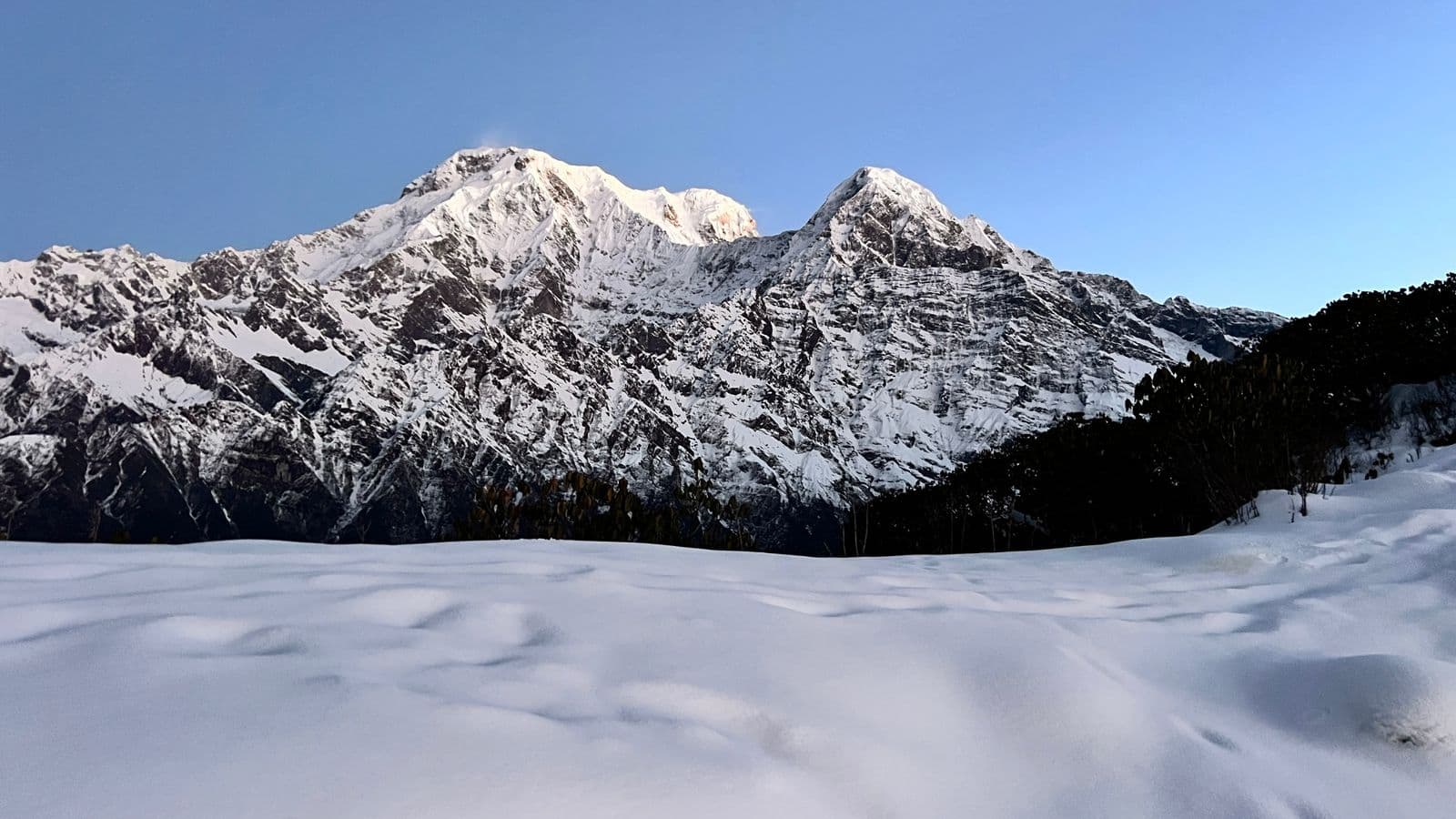
- 06:305,587 mSummit. 15 to 20 minutes on top, photos, summit pin. Annapurna South, Hiunchuli, Macchapuchhre, Manaslu visible.
- 07:005,587 mBegin descent. Rappel the rock pitch on a fixed line. Crampon descent down the couloir.
- 10:005,100 mBack at Camp 1. Hot drink, light meal. Pack and continue down to Base Camp by 14:00.
Our climbing sherpas fix 200 to 300 m of 9 mm static rope on the steeper section of the couloir and on the rock pitch the day before summit, weather permitting. Clients ascend on a mechanical ascender with a Prusik backup, and descend via abseil and arm rappel on the same line. The fixed line is removed by our team on the descent; we do not leave hardware on the route.
The summit-pyramid rock pitch is one short section, roughly 12 m of UIAA II / III scrambling on broken granite. In April it is usually dry; in October it carries verglas and is climbed in crampons. We move clients individually, top-rope-style, with the sherpa fixed above on a snow stake belay.
Two natural bail-outs. First, descend to Camp 1 for a second attempt the next morning if the weather window opens (we hold one spare day in the schedule for this). Second, descend to Base Camp and call the trip if the upper mountain is iced over or visibility drops below 200 m on the ridge. Refunds are not given on a weather call; the next attempt year is offered at 25% off the rebooking.
Cover that actually pays at 5,587 m.
Climbing insurance is mandatory for every booked client. Standard travel insurance does not cover Mardi Himal. Your policy must specifically cover trekking and climbing with ropes, crampons, and ice axes to at least 6,000 metres, and helicopter evacuation from remote terrain to a Pokhara hospital. If your existing travel policy caps mountaineering at 4,500 m or excludes "technical climbing", it will not pay on a Mardi rescue. Read the schedule of cover, not the marketing page.
- Trekking and climbing to at least 6,000 m
- Use of ropes, crampons, ice axe, fixed line
- Helicopter evacuation to USD 10,000 minimum
- Medical treatment in Nepal hospitals (CIWEC clinics)
- Repatriation home for serious injury or fatality
- Trip cancellation, curtailment, baggage
- Altitude caps below 6,000 m (Mardi sits at 5,587 m)
- "Mountaineering" or "technical climbing" exclusions
- Heli rescue requiring "life-threatening" status (denies AMS)
- Guided-by-licensed-guide-only clauses (good for our clients)
- Pre-existing cardiovascular exclusions
- Excess (deductible) higher than common claim sizes
Providers our climbers use most
Reader-tested, not affiliateGlobal Rescue (Premium membership)
Worldwide · Any altitude (field rescue)Field rescue and evacuation only. Pair with regular travel insurance for hospital claims. Most-cited choice for our climbers.
World Nomads (Explorer plan)
Most countries · Up to 6,000 m on Explorer add-onRead the Mountaineering exclusion carefully. Mardi at 5,587 m sits inside the Explorer cap; verify in writing.
IMG Patriot Adventure
USA, most countries · Up to 6,000 mSpecifically covers high-altitude climbing with ropes, crampons, and ice axes. Strong claims process.
Austrian Alpine Club (ÖAV)
EU members preferred · Worldwide, no altitude capMembership-based. Annual fee. Excellent value for repeat climbers; covers any altitude on any peak.
BMC Alpine + Ski
UK · Up to 6,500 m on Alpine planBritish Mountaineering Council policy. Covers fixed-line climbing and helicopter evacuation up to GBP 50,000.
