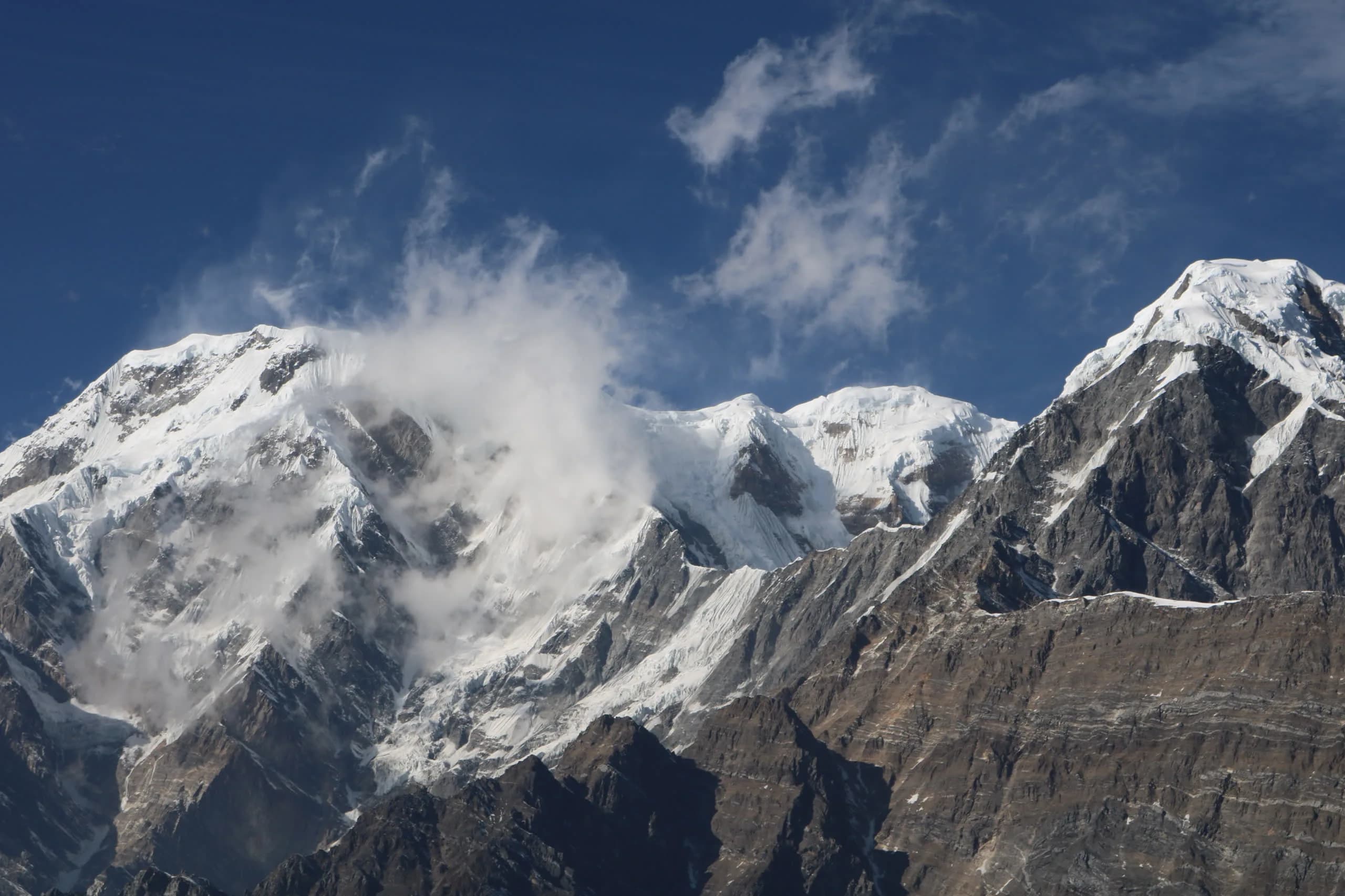
Mardi Himal ridge trek, Annapurna, Nepal
5.0 on Google · 89 reviews on TripAdvisor & Google

Mardi Himal Trek

The complete guide to the quietest ridge in the Annapurna range, and every way to walk it. Choose from a fully-walked three-day express, the classic five and six-day routes, an eight-day cultural version, or a combined trek with Annapurna Base Camp, Poon Hill, or Khopra Danda. A separate helicopter tour covers the same skyline in about two hours. NTB-licensed local guides, permits, and transport from Pokhara handled.

The quietest ridge on the southern Annapurnas.

The Mardi Himal trek is a teahouse walk up a forested ridge on the southern wall of the Annapurna massif, finishing at an upper viewpoint around 4,200 metres directly beneath Machhapuchhre, the Fishtail. It starts with a short drive from Pokhara to Kande, climbs through the Gurung villages of Pothana and Deurali, and follows the dedicated Mardi forest trail through Forest Camp, Low Camp, and High Camp. The route opened to teahouse trekking only in 2012, which is why it stays far quieter than Annapurna Base Camp or Poon Hill.

It works as a short trek or a longer one. The three-day version is the fastest, entirely on foot, the four and five-day versions add an easier pace, the six-day version spreads the same route over an extra night, the eight-day version adds a slow cultural descent through homestay villages, and longer combined routes link it with Annapurna Base Camp, Poon Hill, or Khopra Danda. A separate helicopter tour flies the same ridge in about two hours. Every itinerary below reaches the same viewpoint. A licensed guide and the ACAP permit are mandatory in the Annapurna Conservation Area and are arranged for booked trekkers. Trekking from India? SAARC permit rates, no visa and rupee budgets are on Mardi Himal trek for Indians.

Every Mardi Himal trek, one place.

From a fully-walked three-day express to the classic five and six-day routes, an eight-day cultural version, and combined treks with Annapurna Base Camp, Poon Hill, or Khopra Danda, plus a helicopter tour for those short on time. Pick by the days you have and the pace you want.

By duration

Combined treks

Fly instead

One ridge, five days, 2,430 metres of ascent.

The standard trekking route climbs the southeast ridge of Mardi Himal from the roadhead at Kande (1,770 m) to the Upper Viewpoint at 4,200 m. Longer and peak-permit trips continue above to Base Camp at 4,500 m, below the summit pyramid.

Mardi Himal trek route map on shaded relief. The route climbs 26.62 kilometres north from Kande at 1,770 metres to the Upper Viewpoint at 4,200 metres, gaining 2430 metres, through terraced farmland, a forest belt to Low Camp, open alpine ridge to High Camp at 3,580 metres, then scree and glacier. Legs: Kande to Australian Camp 2.4 km and 2 h 30; to Pothana 1.3 km and 35 min; to Pitam Deurali 2.0 km and 1 h 55; to Forest Camp 8.2 km and 3 h 45; to Low Camp 3.5 km and 2 h 15; to Badal Danda 1.5 km and 1 h 50; to High Camp 2.6 km and 3 h 10; to the Upper Viewpoint 5.2 km and 4 h 50. Times are the slower end of the published range.Modi KholaMardi KholaGhandrukDhampusLumleNaudandaSaiti GhattaChandrakotMardi Himal · 5,587 m▲ Annapurna South · 7,219 m ↑▲ Hiunchuli · 6,441 m ↑2.4 km · +290 m3 h1.3 km · -170 m45 min2.0 km · +210 m2 h 208.2 km · +450 m4 h 203.5 km · +435 m2 h 401.5 km · +225 m1 h 502.6 km · +370 m3 h 105.2 km · +620 m4 h 50Mardi Himal TrekFull route · 26.6 km traced · to 4,200 mRelief: AWS Terrain Tiles · Map data © OpenStreetMap contributors (ODbL) · indicative, not for navigationKande · 1770 mAustralian Camp · 2060 mPothana · 1890 mPitam Deurali · 2100 mForest Camp · 2550 mLow Camp · 2985 mBadal Danda · 3210 mHigh Camp · 3580 mUpper Viewpoint · 4200 m
Day 1
Kande→Pitam Deurali
1,770 → 2,100 m
+330 m
Day 2
Pitam Deurali→Low Camp via Forest Camp
2,100 → 2,985 m
+885 m
Day 3
Low Camp→High Camp
2,985 → 3,580 m
+595 m
Day 4
High Camp→Viewpoint, then Badal Danda
3,580 → 4,200 → 3,210 m
+620 m / −990 m
Day 5
Badal Danda→Sidhing, jeep to Pokhara
3,210 → 1,860 m
−1,350 m
Trek permits

ACAP + TIMS required. Licensed guide mandatory for foreigners.

Peak climbing

The 5,587 m summit is not on the NMA's 27-peak list. Check current rules before a climb.

Highest trekking point

Upper Viewpoint · 4,200 m (13,780 ft)

The numbers, up front.

Difficulty, cost, season, the guide rule: the things everyone searches about Mardi Himal, answered in one place. Each links to the full guide.

Difficulty
ModerateNo ropes, no technical ground. Two big climbing days and altitude above 3,000 m are the work.Difficulty & map
Trek cost
From USD 2945-day group rate per person. 3-day from USD 220, 6-day from USD 354, longer and combined treks priced by group size.Full cost breakdown
Duration
3 – 8 daysFrom the fastest walked express to the relaxed cultural version. All versions reach the same viewpoint.Day-by-day itinerary
Best months
Oct – Nov · Mar – MayClearest skies in autumn, rhododendron bloom in spring. Winter is possible with snow above High Camp.Month by month
Guide rule
Guide mandatorySince April 2023 foreign trekkers cannot walk guideless in the Annapurna Conservation Area.Solo trekking rules
Highest points
4,200 m viewpointHigh Camp at 3,580 m is the highest sleeping point. True Base Camp at 4,500 m is reached on longer and peak-permit trips only.Base camp explained
Permits
ACAP + TIMSBoth mandatory, both arranged for booked trekkers. They cover the walk, not a summit climb.Permit details
Trailhead
KandeA 1 to 1.5-hour drive from Pokhara. The trek exits via Sidhing, a jeep ride back to the lakeside.How to reach

What it costs, at a glance.

Trekkers from outside Nepal need an ACAP entry permit and, since April 2023, a licensed guide is mandatory inside the Annapurna Conservation Area; the rule is enforced at the Pothana checkpoint on Day 1. The headline numbers for 2026 are below. The full line-item breakdown, budget tiers, where to get the permits, and the hidden costs to plan for are on the dedicated guide.

Headline costs

Per person, 2026 rates
  • ACAP entry permitNPR 3,000 (~USD 20)
  • TIMS cardNPR 2,000 (~USD 13)
  • Licensed guide (mandatory)USD 30 – 40 / day, by experience
  • Porter (optional)Quoted on request
  • Teahouse, food + bedPaid on the trail
  • Group package, all-inclusiveFrom USD 220 / person
Full permits & cost guide: budget tiers, inclusions, money on the trail →

What to bring, in seven groups.

Target pack weight is 8 to 10 kg with a porter, 12 to 14 kg without. The big-ticket items (down jacket, sleeping bag, shell, poles) all rent in Pokhara Lakeside: a sleeping bag roughly USD 1 to 2.50 a day and a down jacket about USD 1 to 3 a day, so there is no need to fly with them. The item-by-item list with specs, weights, and seasonal additions is on the full guide.

Clothing layers

Merino base layers, fleece mid layer, 650+ fill down jacket, waterproof shell. No cotton.

Footwear

Broken-in mid-cut boots, camp shoes, four pairs of merino socks.

Sleep

Sleeping bag rated -5 °C in autumn, -10 °C in winter, plus a liner.

Pack & poles

30 – 40 L daypack, shared duffel for the porter, two trekking poles for the descent.

Electronics & light

Headlamp, 10,000+ mAh power bank, universal adapter. Charging costs extra above Forest Camp.

Sun & first aid

Category 4 sunglasses, SPF 50+, blister kit, water purification.

Documents

Passport with copies, two photos for ACAP, insurance card, NPR 15,000 – 25,000 cash.

Full packing list: every item, weights, rentals, season by season →

Teahouses every overnight stop.

The Mardi Himal trek is a teahouse trek: no tents needed. Family-run lodges sit at every overnight stop, with rooms simple but warm and communal kitchens on a fixed menu. We pre-book the popular Forest Camp, Low Camp, and High Camp lodges for our groups in October and April. Room standards, showers, charging, and wifi for each stop are on the full guide.

Overnight stops

Standard 7-day route
  • Pitam Deurali2,100 mEight or more teahouses, hot water on demand.
  • Forest Camp (Kokar)2,550 mEight or more teahouses in the rhododendron belt.
  • Rest Camp~2,600 mAn hour above Forest Camp, where the forest thins.
  • Low Camp2,985 mEight or more teahouses facing the massif. Books out in October.
  • High Camp3,580 mEight or more teahouses, plywood rooms, cold nights, no wifi.
  • Sidhing1,860 mFamily-run Gurung homestays on the descent.
  • Lwang1,460 mTea estate village, the quieter exit.
Full accommodation guide: rooms, showers, wifi, stop by stop →

Dal bhat power, 24 hours.

Teahouse menus are roughly identical from one lodge to the next, and dal bhat is the trail standard for good reason: rice, lentils, vegetable curry, and usually unlimited refills. Vegetarian is the default; vegan is workable; gluten-free is harder. Prices rise with altitude and lodges set their own. The full menu, drinking water, and dietary notes are on the dedicated guide.

Full food guide: the whole menu, water safety, dietary needs →

What to watch for, what to do.

Acute mountain sickness (AMS) is real on Mardi Himal but rarely severe at the standard 7-day pacing, which keeps daily ascent under 700 metres above Forest Camp. Most cases on this route are mild headaches at Low Camp and High Camp. The full symptom ladder from mild to severe, Diamox guidance, and the evacuation reality are on the dedicated guide.

Rule 1

Climb slow.

Above 3,000 m, walk at a pace where you can hold a full conversation. If you are out of breath, you are going too fast.

Rule 2

Drink water.

3 to 4 litres per day. Dehydration mimics altitude sickness; treating one prevents the other.

Rule 3

Descend if you doubt.

The cure for serious AMS is altitude. Going down even 300 m can resolve symptoms in hours.

Full altitude guide: the symptom ladder, Diamox, evacuation →

Cover that actually pays.

Travel insurance is mandatory for our bookings, and many standard policies cap altitude at 3,000 m, below Mardi Himal's overnight stops. Read the policy schedule before you buy. The policy traps to watch for, the providers we see most often, and how to claim are on the dedicated guide.

Your policy must cover
  • Trekking to 4,500 m (covers the 4,200 m Upper Viewpoint, and Base Camp if you go on)
  • Helicopter evacuation, ideally to USD 10,000 minimum
  • Medical treatment in Nepal hospitals
  • Trip cancellation and curtailment
  • Lost or delayed baggage
Full insurance guide: the altitude clause, providers, claiming →

Who else is on this trail.

The ten largest nationalities on the Mardi Himal route, from trail check-in records for 2023 to 2025. Between them they account for 61% of everyone who walks it.

1France9.3%
2Germany9.0%
3United Kingdom6.9%
4South Korea6.1%
5India6.0%
6Australia5.2%
7United States5.0%
8Netherlands4.9%
9Malaysia4.2%
10China4.2%
  • Europe
  • Asia
  • North America
  • Oceania
Every country on the trail, year by year →

Every guide, one trail.

Planning guides

Combine treks

Compare treks

Answers to the questions people actually ask.

The questions people search and ask on every booking call, answered plainly.

How difficult is the Mardi Himal trek?

Moderate. There is no technical climbing, no ropes, and no glacier on the trek. The work is two long climbing days of roughly a thousand metres each and the altitude above 3,000 m. Reasonably fit beginners manage it well on the 5 or 6-day pacing; the shorter versions suit trekkers with prior altitude experience. Difficulty, grades & route map

How long is the Mardi Himal trek?

Three to eight days depending on the version. The 5-day is the standard most people book, the 6-day adds a gentler pace, the 4-day and 3-day walk the same route faster and are both fully on foot, and the 8-day adds a slow cultural descent through homestay villages. Day-by-day itinerary

How much does the Mardi Himal trek cost?

Guided group rates start at USD 294 per person for the 5-day trek and USD 220 for the fully-walked 3-day, including permits, guide, accommodation, and transfers. Other durations are priced by group size. The Mardi Himal helicopter tour is a separate product, from USD 500 per person. Independent budgets run lower but the guide, permits, food, and lodges still add up. Full cost breakdown

Do I need a guide, or can I trek solo?

A licensed guide is mandatory. Since 1 April 2023 Nepal does not permit foreign trekkers to walk guideless inside the Annapurna Conservation Area, where the whole Mardi route sits. You can still travel solo in the everyday sense, at your own pace with your own itinerary, but a guide walks with you. Solo trekking under the 2023 rule

When is the best time to go?

Autumn (September–November) has the most stable weather and the clearest mountain views, and spring (March–May) adds the rhododendron bloom. For summit attempts, pre-monsoon April–May is preferred. Best season, month by month

Can you trek Mardi Himal in December or January?

Yes. Winter brings the clearest skies of the year and an empty trail, with the trade-off of snow above High Camp and hard cold at night. Teahouses stay open. Microspikes and a serious sleeping bag make the difference; some winter weeks the final viewpoint push depends on snow conditions. Weather by season & altitude

Do I need a permit?

Yes. ACAP and TIMS are mandatory for the trek, and both are arranged for booked trekkers.

Is the Mardi Himal trek worth it?

If you want big Annapurna views without the crowds, yes. The trail opened to teahouse trekking only in 2012 and remains the quietest major route in the region, and the Upper Viewpoint puts you closer to Machhapuchhre than any other legal vantage point. Trekkers who want villages and culture en route may prefer Poon Hill or a combined route.

Can I combine Mardi Himal with Annapurna Base Camp or Poon Hill?

Yes, both are established combinations. Mardi plus ABC takes about 10 days and links the ridge with the Sanctuary. Mardi plus Poon Hill runs about 7 days with two sunrise viewpoints and the Gurung village of Ghandruk. A quieter 11-day pairing links Mardi with Khopra Danda. All treks & combined routes

5.0 on Google, 89 reviews across two platforms.

The 6 reviews below are all Mardi Himal treks, each rated 5 out of 5. Every one is on TripAdvisor or Google and links back to the original. Quotes are shortened excerpts; names, dates and trek lengths are taken from the source. Counts as of April 2026.

5.0Google rating
52TripAdvisor reviews
37Google reviews
2Independent platforms
★★★★★
Our recent trip to Nepal and trek to Mardi Himal turned out to be one of the most memorable adventures of my life. Our guide Max was friendly, knowledgeable, and incredibly supportive, especially during the steep sections. The views along the route were breathtaking.
Tasnuva ROct 2025 · Couple · 7-day Mardi HimalRead on TripAdvisor ↗
★★★★★
We had an excellent five-day trek on the Mardi Himal trail. It is frequented primarily by Nepali tourists. The views are incredible all along the trail, and many guest houses have spectacular views. Our guide was a joy to be with.
Scott MNov 2023 · Couple · 5-day Mardi HimalRead on TripAdvisor ↗
★★★★★
We were considering trekking to Annapurna Base Camp, but changed to the Mardi Himal based on Raj's advice. This was probably the best advice we got in Nepal. Mountains were fully covered in snow, the lower fields were green, and the rhododendron trees were flourishing.
Wessel AApr 2023 · Couple · 7-day Mardi HimalRead on TripAdvisor ↗
★★★★★
Prakash was our trekking guide for the Mardi Himal trek. Even when we arrived feeling unwell, he showed immediate sympathy and organised a range of Pokhara-based activities for us. We can't recommend him enough. Prakash has completed over 500 trips on this route.
Krista JonesMar 2023 · Solo · 7-day Mardi HimalRead on TripAdvisor ↗
★★★★★
Our Mardi Himal trekking experience was great because of this team. Our guide Gautam was so professional, cordial and hospitable. We enjoyed it a lot. Looking forward to our next adventure with them.
Elora Alam2024 · Family · 7-day Mardi HimalRead on Google ↗
★★★★★
Truly exceeded our expectations and made our trip to the Himalayas absolutely memorable. From the moment we inquired until the day we returned, their professionalism and attention to detail were outstanding.
Üvesön Magar2023 · Couple · 5-day Mardi HimalRead on Google ↗
Registered & affiliated with

The tourism bodies we are registered and affiliated with.

Walk it with us. Or just ask a question.

We answer every WhatsApp message within an hour during Kathmandu office hours (Sun–Fri 9 AM – 10 PM NPT). A deposit holds your seat on any 2026 departure; the balance is paid in cash or by card at our Kathmandu office before departure. Cancel more than a month ahead and we hold 20 % of the trip cost as a deposit against your next trip in Nepal, rather than keeping it as a fee. Our booking policy has the full schedule.