Spring season open · Mar 15 – Jun 25 places left · Classic 7d · May 03Rhododendron bloom reported at Forest Camp
Trail status: Open
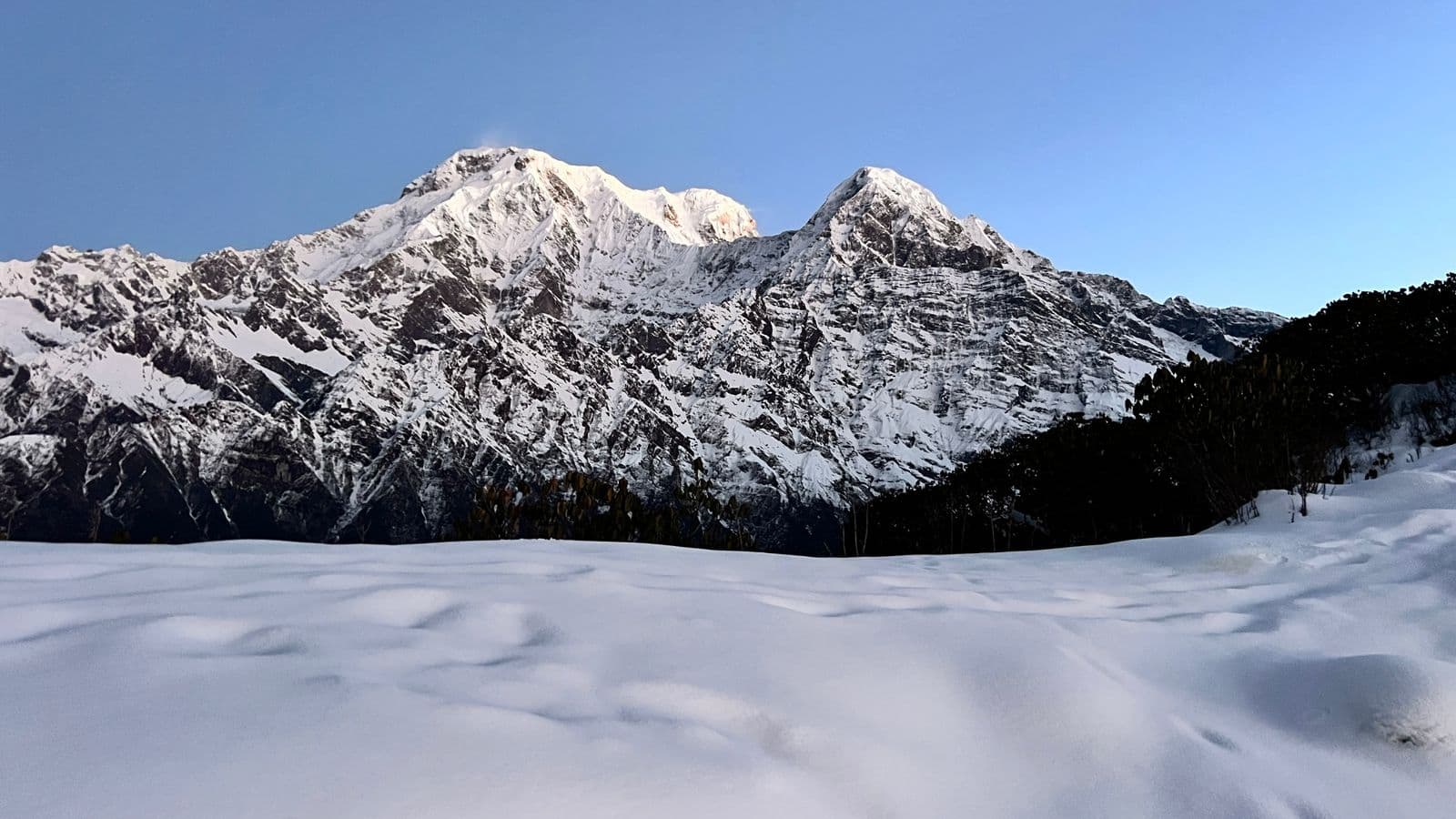
Mardi Himal summit pyramid above the southwest ridge
Royalty-free Annapurna summit

Mardi Himal Peak Climbing

The 5,587-metre summit above the trekkers' viewpoint, climbed by Jimmy Roberts and a Sherpa team in 1961 and rarely repeated since. A two-week alpine expedition on rope, ice axe, and crampons via the southwest face, with one acclimatised summit day from a 4,500 m climbers' base camp. No NMA royalty, no garbage deposit, but real glacier travel and a fixed-rope pitch on the summit pyramid.

Summit5,587 m / 18,330 ft
Duration14 days standard
Alpine gradePD (Peu Difficile)
Best windowApr – May

A trekking peak that still bites.

Most operators sell "Mardi Himal" without distinguishing between the trek and the climb. They are not the same product. Below, what the peak climbing version actually involves and how it differs from the 5-day trek most visitors do.

The 14-day standard line.

Fourteen days door-to-door from Kathmandu, with one acclimatised summit attempt and a spare-day buffer for weather. Compressed 12-day variants exist for climbers with prior 5,000 m experience. Stretched 16-day variants add a second contingency day plus an extra rotation between Base Camp and Camp 1.

  1. Day 1

    Arrive Kathmandu, expedition briefing

    Altitude
    1,400 m
    Walking
    Net ascent

    Arrival at Tribhuvan, transfer to hotel, evening briefing with the climbing guide. ACAP and TIMS paperwork, gear check, insurance verification. Welcome dinner.

  2. Day 2

    Drive to Pokhara

    Altitude
    820 m
    Walking
    Net ascent

    Tourist coach or domestic flight to Pokhara, 200 km west. Final gear pickup at the Lakeside outfitters; satellite phone and weather radio test. Lakeside walk.

  3. Day 3

    Pokhara → Kande → Forest Camp

    Altitude
    1,770 → 2,520 m
    Walking
    5 – 6 hrs
    Net ascent
    +750 m

    1.5 hr drive to Kande trailhead. ACAP and TIMS check at Pothana. Climb through rhododendron forest to Forest Camp (Kokar), the first overnight on the standard trekking route.

  4. Day 4

    Forest Camp → Low Camp → Badal Danda

    Altitude
    2,520 → 3,210 m
    Walking
    4 – 5 hrs
    Net ascent
    +690 m

    Climb out of cloud forest to the open ridge. Low Camp lunch, then a deliberate-pace afternoon to Badal Danda (Cloud Ridge) at 3,210 m for first acclimatisation night.

  5. Day 5

    Badal Danda → High Camp

    Altitude
    3,210 → 3,580 m
    Walking
    3 – 4 hrs
    Net ascent
    +370 m

    Short ridge stage to High Camp, last teahouse on the route. Pulse-oximetry check on arrival. Afternoon acclimatisation walk to 3,800 m and back. Early dinner.

  6. Day 6

    Acclimatisation, walk to Upper Viewpoint

    Altitude
    3,580 → 4,200 → 3,580 m
    Walking
    4 – 5 hrs
    Net ascent
    +620 m / -620 m

    Pre-dawn climb to the Upper Viewpoint at 4,200 m for sunrise across the Annapurnas. Return to High Camp for breakfast, rest day. The viewpoint walk is the standard trek's high point; for the climbing party it is a rehearsal lap.

  7. Day 7

    High Camp → Climbers' Base Camp

    Altitude
    3,580 → 4,500 m
    Walking
    5 – 6 hrs
    Net ascent
    +920 m

    Leave the trekkers' route and climb west off the ridge to Mardi Himal Base Camp at 4,500 m, on a moraine shelf below the southwest face. Tents pitched, kitchen tarp set, first night under canvas.

  8. Day 8

    Base Camp rest and skills day

    Altitude
    4,500 m
    Walking
    Net ascent

    Mandatory acclimatisation day. Crampon and ice-axe drill on the lower glacier. Fixed-rope ascender practice. Self-arrest review. The guide makes the go/no-go call for High Camp based on weather, group performance, and pulse oximetry.

  9. Day 9

    Base Camp → High Camp (Camp 1)

    Altitude
    4,500 → 5,100 m
    Walking
    4 – 5 hrs
    Net ascent
    +600 m

    Carry to Camp 1 at 5,100 m on the southwest face. The route crosses the lower glacier on rope, then climbs a moraine spur to a small col where two-person tents are pitched. Cold dinner, early night.

  10. Day 10

    Summit day. Camp 1 → 5,587 m → Base Camp

    Altitude
    5,100 → 5,587 → 4,500 m
    Walking
    10 – 12 hrs
    Net ascent
    +487 m / -1,087 m

    Alpine start, 02:00. Headtorch, crampons on, roped up. The route follows the southwest face over mixed snow and rock, weaving between the three ridges that drop from the summit pyramid, with one fixed-rope pitch on the upper face. Summit between 08:00 and 10:00 weather permitting; 30 minutes on top for photographs and the panorama. Descent retraces the line of ascent through Camp 1, which is struck on the way down, to reach Base Camp by late afternoon.

  11. Day 11

    Contingency / weather buffer

    Altitude
    4,500 m
    Walking
    Net ascent

    Built-in spare day at Base Camp. If the summit went on Day 10, Day 11 is a recovery and pack-out day. If weather or fitness pushed the attempt back, this is the second window. Without this buffer, the summit success rate drops by roughly half.

  12. Day 12

    Base Camp → Sidhing village

    Altitude
    4,500 → 1,860 m
    Walking
    6 – 7 hrs
    Net ascent
    -2,640 m

    Long descent off the moraine, through Low Camp, and down the steep forest path to the Gurung village of Sidhing. Trekking poles essential. Hot shower, real bed, celebratory dal bhat.

  13. Day 13

    Sidhing → Pokhara

    Altitude
    1,860 → 820 m
    Walking
    Net ascent

    Jeep transfer (3 hrs) or helicopter lift (25 minutes, weather permitting) back to Pokhara. Lakeside hotel. Optional paragliding or rest. Expedition wrap-up dinner.

  14. Day 14

    Pokhara → Kathmandu, departure

    Altitude
    Walking
    Net ascent

    Coach or flight to Kathmandu. Time for last-minute shopping in Thamel. Airport transfer for evening departures. Operator-issued summit certificate handover (no NMA-issued certificate exists for this peak).

The paperwork, the kit, the bill.

Mardi Himal does not sit on the 27-peak NMA fee list. Climbing royalty is zero, the garbage deposit is zero. The full bill is the Annapurna Conservation Area Permit, the TIMS card, and the expedition logistics. Below: the line items, the mandatory gear, and what the trip actually costs when run end-to-end out of Kathmandu.

Permits & fees

Government and conservation

  • Climbing royalty (NMA)
    USD 0
    Mardi Himal is one of a small group of peaks (along with Tharpu Chuli, Yala Peak, Pokhalde, Chhukung Ri, Machhermo) that the Nepal Mountaineering Association lists with no climbing fee. The 27 fee-charging NMA peaks (Mera, Island, Lobuche, Pisang, etc.) charge USD 350 in spring under the September 2025 tariff. Mardi sits outside that list.
  • Garbage deposit
    USD 0
    Because there is no NMA permit, there is no NMA garbage deposit. The agency carries out group waste under its own ACAP-registered protocol. Personal pack-out responsibility still applies.
  • ACAP — Annapurna Conservation Area
    NPR 3,000 (~USD 25)
    Mandatory for both trekkers and climbers in the Annapurna region. Issued in Kathmandu or Pokhara.
  • TIMS card
    NPR 2,000 (~USD 17)
    Trekkers' Information Management System. Checked at lower checkpoints. Foreigners pay double the SAARC rate.
  • Liaison / community fee
    Included in package
    Local community contribution administered by the Mardi Himal local committee. Funds the trail and the Sidhing pickup road.
Pricing

Per person, all-inclusive

  • Group of 4 – 8
    USD 2,750 / person
    Best value. Fixed departures, shared guide ratio 1:4.
  • Group of 2 – 3
    USD 3,400 / person
    Private climbing guide, flexible date.
  • Solo climber
    USD 4,200
    Dedicated 1:1 climbing sherpa for the upper mountain.

Includes Kathmandu and Pokhara hotels, ACAP and TIMS permits, ground transport, climbing guide, group climbing equipment (rope, snow bars, fixed line), tents at Base Camp and Camp 1, porter load up to 15 kg, and all meals on trek and at Base Camp. Excludes Nepal visa, international flights, personal climbing kit, travel and rescue insurance, and tips. Helicopter return from Sidhing is optional, USD 350 per person on a group lift.

Mandatory kit

What you bring, what we provide

Personal climbing kit

  • Mountaineering boots (single-skin B2 minimum, B3 preferred for cold years)
  • Crampons, 12-point, with anti-balling plates
  • Ice axe, technical or general-mountaineering, 50 – 60 cm
  • Climbing harness with adjustable leg loops
  • Belay device and 2 locking carabiners
  • Prusik cord, 5 mm × 1.5 m
  • Helmet (UIAA-rated)
  • Mechanical ascender (one)

Layering system

  • Base layers, merino wool, top and bottom
  • Mid layer fleece (200-weight) or wool
  • Insulated synthetic mid jacket
  • Hardshell jacket and pants, 3-layer
  • Down jacket, 800-fill, hooded, summit-grade
  • Mountaineering gloves, three pairs (liner, mid, summit)

Sleep & shelter (provided in package)

  • Two-person 4-season tent at Base Camp and Camp 1
  • Down sleeping bag, -20 °C comfort rating
  • Closed-cell foam pad plus inflatable
  • Group dining tent, kitchen tent, toilet tent at Base Camp

Other essentials

  • Headtorch + spare batteries (lithium for cold)
  • UV-grade glacier glasses (Cat 4) and ski goggles
  • Sunscreen SPF 50+ and lip balm SPF 30
  • 60 L summit pack and 80 L duffel for porter load
  • Personal first-aid + Diamox (consult your physician)
  • Trekking poles, three-section, with snow baskets

Fitness, season, the cut-offs.

Mardi is sold as a beginner-friendly Himalayan summit. That framing is loose. The honest version: it is the right peak for trekkers stepping into mountaineering, provided they have already touched 5,000 m and held an ice axe in real conditions. The list below is who we book and who we steer elsewhere.

Right for this expedition

  • Trekkers with prior 5,000 m experience

    Kilimanjaro, Mera Peak, Stok Kangri, Aconcagua trek, EBC, Toubkal in winter, or Mont Blanc all count. Your body has met thin air and remembered.

  • Climbers with basic glacier skills

    You have used crampons and an ice axe on a real route, you have roped up across a glacier, and you can self-arrest. A weekend course this year is enough; a course five years ago is not.

  • Strong cardio base, 6+ hours uphill

    You can climb 1,000 m of vertical with a 6 kg pack inside 4 hours, on consecutive days. Resting heart rate ideally below 70.

  • Time-boxed alpinists

    Mardi gives a 5,500 m summit in 14 days from Kathmandu, no Lukla flight, no NMA royalty, no garbage deposit. For climbers fitting Nepal into a single annual leave block, the logistics math is hard to beat.

Wrong for this expedition

  • First-time Himalayan trekkers

    We do not run this for clients whose highest point is below 4,500 m. Do the trek first; it ends 1,400 m below where the climb begins.

  • Anyone without crampon experience

    The summit pyramid is 30 to 35-degree mixed snow and rock with one exposed pitch. Crampon-and-axe technique cannot be learnt during the expedition. We will not run a guide-1:1 fast-track for unrelated reasons of safety.

  • Climbers with active cardiovascular issues

    Hypertension, recent cardiac events, or chronic respiratory conditions are absolute exclusions. A medical certificate from a physician familiar with altitude is required at booking.

  • Climbers under 18 or over 65

    Hard age envelope for the climb. The trek is open to a wider range; the summit attempt is not.

Season window

When the route is in condition

Pre-monsoon (Apr – May)
Primary window. Stable mornings, cold but reliable nights at Base Camp, the rock pitch on the summit pyramid is in season.
Post-monsoon (Oct – Nov)
Workable, with caveats. Skies are at their clearest of the year, but the summit pyramid carries fresh autumn snow that adds time and complexity. Group sizes smaller.
Acceptable
Winter (Dec – Feb)
Cold weather expedition only. Below -25 °C at Base Camp, deep snow on the upper route, fixed-rope work in mittens. We run on request for experienced parties.
Specialist
Monsoon (Jun – early Sep)
Closed. Daily storms, avalanche-risk on the upper route, no visibility for the summit window. We do not run.
Closed

Climbing questions, straight answers.

The questions every prospective climber asks on the first call. Honest answers, no marketing softening, including the ones where the answer is no.

It is two different products with the same name. The Mardi Himal Trek tops out at the Upper Viewpoint, 4,200 m, on a walking trail. Mardi Himal Peak Climbing summits the actual mountain at 5,587 m via the southwest face. The climb requires crampons, an ice axe, roped travel on the lower glacier, and one fixed-rope pitch on the upper face. They share a route only as far as High Camp; after that, they split.

Read the detail, or walk the warm-up.

One link goes deep on permits, gear, training, route, and rescue. The other steps back to the 5-day trek most climbers walk first as their acclimatisation lap. Pick whichever you need next.

Read the mountain, then come walk it.

We run small-group trips from Pokhara every Saturday from September to May. We also run private trips any day. A $50 deposit holds your place. Pay the rest on arrival in cash or by card.