Solo guideless trekking, no longer permitted.
On 1 April 2023, the Nepal Tourism Board ended independent trekking in the Annapurna Conservation Area. Foreign trekkers must now hire a licensed guide for every trek inside the ACA, including Mardi Himal. The rule is enforced at the ACAP checkpoint at Pothana on Day 1; trekkers without a guide are turned back. Nepali nationals are exempt.
The rule was introduced after several solo trekker fatalities and extensive search-and-rescue operations across the Annapurna and Manaslu regions in 2022. The official rationale is safety and local employment; in practice the trail has felt less crowded and the standard of care has measurably improved.
All non-Nepali trekkers, including Indian nationals, on every trek inside the ACA. Day hikes (Australian Camp, Sarangkot) do not require a guide.
ACAP checkpoint at Pothana (Day 1, ~3 hrs from Kande). Officials check permit, guide license, and trekker passports.
Pokhara has dozens of guide agencies and freelance licensed guides on call. You can usually hire one in 24 hours, but the hike of the day is lost.
Two roles, different jobs.
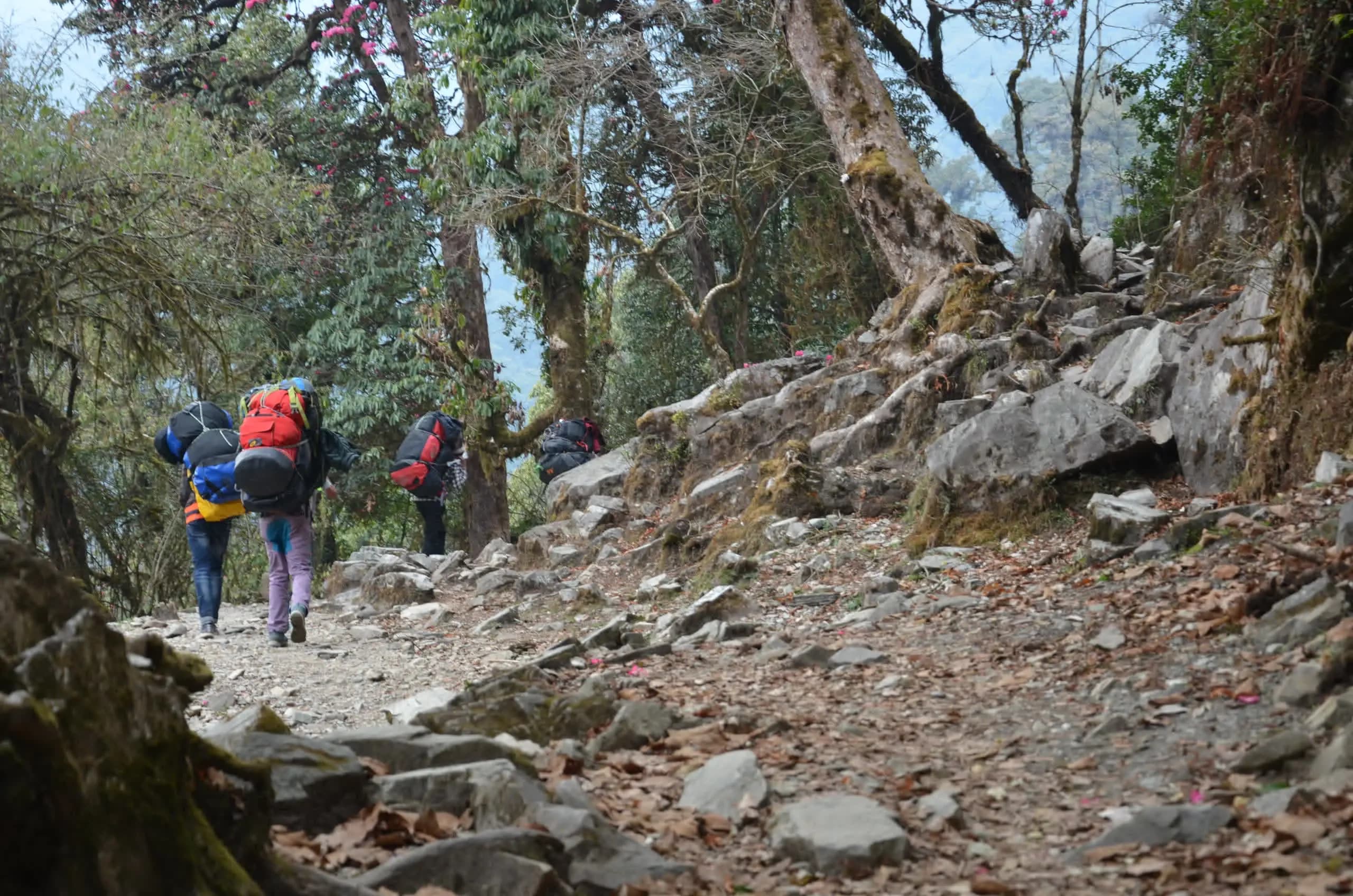
Guides and porters are not the same thing. Many first-time trekkers assume one person does both jobs, and operators sometimes encourage that confusion to reduce daily cost. They are different roles, with different training, different daily rates, and different obligations. Hire them separately.
Trail leader
Pack carrier
Three tiers of licensed guide.
Every guide on Mardi Himal must hold a current Nepal Tourism Board license. Within that, there are tiers based on years on this specific route, language ability, and emergency training. The cheapest licensed guide is not the same product as the most experienced.
NTB licensed (entry)USD 25 / day Holds the Nepal Tourism Board license. Has walked the route at least once. Sufficient for the standard 5-day trek for fit, easy-going groups.
Senior licensed (5+ years)USD 30 / day Five seasons or more on Mardi specifically. Speaks fluent English, often a second European language. Manages altitude monitoring and weather decisions independently.
Senior + WFR or wilderness first responderUSD 35 / day Wilderness first responder certification, satellite communicator, decision authority for evacuations. The default for our private and family trips.
When a porter actually helps.
Porters are optional but recommended for first-time trekkers. The honest case for hiring one: walking with 14 kg on your back at 3,500 metres is meaningfully harder than walking with 6 kg, and Day 5 is hard enough already. The honest case against: porters walk ahead with the duffel and you do not see them during the day, which can feel disconnected.
We recommend one porter shared between two trekkers. Maximum load is 18 kg total, regulated by the Nepal Mountaineering Association and respected by every reputable agency. Pack the duffel under the limit and pad sharp items so the porter is not bruised.
Porters on our trips have insurance, full kit (boots, jacket, sleeping bag), and first aid coverage equal to the guide. We do not run with under-equipped porters; this has been a problem on the trail historically and we will not contribute to it. Every trip we run comes with a licensed guide, whether you join one of our Mardi Himal fixed departures or book your own dates with group booking.
The convention, not the obligation.
Tipping in Nepal trekking is conventional, not mandatory, and is expected at the end of the trek rather than after each day. The standard is roughly 10 to 15 percent of the trek cost, split between guide and porter. Below is the actual ratio we suggest, and what is reasonable to omit if the experience was poor.
- Lead guide, 5-day trekUSD 38 – 57 / trekker10 – 15% of the package cost is the convention, shown here at the two-person rate. Hand over on the last evening in Pokhara.
- Porter (one shared between two)USD 19 – 29 / trekkerRoughly 10 – 12% of the porter cost. Covers them for the days walked.
- Assistant guide (if used)USD 19 – 29 / trekkerUsed on groups of 8 or more. Same convention as the lead guide, scaled down.
- Teahouse staff (small kindness)NPR 50 – 100Optional. The kitchen kid who refilled your dal bhat or carried your bag to the room. NPR notes only.