Three points get called 'the top' of this trek, and they are not the same. High Camp at 3,580 m is where you sleep, the Upper Viewpoint at 4,200 m is where the standard trek turns around, and the true Base Camp at 4,500 m is for longer trips only. Here are the altitudes, the peaks you see, the teahouses, and the weather.
The single biggest source of confusion on this trek is what 'base camp' means. There are three separate points, and most standard treks reach only the first two. Knowing which is which tells you exactly how high you will go.
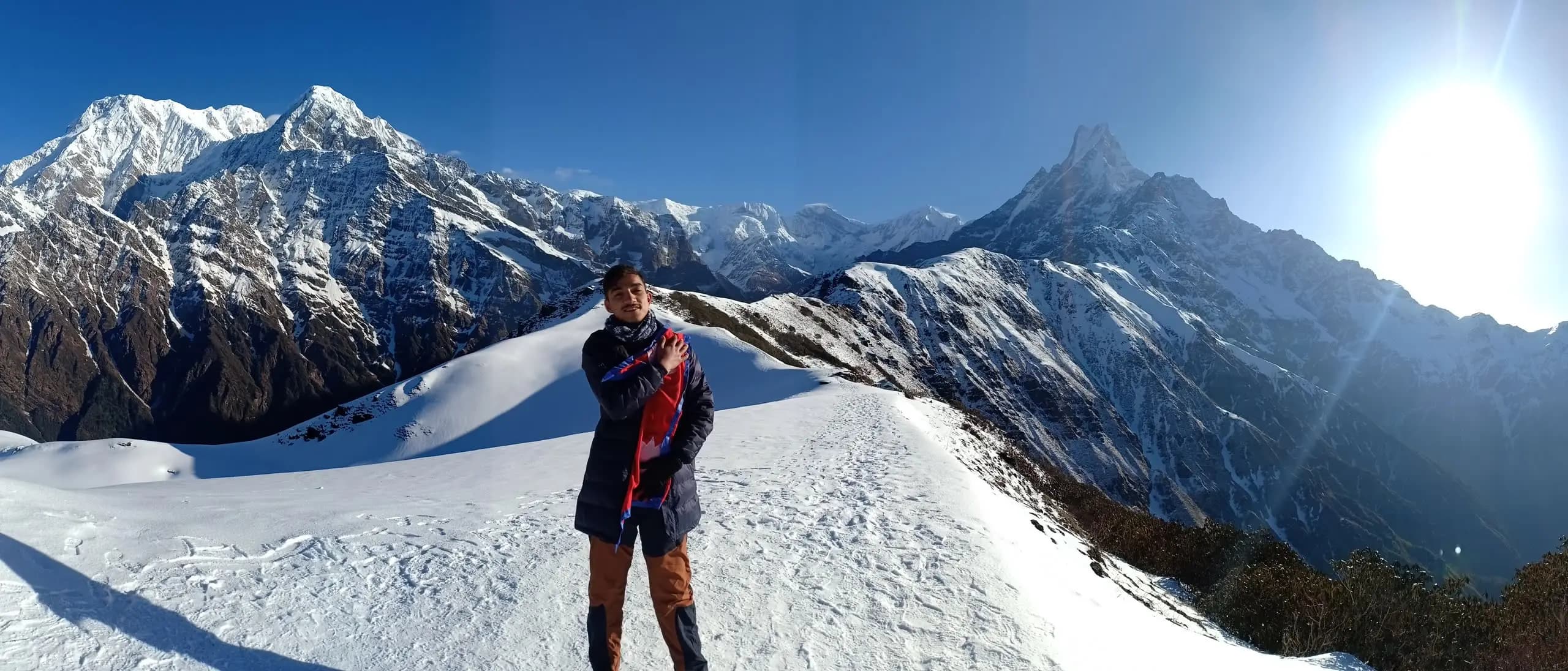
Where you sleep. High Camp is the highest lodge cluster on the trek and the base for the final morning push. Annapurna South and Machhapuchhre (Fishtail) are clearly visible from here. The commonly cited altitude is 3,580 m, though some sources put it at 3,540 m or 3,550 m. Note: a few operators confuse this point with the base camp, so you may see 3,580 m wrongly labelled as Base Camp.
The turnaround on the standard 4-to-5-day trek. From High Camp it is about 620 m of climbing to the Upper Viewpoint at 4,200 m, the highest point most trekkers reach. This is what the majority of itineraries mean when they sell a sunrise climb above High Camp.
The full base camp at 4,500 m, reached only on longer or peak-permit trips. From High Camp it is roughly 2 to 3 hours and about 920 m of gain. Nepal Intrepid notes that the true 4,500 m base camp is not part of the standard itinerary. The standard trek stops at the 4,200 m Upper Viewpoint, not here.
The standard 4-to-5-day trek tops out at the 4,200 m Upper Viewpoint, not the 4,500 m Base Camp. If reaching 4,500 m matters to you, ask for a longer itinerary. The full walk is covered on the trek page.
The reward for the height is a close wall of Annapurna giants. From the top of the trek the named peaks include:
From High Camp itself, Annapurna South and Machhapuchhre (Fishtail) are the two that dominate the skyline. Machhapuchhre and Mardi Himal are joined by a 5,200 m col, which is why the Fishtail looms so close above the ridge.
High Camp has a cluster of stone lodges, with sources counting between 6 and 14 depending on what is classed as a lodge and when the count was taken. Most operate roughly October through May. It is a teahouse trek, so you sleep and eat indoors rather than camp.
Basic Nepali, Tibetan, and western dishes, with dal bhat the staple. A vegetable dal bhat was around NPR 630 at a 2021 rate. Prices this high on the mountain are well above valley prices and change year to year, so treat any figure as indicative.
Charging is available at High Camp from solar or generator power, but it is unreliable. Charging a phone cost around NPR 200 in 2021, with NPR 100 to 300 cited elsewhere. Carry a power bank.
Wifi is not available, or very limited, at High Camp and above. Plan to be offline for the top of the trek.
High Camp has squat and western toilets attached to the main building. A bucket hot-water shower cost around NPR 500 in 2021, with NPR 200 to 400 cited elsewhere. These are indicative and dated.
This is a lodge trek, not a camping trek. If you want a tent, some teahouses can provide one and pitch it next to the lodge, with dinner taken inside.
Food, charging, and shower prices above date from around 2021, are far higher than in the valley, and change every season. Treat them as indicative and carry enough cash, since there are no ATMs on the mountain.
The base camp area sits high enough that the weather is a different world from Pokhara. Plan for cold nights whatever the season.
Days at the base camp area around 4,500 m run roughly 5 to 10°C, with nights falling to -5°C or lower. These are the recommended trekking windows for the clearest skies.
Nights can drop to around -10°C with snow on the trail and campsite. High Camp and above can be snow-blocked from December to February, with January the worst.
For the full month-by-month picture, including temperatures lower down, see Mardi Himal weather. Prefer not to walk up at all? The helicopter tour reaches the base-camp area from Pokhara in 15 to 20 minutes.
The true Mardi Himal Base Camp sits at 4,500 m and is most commonly cited at that height. It is not the same as High Camp (3,580 m) where you sleep, or the Upper Viewpoint (4,200 m) where most standard treks turn around.
High Camp at 3,580 m is the highest lodge cluster, where you sleep. The Upper Viewpoint at 4,200 m is the turnaround on the standard 4-to-5-day trek. The true Base Camp at 4,500 m is about 920 m above High Camp and is reached only on longer or peak-permit trips, so the standard trek does not reach 4,500 m.
The big ones are Annapurna I at 8,091 m, Annapurna South at 7,219 m, Machhapuchhre (Fishtail) at 6,993 m, Hiunchuli at 6,441 m, and Mardi Himal itself at 5,587 m. Annapurna III, Gangapurna, and Gandharwa Chuli are also named as visible. From High Camp, Annapurna South and Machhapuchhre stand out clearly.
From High Camp (3,580 m) to the true Base Camp (4,500 m) is normally 2 to 3 hours of walking, with around 920 m of elevation gain. The shorter climb to the 4,200 m Upper Viewpoint is about 620 m of gain from High Camp.
Stone teahouses with basic Nepali, Tibetan, and western food, squat and western toilets, and unreliable solar or generator charging. Wifi is not available or very limited. Hot showers are bucket-style and paid. Many lodge and food prices date from around 2021 and are higher than valley prices, so treat them as indicative.
At the base camp area around 4,500 m, spring and autumn days run roughly 5 to 10°C and nights can fall to -5°C or lower. In winter, nights can drop to around -10°C with snow on the trail and campsite.
Working out your route up? See how to reach Mardi Himal for trailheads and transport from Pokhara.
We run small-group trips from Pokhara every Saturday from September to May. We also run private trips any day. A $50 deposit holds your place. Pay the rest on arrival in cash or by card.