Grade 1
Easy
Short day hikes and valley walks on good trails. No trekking experience needed; suitable for most ages with everyday fitness.
On our tripsDay hikes around Pokhara, Australian Camp, Dhampus
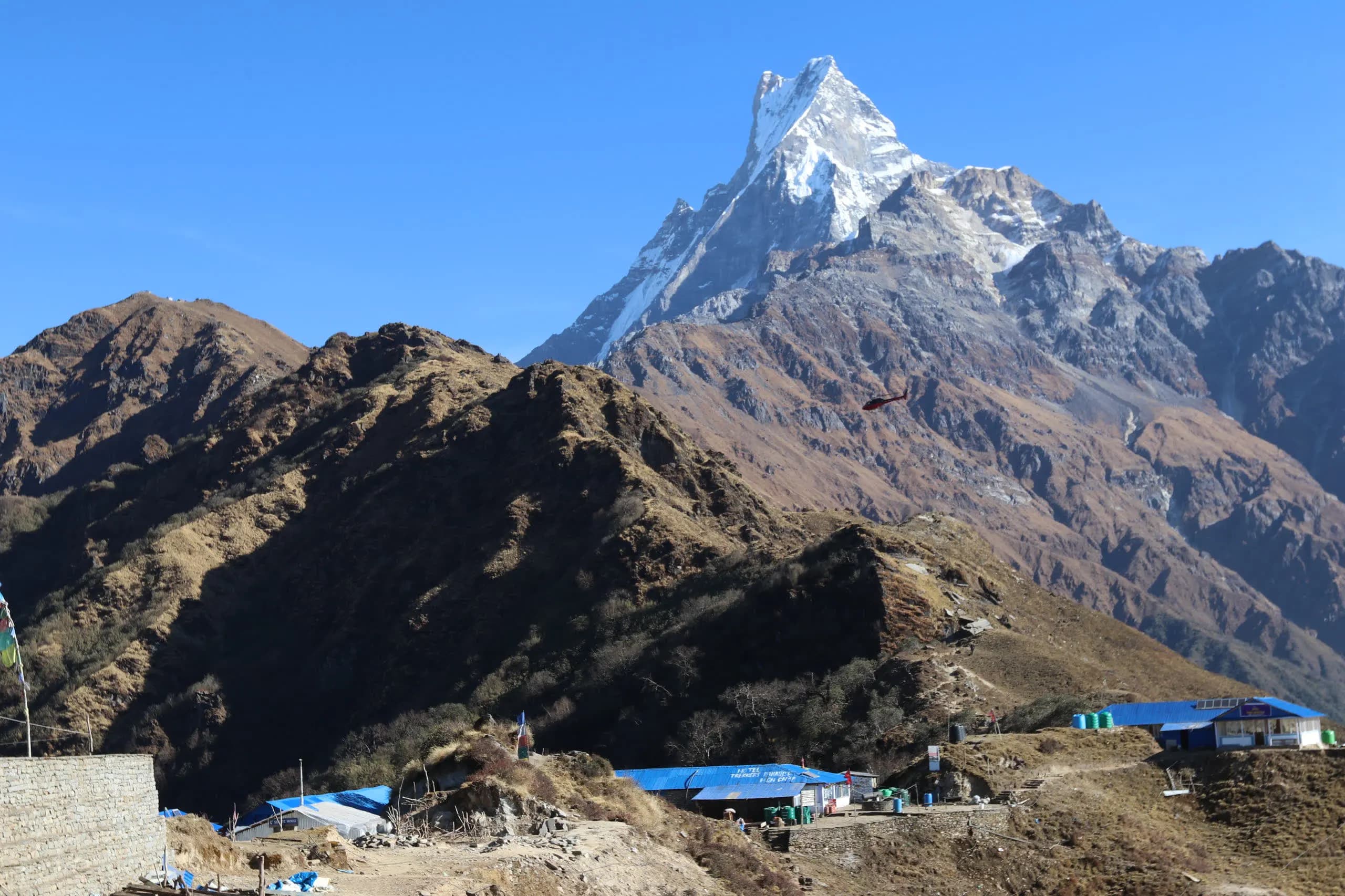
Every Mardi Himal trip carries a grade so you can match it to your fitness and experience before you book. The scale runs from easy day hikes to the technical 5,587 m climb. Below: what each grade means, the four things we grade on, and where each trip sits. For the trek in detail, see the difficulty and map page.
Short day hikes and valley walks on good trails. No trekking experience needed; suitable for most ages with everyday fitness.
On our tripsDay hikes around Pokhara, Australian Camp, Dhampus
Multi-day teahouse trekking on well-marked trails with sustained uphill and stone-step sections. No technical skill or prior altitude experience required, but a base of hill fitness makes it far more enjoyable.
On our tripsMardi Himal Trek, 5 days, to the Upper Viewpoint
The same trail compressed into fewer days, so the daily ascent and walking hours go up and there is less time to acclimatise. Good current fitness and recent hiking are strongly recommended.
On our tripsExpress and 3-day Mardi Himal Trek
Long days at altitude on remote trails, sometimes over a high pass. Requires solid fitness, prior multi-day trekking, and dedicated acclimatisation days built into the plan.
On our tripsExtended Mardi Himal and Annapurna Base Camp combinations
How long you are on your feet each day, and how much of that is climbing rather than contouring. This is the factor most people underestimate.
The highest point you sleep at and pass through. Above 3,000 m, the rate of ascent matters as much as the absolute height.
From stone-step trails to glacier and fixed-line snow slopes. Higher grades add skills you cannot improvise on the day.
Whether the trip suits a first-timer or assumes prior multi-day trekking, altitude exposure, or basic mountaineering.
Grades are a guide, not a gate. If you are unsure where you sit, tell us your recent hiking, your age, and any altitude you have reached before, and we will tell you honestly whether a trip fits. A Grade 2 trek with good preparation is well within reach of most people in everyday health.
The standard 5-day Mardi Himal trek is Grade 2, Moderate. It is a well-marked teahouse trek with sustained uphill to 4,200 m, no technical sections, and no prior altitude experience required. For the full fitness benchmarks, daily demand, and elevation profile behind that grade, see our trek difficulty and route map guide.
No. The Mardi Himal trek is non-technical: no ropes, crampons, or climbing skill, just steady walking to the 4,200 m Upper Viewpoint. It suits fit beginners walking with a guide.
Yes. The shorter itineraries cover the same ascent in fewer days, so daily walking hours and the rate of climb both rise, and there is less time to acclimatise. We grade them Moderate to strenuous (Grade 3).
Enough to walk 4 to 6 hours on hilly ground for several days in a row. Regular walking, stair work, and a few loaded day hikes in the months before you travel are the best preparation.
The 6 reviews below are all Mardi Himal treks, each rated 5 out of 5. Every one is on TripAdvisor or Google and links back to the original. Quotes are shortened excerpts; names, dates and trek lengths are taken from the source. Counts as of April 2026.
Our recent trip to Nepal and trek to Mardi Himal turned out to be one of the most memorable adventures of my life. Our guide Max was friendly, knowledgeable, and incredibly supportive, especially during the steep sections. The views along the route were breathtaking.
We had an excellent five-day trek on the Mardi Himal trail. It is frequented primarily by Nepali tourists. The views are incredible all along the trail, and many guest houses have spectacular views. Our guide was a joy to be with.
We were considering trekking to Annapurna Base Camp, but changed to the Mardi Himal based on Raj's advice. This was probably the best advice we got in Nepal. Mountains were fully covered in snow, the lower fields were green, and the rhododendron trees were flourishing.
Prakash was our trekking guide for the Mardi Himal trek. Even when we arrived feeling unwell, he showed immediate sympathy and organised a range of Pokhara-based activities for us. We can't recommend him enough. Prakash has completed over 500 trips on this route.
Our Mardi Himal trekking experience was great because of this team. Our guide Gautam was so professional, cordial and hospitable. We enjoyed it a lot. Looking forward to our next adventure with them.
Truly exceeded our expectations and made our trip to the Himalayas absolutely memorable. From the moment we inquired until the day we returned, their professionalism and attention to detail were outstanding.
We run scheduled departures from Pokhara, September to May. Most weeks the 5-day itinerary leaves on a Sunday and the 6-day on a Thursday, plus extra dates as groups form. Every other trip on this site runs privately, on your own dates. A 20 % deposit holds your place, and the balance is paid in Kathmandu before the trip starts.