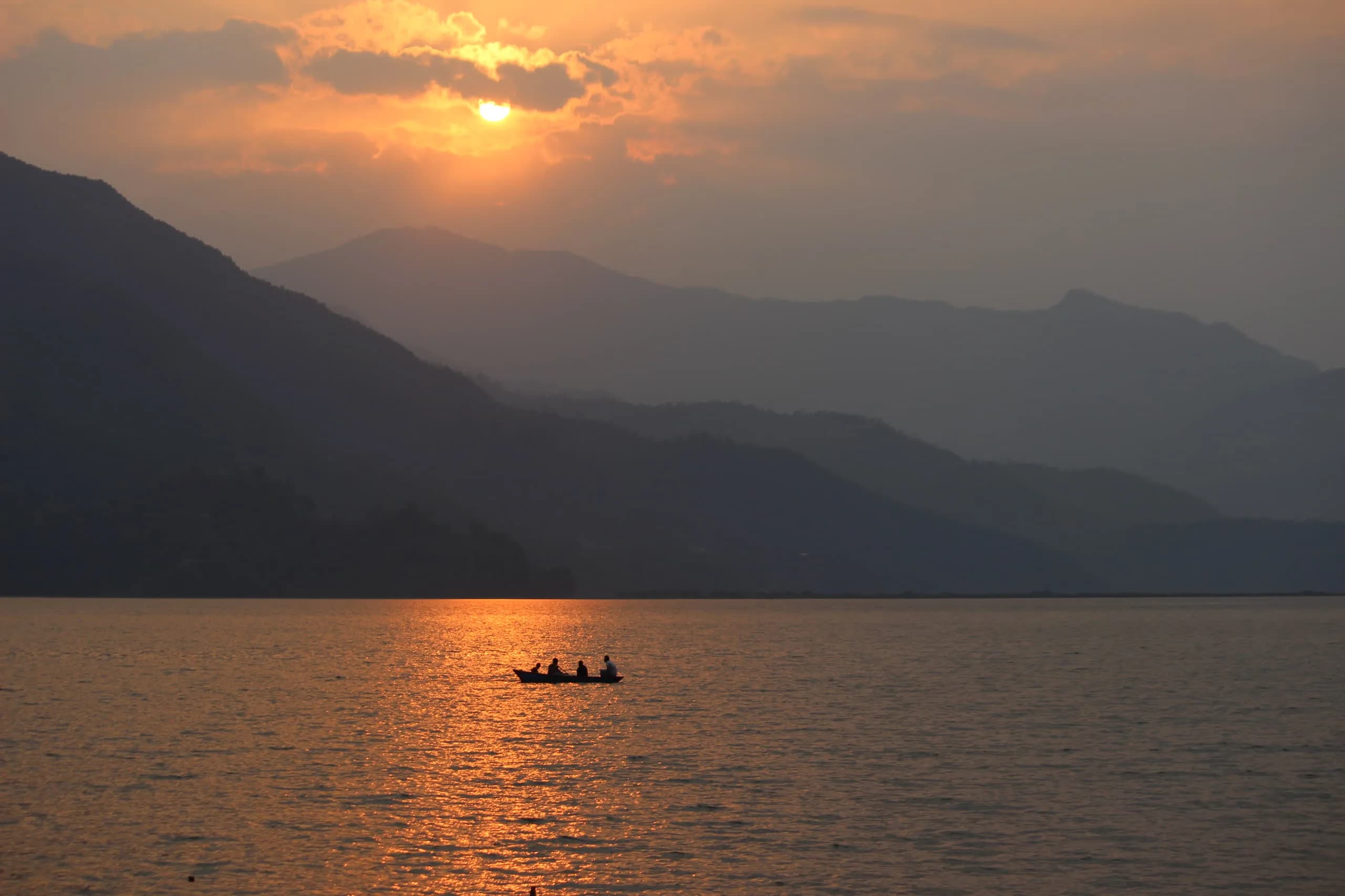
Phewa Lake
~742 m, ~5.7 km²Nepal's second-largest lake and Pokhara's centrepiece, lined by Lakeside on the north and east shores. Hire a wooden boat out to the island Tal Barahi temple, or just walk the promenade at dusk.
Pokhara is where every Mardi Himal trek begins and ends: a warm lakeside city at about 822 metres, with the Annapurna wall on the skyline. Here is what to see, where to base yourself, what gear to rent, and how to get from Lakeside to the trailhead.
Pokhara sits about 200 km west of Kathmandu on the shore of Phewa Lake. The city sprawls across a range of elevations, from the lake near 742 metres up into the surrounding hills, so the commonly cited ~822 metres is the valley floor. It is a low, warm base with no altitude to acclimatise to before you start walking.
Nepal's second-largest lake and Pokhara's centrepiece, lined by Lakeside on the north and east shores. Hire a wooden boat out to the island Tal Barahi temple, or just walk the promenade at dusk.
The white Shanti Stupa sits on the ridge above the south shore of Phewa Lake, completed in 1999. Reach it by boat then a short uphill walk, or by road, for a wide view back over the lake and city.
The premier sunrise viewpoint, about 5 km northwest of Lakeside. On a clear morning you see Annapurna, Machhapuchhre (Fishtail), Dhaulagiri, and Manaslu light up. It is also a paragliding launch.
A waterfall fed by the Phewa Lake outflow, also called Devi's Falls or Patale Chhango. It is named after a Swiss visitor swept away here in 1961, and sits in Chhorepatan on the south side of town.
Directly across the road from Davis Falls, a long limestone cave with a Shiva shrine inside. Operators describe it as the longest cave in Nepal, though that is a tourism claim rather than a verified record.
Three halls covering the Great Himalayas, a Hall of Fame, and world mountains, documenting Himalayan mountaineering history. A good half-day if rain keeps you off the lake.
Lakeside, also called Baidam, runs along the north and east shore of Phewa Lake. It is the tourist hub: hotels at every budget, restaurants, gear shops, and trekking agencies packed into one walkable strip. For a Mardi Himal trek it is the obvious place to base yourself, because you can sort permits, rent gear, withdraw cash, and arrange transport to the trailhead all within a few minutes' walk.
Gear rental, ATMs, agencies, and food are all on or just off the main Lakeside road, so a day of pre-trek errands is easy on foot.
ATMs are reliable in Pokhara but sparse and unreliable on the trail, so draw the rupees you need for the trek here before you leave.
Build in a night before and after the trek. The lake, the sunrise from Sarangkot, and the museum fill a rest day, and a buffer day protects against weather and transport hiccups.
Lakeside's main street has many gear shops renting sleeping bags, down jackets, poles, and crampons. For Mardi the items worth renting are a warm sleeping bag and a down jacket for the High Camp and Upper Viewpoint cold. The trek is short enough that buying full kit is usually unnecessary. Pokhara stocks both genuine brands and cheaper local copies, so check zips and seams before you pay.
Rental rates are indicative and vary shop to shop and by season, so treat the figures above as a guide, not a fixed price. Most shops ask for a refundable deposit, often around USD 110 to 200 or a passport copy, which you get back when you return the gear.
The standard Mardi Himal trek starts at Kande, the road-accessible trailhead at about 1,770 metres northwest of Pokhara. Most trekkers drive there from Lakeside by private vehicle or shared jeep, then start walking the same morning. For the full transport breakdown, including drive times, jeep options, and the alternative approaches, see our dedicated guide.
Three common ways. A flight takes about 30 minutes with several daily departures, a tourist bus is roughly 6 to 8 hours with morning and night services, and a private car or jeep is about 5 to 6 hours on the Prithvi Highway. Road times vary with traffic and conditions.
The valley floor sits at about 822 metres, with Phewa Lake near 742 metres and the surrounding hills higher. It is a low, warm base compared with the trek, so there is no altitude to acclimatise to in the city itself.
Lakeside, also called Baidam, on the north and east shore of Phewa Lake. It is the tourist hub with hotels, restaurants, gear shops, and trekking agencies in one walkable strip, which makes it the natural base for organising your Mardi Himal trek.
Rent the bulky cold-weather items, a warm sleeping bag and a down jacket, from a Lakeside shop, since Mardi is short. Buy boots and base layers at home for fit and hygiene. Most rental shops ask for a refundable deposit or a passport copy, and prices vary by shop and season.
Most trekkers drive from Pokhara to Kande, the road-accessible trailhead at about 1,770 metres, by private vehicle or shared jeep, then start walking. See our how to reach Mardi Himal guide for the full transport breakdown.
Phewa Lake and the Tal Barahi temple by boat, the World Peace Pagoda above the south shore, sunrise from Sarangkot, Davis Falls with the Gupteshwor cave opposite, and the International Mountain Museum. Most sit within a short drive of Lakeside.
The 6 reviews below are all Mardi Himal treks, each rated 5 out of 5. Every one is on TripAdvisor or Google and links back to the original. Quotes are shortened excerpts; names, dates and trek lengths are taken from the source. Counts as of April 2026.
Our recent trip to Nepal and trek to Mardi Himal turned out to be one of the most memorable adventures of my life. Our guide Max was friendly, knowledgeable, and incredibly supportive, especially during the steep sections. The views along the route were breathtaking.
We had an excellent five-day trek on the Mardi Himal trail. It is frequented primarily by Nepali tourists. The views are incredible all along the trail, and many guest houses have spectacular views. Our guide was a joy to be with.
We were considering trekking to Annapurna Base Camp, but changed to the Mardi Himal based on Raj's advice. This was probably the best advice we got in Nepal. Mountains were fully covered in snow, the lower fields were green, and the rhododendron trees were flourishing.
Prakash was our trekking guide for the Mardi Himal trek. Even when we arrived feeling unwell, he showed immediate sympathy and organised a range of Pokhara-based activities for us. We can't recommend him enough. Prakash has completed over 500 trips on this route.
Our Mardi Himal trekking experience was great because of this team. Our guide Gautam was so professional, cordial and hospitable. We enjoyed it a lot. Looking forward to our next adventure with them.
Truly exceeded our expectations and made our trip to the Himalayas absolutely memorable. From the moment we inquired until the day we returned, their professionalism and attention to detail were outstanding.
We run scheduled departures from Pokhara, September to May. Most weeks the 5-day itinerary leaves on a Sunday and the 6-day on a Thursday, plus extra dates as groups form. Every other trip on this site runs privately, on your own dates. A 20 % deposit holds your place, and the balance is paid in Kathmandu before the trip starts.