Reach the Mardi Himal base-camp area from Pokhara in 15 to 20 minutes, land for a 360° Annapurna panorama, and be back at your hotel by late morning. No trekking, no altitude grind, all ages. Everything you need below: cost, route, what to expect, landing versus fly-by, and how to book.
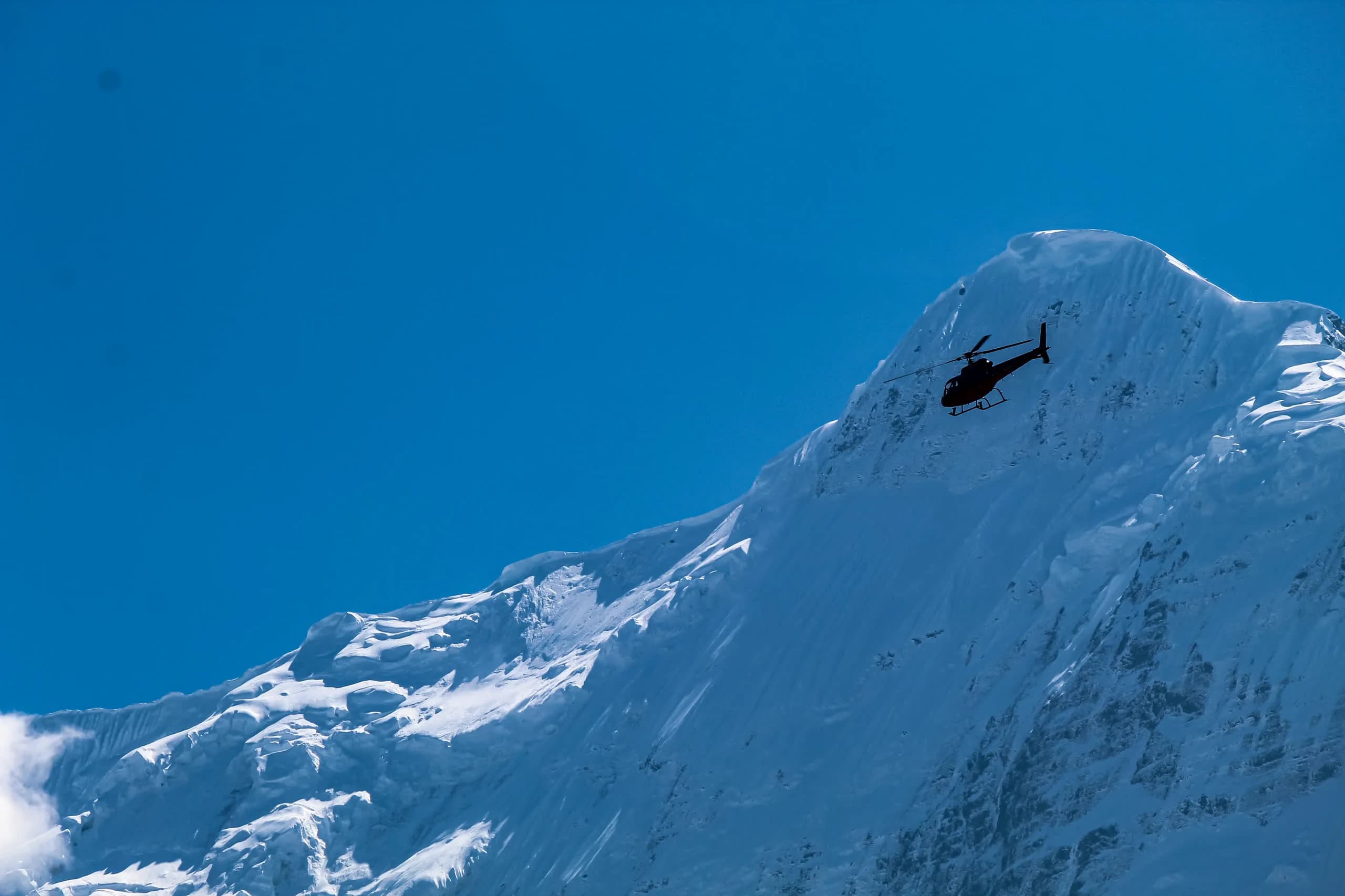
The tour flies up the same valley the trek walks for five days, over Phewa Lake, the forested ridges above Pokhara, and the Gurung villages, before the Annapurna wall opens up: Machhapuchhre (Fishtail), Annapurna South, Hiunchuli, and Mardi Himal itself at 5,587 m.
We collect you from your Lakeside hotel and transfer to the domestic terminal at Pokhara airport. Early-morning slots (6-9 AM) have the clearest air and the best mountain views.
Passengers and bags are weighed for load balance, you get the pre-flight safety briefing, then board the 5-seater.
Lift off over Phewa Lake and the Pokhara valley, then climb fast over forested ridges, terraced farms, and Gurung villages as the Annapurna wall fills the window.
Set down near High Camp / the Mardi Himal base-camp area for about 30 minutes, with a 360° panorama of Machhapuchhre, Annapurna South, Hiunchuli, and Mardi Himal. Time for photos and a warm drink.
Lift off again for a fresh angle on the valleys and ranges on the return leg.
Land in Pokhara and transfer back to your hotel. The rest of the day is yours.
The Mardi Himal flight is charter only, so you book the whole 5-seat helicopter from Pokhara, your party alone, on the date and time you pick. Up to five passengers fly for the same charter price.
Whole-aircraft price from Pokhara, not per person. A charter direct from Kathmandu runs much higher, around USD 4,700.Fill the charter with a group and the per-head cost drops to roughly this range. A party of about four makes it worthwhile; with fewer passengers each share climbs steeply.
Indicative split of the Pokhara charter across four to five passengers.Group charter only. The Mardi Himal flight is not a scheduled commercial service, so there are no single seats to buy on a fixed departure. You charter the whole helicopter and split the cost across your group, which is why a party of about four (up to five) makes it work. Indicative 2026 prices move with fuel and season, so we confirm the exact figure when we check availability for your date. Deposit and cancellation terms are on the booking policy.
It is cold at the landing site even in summer. Wear a warm jacket, hat, and gloves, and bring sunglasses for the snow glare. The cabin is small, so leave big bags at the hotel.
You climb from 800 m to around 3,600 m in twenty minutes. Move slowly at the landing site, do not run for photos, and tell us beforehand about any heart, lung, or blood-pressure condition.
A phone is fine; a zoom lens is better. Keep the strap on, the door may be opened for photos. The best light is the early-morning slot you flew in for.
Flights are weather-dependent and can shift or postpone at short notice. Keep a flexible morning, and ideally a spare day in Pokhara, so a cloudy start does not cost you the flight.
The flight always lifts off from Pokhara, because that is where the Annapurna foothills begin and the 15-minute hop to the ridge is possible. The only thing that changes is how you reach Pokhara.
Already in Pokhara? Then it is a single 4-to-5-hour morning: hotel pickup in Lakeside, flight from the domestic terminal, the landing at the base-camp area, and back to your hotel by late morning. The prices above are for this Pokhara start.
No need for an expensive direct charter from Kathmandu, which runs around USD 4,700 against roughly USD 1,900 from Pokhara. Get to Pokhara, stay the night, and fly the tour the next clear morning. We can bundle the Pokhara connection and a night's hotel into the package, then get you back to Kathmandu the same afternoon.
A same-day round trip from Kathmandu is possible if you take the first morning flight down, but an overnight in Pokhara is far safer: it gives the weather a window to clear, and a grounded flight does not cost you the whole trip.
The standard Mardi Himal tour. The helicopter sets down near the base-camp area for about 30 minutes so you can stand in the snow, photograph the panorama, and feel the altitude. This is what most people book.
A shorter option that stays airborne, banking past the peaks without landing. Cheaper and quicker, useful when landing sites are snowed in or weather is marginal, but you do not step out onto the mountain. Ask us if you prefer this.
The flight is charter only, so you book the whole helicopter rather than a single seat. A private charter from Pokhara is around USD 1,900 for up to five passengers; split across a group of four or five that works out to roughly USD 380 to 475 each. A charter direct from Kathmandu is far higher, around USD 4,700. Prices are indicative for 2026 and move with fuel and season; we confirm the exact figure when we check availability for your date.
Not as a scheduled seat, because the Mardi Himal tour is not a commercial seat-by-seat flight. The whole helicopter is chartered and the cost is shared, so we take bookings as a group, ideally four or more. Solo travellers and couples can either cover the full charter or ask us to try to combine them with others on the same date, though a shared departure cannot be guaranteed.
Near High Camp at around 3,600 metres (11,800 ft), with the exact spot depending on snow and the safe landing site on the day. You spend about 30 minutes on the ground for photos and the panorama before flying back.
The flying is about 15 to 20 minutes each way, with roughly 30 minutes on the ground. Door to door from your Pokhara hotel it is about 4 to 5 hours, including transfers and check-in. Most tours run in the early morning for the clearest weather.
The tour itself departs Pokhara. From Kathmandu you connect first by a 25-minute flight or a 6 to 7-hour drive to Pokhara, then join the heli tour. A direct private charter from Kathmandu is possible but much more expensive, so most travellers fly to Pokhara first.
No. The tour suits all ages and fitness levels with no trekking required. Because you reach altitude quickly, avoid rushing around at the landing site, and tell us in advance about any heart, lung, or blood-pressure conditions.
Spring (March to May) and autumn (September to November) have the most stable weather and clearest views. Winter flies on clear days but is cold with possible snow; the monsoon (June to August) is the least reliable for visibility.
Tell us your dates and group size and we will check availability, confirm the charter price, and hold your slot. Charters fill in peak season, so the earlier you ask, the better.