Spring season open · Mar 15 – Jun 25 places left · Classic 7d · May 03Rhododendron bloom reported at Forest Camp
Trail status: Open
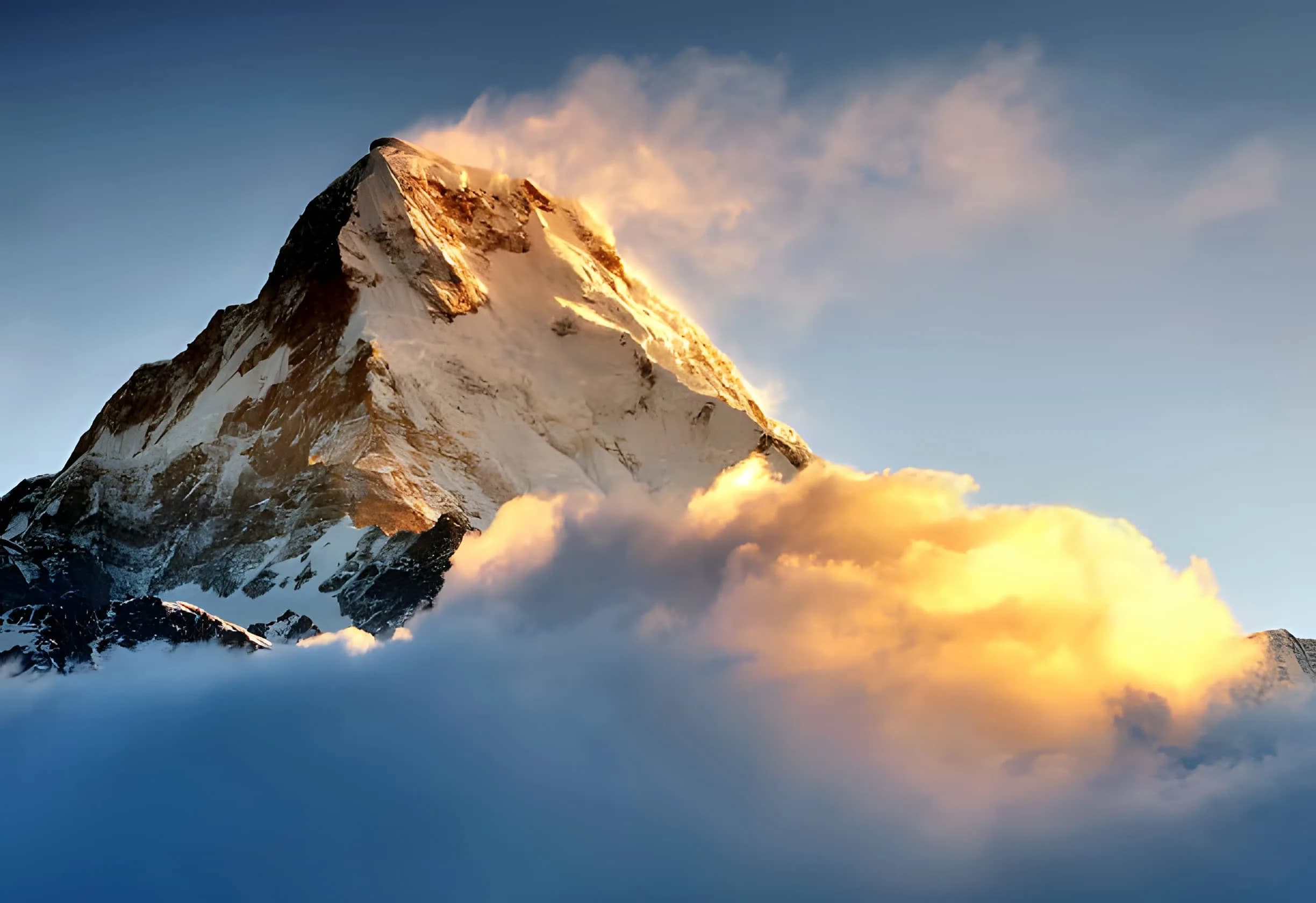
Machhapuchhre, the sacred Fishtail peak, above the Mardi Himal trail
Sacred mountains & living faith

A sacred skyline.

The Fishtail peak above the trail has never been climbed and is closed as sacred. The villages below it follow a Gurung faith that layers animism, Bon, and Buddhism, led by shamans whose roles reach back centuries. We source these claims carefully and keep the traditions distinct.

The sacred, in brief.

Sacred peak
Machhapuchhre (Fishtail)
Height
6,993 m
Climbing status
Closed since 1957
Sacred to
Gurungs & Chhomrong
Gurung priests
Pachyu, Khlepree, Lama
Trail villages
Dhampus, Pothana

Machhapuchhre, the Fishtail.

Machhapuchhre rises to 6,993 m on the eastern edge of the Annapurna Sanctuary, about 25 km north of Pokhara. Its name means fishtail in Nepali, after the double summit that resembles a fish's tail, and the Gurung name for it is Katasun Kliko. It is held sacred by the Gurungs and the people of Chhomrong, and in Hindu framing it is described as a home of the god Shiva.

It is closed to climbing, and has been since 1957. That year a British team led by Lt. Col. Jimmy Roberts attempted it under terms set by King Mahendra, who gave permission to climb but forbade stepping on the summit itself. Wilfrid Noyce and A.D.M. Cox reached to within about 45 to 46 metres of the top via the north ridge, then stopped, by agreement and in bad weather. After the expedition Roberts asked the Nepal government to keep the peak permanently off-limits, and it agreed; no climbing permits have been issued since. Noyce's "Climbing the Fish's Tail" remains the only climbing record. Roberts himself went on to found Nepal's first trekking agency and is often called the father of trekking in Nepal.

Animism, Bon, and Buddhism.

Gurung belief is layered rather than singular. Beneath it runs an old animism and shamanism, counted among the oldest religious traditions in Nepal, with the indigenous Gurung religion known as Pye Ta Lu Ta. Over time many Gurungs also took up Tibetan Buddhism, especially the Nyingma school and particularly in the Manang region, alongside Bon and local Hindu practice.

These traditions coexist. In the 2001 Nepal census about 69% of ethnic Gurungs identified as Buddhist, about 29% as Hindu, and under 1% as Christian; those are 2001 figures and may differ today. The villages along the trail carry this living culture, which we cover in more depth on our people and culture page.

Pachyu and Klihbri.

Gurung tradition recognises three types of priest. The Pachyu, also written Poju or Pajyu, is understood as the first or senior priest. The Khlepree, also recorded as Lhori, Ghyabri, or Klihbri, comes next, followed by the Bonpo Lama, the proper term for a pre-Buddhist Gurung Lama. The spellings shift from village to village, so the same role may be written several ways.

These priests lead the central rituals. Phailu, also called Pwelu, is an ancestral worship lasting around twelve hours, held yearly or every three years. Pae, also called Arghum, is the death ritual that sends the soul to the Land of the Ancestors. We describe these as the tradition records them rather than interpreting them, out of respect for a living practice.

Monasteries and prayer flags.

The Mardi Himal trek passes Gurung and Magar villages that have local monasteries and Buddhist prayer flags strung along the way. Dhampus, a classic Gurung ridge-top village at around 1,650 m and about 25 km north-west of Pokhara, is the usual gateway to the trail, with Pothana a short stage beyond it.

These are working places of worship in inhabited villages, not monuments. Walk quietly past shrines and monasteries, keep prayer flags and mani walls on your right as local custom does, and ask before photographing people or interiors. The peaks themselves are best read alongside our geography and geology page, which sets out the ground below the sacred skyline.

Sacred-mountain questions.

Why can't you climb Machhapuchhre?

Machhapuchhre, the Fishtail peak (6,993 m), is closed to climbing and has been since 1957. It is held sacred by the Gurungs and the people of Chhomrong, and in Hindu framing it is said to be a home of the god Shiva. In 1957 a British team led by Lt. Col. Jimmy Roberts climbed it under terms set by King Mahendra that forbade stepping on the actual summit; Wilfrid Noyce and A.D.M. Cox stopped about 45 metres below the top. No climbing permits have been issued since.

Has anyone reached the summit of the Fishtail?

Officially, no one. The 1957 party reached to within about 46 metres (150 feet) of the summit via the north ridge and turned back by agreement and in bad weather. There are unconfirmed reports that a New Zealand climber, Bill Denz, illegally reached the summit in the early 1980s, but this has never been verified. The peak is treated as unclimbed and sacred.

What religion do the Gurung people follow?

Gurung belief blends several layers. Underlying it is an old animism and shamanism, among the oldest religious traditions in Nepal, with the indigenous Gurung religion known as Pye Ta Lu Ta. Over time many Gurungs also embraced Tibetan Buddhism, especially the Nyingma school, alongside Bon and local Hindu practice. In the 2001 census about 69% of ethnic Gurungs identified as Buddhist and about 29% as Hindu. These layers coexist rather than replace one another.

Who are the Gurung shamans?

Gurung tradition recognises three types of priest: the Pachyu (also written Poju or Pajyu), the Khlepree (also Lhori or Ghyabri), and the Bonpo Lama, a pre-Buddhist Lama. The Pachyu is understood as the senior or first priest, followed by the Khlepree, then the Bonpo Lama. They lead key rituals including Phailu, an ancestral worship lasting around twelve hours, and Pae, the death ritual that guides the soul to the Land of the Ancestors. Spellings vary from village to village.

Are there monasteries on the Mardi Himal trail?

Yes. The Mardi Himal trek passes Gurung and Magar villages that have local monasteries and Buddhist prayer flags along the way. Dhampus, a classic Gurung ridge-top village at around 1,650 m and about 25 km north-west of Pokhara, is the usual gateway to the trail. These sites are living places of worship, so visit them respectfully.

Is Machhapuchhre sacred to Hindus or to the Gurungs?

Both, but in different ways. In Hindu framing the peak is described as a home of the god Shiva. For the Gurungs and the people of Chhomrong the sacredness is local and ancestral rather than tied to a single deity. We keep the two framings distinct because they come from different traditions, and the mountain matters to both.

Read the mountain, then come walk it.

We run small-group trips from Pokhara every Saturday from September to May. We also run private trips any day. A $50 deposit holds your place. Pay the rest on arrival in cash or by card.