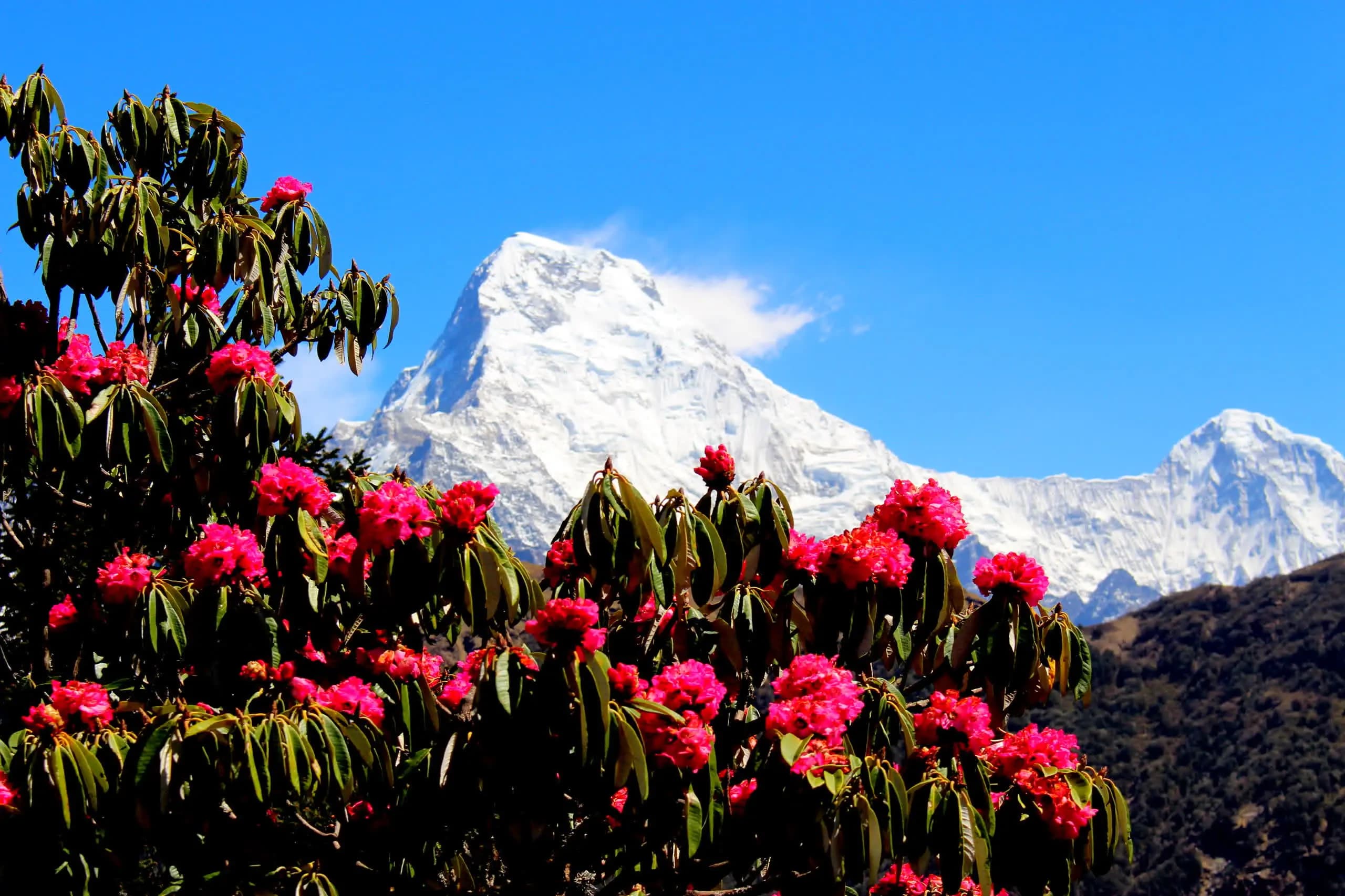
The whole Mardi Himal trail sits inside the Annapurna Conservation Area, Nepal's largest protected area. Here is what actually grows and lives along the route: the forest zones you climb through, the rhododendrons that colour the spring, the birds, and an honest account of which animals you can really hope to see.
The Annapurna Conservation Area was Nepal's first conservation area and is still its largest protected area, covering 7,629 square kilometres. It was launched in 1986, piloted in Ghandruk, and gazetted as a Conservation Area in 1992. The National Trust for Nature Conservation manages it, and more than 100,000 people live inside its boundaries. Every step of the Mardi Himal trek is inside this area, so the rules and the wildlife you read about below are the ones that apply on your trail.
On the southern flank of the Annapurna range, the vegetation shifts in clear bands as you gain height. The Mardi trail walks straight up through them, from warm broad-leaved forest near Pokhara to open alpine ground below the snow.
Lowland flora with oak and rhododendron through the foothills above Pokhara and the Gurung villages.
Moss-covered oak woodland, the main wildlife habitat on the trail and the kind of forest you walk through above Forest Camp.
Dense bamboo that helps with erosion control and is favoured cover for shyer forest animals.
Mid-temperate rhododendron that blooms in spring and thins out as you climb toward the high ridge around Deurali (~3,230 m).
Pine groves giving way to hardy shrubs and grasses on the open ground toward High Camp and the base-camp area.
Rhododendron arboreum, the Laligurans, is Nepal's national flower, and the Annapurna and Ghorepani forests hold over 30 rhododendron species in total, including the world's largest rhododendron forest at Ghorepani within the conservation area. The bloom runs through spring, roughly March to May, and is staggered by altitude: the lower hills start in March, the mid-altitude forest peaks around late March to April, and the high-altitude white species flower in May.
Laligurans, Nepal's national flower. Red, dominant in the lower and subtropical zones.
Pinkish-purple, found higher up.
Bright red.
Large white to pink flowers.
Small, shrubby, with aromatic leaves at high altitude.
White flowers with fringed edges.
The conservation area records 523 bird species. The one most trekkers hope to see is the Himalayan Monal, the Danphe.
The Impeyan pheasant (Lophophorus impejanus) is Nepal's national bird, an iridescent ground bird seen in the rhododendron and forest zones. Early morning, when it comes out to feed, is the best time to spot one.
A large vulture of the high-altitude zones, often seen soaring on the thermals along the open ridgelines above the treeline.
Other pheasants are reported around the forest zones and villages such as Chhomrong on the neighbouring trails.
This is where most trekking websites blur the line. The conservation area is home to a long list of mammals, but very few are realistically encountered on the Mardi Himal trail. Here is the honest version, in three tiers.
Commonly seen in the mid-elevation forests, roughly 2,300 to 2,600 m. The animal you are most likely to meet on the trail.
With luck, on rocky slopes at mid and high elevation, most often at dawn.
Possible in the subtropical forest.
Occasional, in oak and bamboo forest.
Only in the high zones near the upper base-camp ground.
The conservation area is home to these animals, though trekkers rarely see them. They live in remote, shy, or high-altitude habitats well away from the trail, so do not expect to encounter them on a Mardi Himal trek.
Shy and seldom seen, in high bamboo and oak forest.
Endangered and rarely glimpsed in shadowy high-altitude forest.
Effectively never seen by trekkers, in the remote high Himalaya.
The best months for clear wildlife sightings are the dry months of October and November. Walking quietly, starting early, and treading lightly all help. For how we keep the trail and its wildlife healthy, see our responsible travel page, and for the route itself see the Mardi Himal trek.
It is Nepal's largest protected area, covering 7,629 square kilometres. It was launched in 1986, piloted in Ghandruk, and gazetted as a Conservation Area in 1992. It is managed by the National Trust for Nature Conservation (NTNC) and records 1,226 flowering plants, 105 mammals, and 523 birds. The whole Mardi Himal trail sits inside it.
Spring, roughly March to May, with the bloom staggered by altitude. The lower hills start in March, the mid-altitude forest peaks around late March to April, and the high-altitude white species flower in May. Over 30 rhododendron species are reported across the Annapurna and Ghorepani forests.
Realistically, the gray (Nepal) langur, which is common in the mid-elevation forests, and with luck the Himalayan tahr on rocky slopes at dawn. Barking deer and Himalayan black bear are occasional. The conservation area is also home to red panda, musk deer, and snow leopard, though trekkers rarely see them.
Almost certainly not. The conservation area is home to snow leopard, red panda, and musk deer, but they live in remote, shy, high-altitude habitats and trekkers rarely see them. Treat any sighting as extraordinary luck rather than something to expect on a Mardi Himal trek.
The Himalayan Monal, known locally as the Danphe (the Impeyan pheasant, Lophophorus impejanus), is Nepal's national bird and is seen in the rhododendron and forest zones. The Himalayan Griffon is the large soaring bird you may spot in the higher, open zones.
The dry months of October and November give the clearest sightings, with stable weather and better visibility through the forest. Spring is also good and adds the rhododendron colour.
We run small-group trips from Pokhara every Saturday from September to May. We also run private trips any day. A $50 deposit holds your place. Pay the rest on arrival in cash or by card.