Khopra Danda and Mardi Himal are the two great quiet ridge treks of the Annapurna region, each a calm alternative to the crowded classics. One is a long balcony facing Dhaulagiri across a great gorge; the other is a short, steep climb to a close-up of the fishtail. Here is how they truly compare.
Both treks need the same paperwork, an ACAP permit and a TIMS card, and both stay quiet by the standards of the region. What sets them apart is length, height, and the direction they face. The headline figures are below; the rest of this page works through what they mean on the ground. For the trek we run, start with the Mardi Himal trek overview.
The single clearest way to see the difference is to put the two treks next to each other. Khopra Danda is longer and faces west; Mardi Himal is shorter, climbs higher on its ridge, and faces east. Treat the day counts and altitudes as indicative ranges rather than fixed numbers, since they shift with the itinerary and the source.
Altitudes and day counts are drawn from operator itineraries and cross-checked where possible. The Khayer Lake elevation in particular is quoted anywhere from about 4,600 to 4,800 m, so we show it as a range and flag it as approximate.
Mardi Himal is the quicker of the two. A typical Mardi itinerary runs around four to seven days, climbing from the forest at Kande up a single ridge to viewpoints at roughly 4,200 m and, for those who want it, base camp at around 4,500 m. It is moderate rather than hard, and it packs a lot of height gain into a short trip, which is part of why it suits walkers with only a week to spare. For the month-by-month picture, see our best months guide.
Khopra Danda asks for more time. The core route runs around six to nine days, often longer once you add the Poon Hill approach and the Khayer Lake side trip. The ridge itself sits lower than Mardi's viewpoints, at about 3,660 m, so the day-to-day altitude is gentler. The exception is the optional pilgrimage to Khayer Lake, a sacred lake at roughly 4,600 to 4,800 m, which is the highest and hardest single push on either trek and a long out-and-back day. If you want the lake, build in the spare days; if you do not, Khopra stays a comfortable mid-altitude walk.
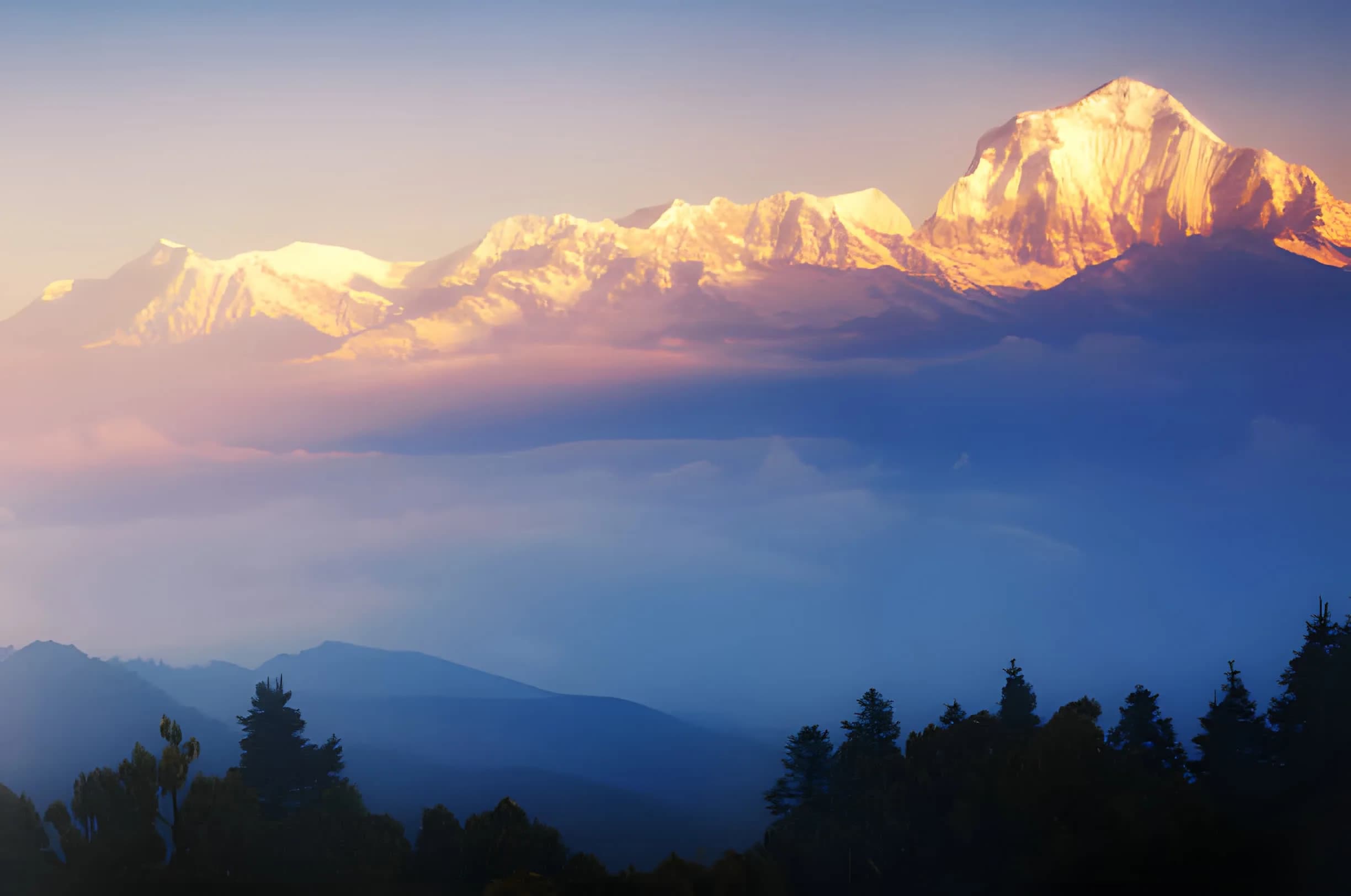
This is where the two treks split most sharply. Khopra Danda is a west-facing balcony perched on the rim of the Kali Gandaki, one of the deepest gorges on Earth. From the ridge, Dhaulagiri I rises across that void at 8,167 m, with Nilgiri, Annapurna South, and Fang ranged alongside it. The Muldai viewpoint nearby adds a near 360-degree sunrise. The scale is the point: you are looking across a colossal gap at an eight-thousander, not standing under one.
Mardi Himal does the opposite. It climbs the eastern flank of the Annapurna Sanctuary and brings you up close to Machhapuchhre, the sacred fishtail peak at 6,993 m, with Annapurna South and Hiunchuli crowding the skyline. The mountains feel near enough to touch rather than spread across a horizon. In character, both are quiet community-flavoured alternatives to the classic routes, but Khopra leans further into remoteness and Mardi into a sharp, intimate high-mountain finish.
Khopra Danda is known for its community lodges. The route opened to trekkers in 2012, with community-run lodges established from around 2014 on a model widely associated with Mahabir Pun, the Ramon Magsaysay Award winner from the region. The villages of Swanta, Chistibung, and Khopra each hold a handful of small lodges, and the stated aim is to keep tourism revenue in the community and help fund local services such as schools. We report that as the route's documented model; the exact share reaching any one school is an operator claim rather than an audited figure.
Mardi Himal runs on conventional private teahouses, which have grown quickly since the viewpoints opened. Both treks are quiet next to Poon Hill or Annapurna Base Camp, but Khopra is the quieter, kept that way by its length and remoteness. Access differs too: Khopra is usually reached from the Ghorepani side via Nayapul and Ulleri, while Mardi starts at Kande, far closer to Pokhara, which shortens the transfer and the overall trip. We cover the surrounding routes on our nearby treks page, which has a dedicated Khopra Ridge section.
On paperwork the two are identical: both sit inside the Annapurna Conservation Area, so both need an ACAP permit and a TIMS card, with no special restricted-area permit. On cost, the main driver is length. Khopra Danda usually costs more simply because it runs more days, with more nights of lodging, food, and guiding; Mardi is cheaper largely because it is shorter and the transfer is quick. Day-rate spending is broadly similar on both. One practical note: because Khopra leans on community lodges with limited rooms, beds can fill in the short autumn and spring windows, so booking ahead matters more there than on Mardi's busier teahouse trail.
The verdict is not that one trek beats the other, despite how some operator pages frame it. Pick Mardi Himal for a short trip near Pokhara, a close-up of Machhapuchhre, and high viewpoints in under a week. Pick Khopra Danda for more time, the sweeping Dhaulagiri panorama across the Kali Gandaki, community lodges, and the option of the Khayer Lake pilgrimage. If you are weighing other rivals, see how Mardi stacks up against Annapurna Base Camp and against Poon Hill.
On the ridge itself, no. Khopra Danda tops out at around 3,660 m, while the Mardi Himal trail climbs higher to its upper viewpoints at around 4,200 m and base camp at around 4,500 m. The picture flips if you add the optional Khayer Lake side trip on the Khopra route, which reaches a sacred lake at roughly 4,600 to 4,800 m, the single highest point of either trek. Source figures for the lake vary widely, so we treat that range as approximate.
Khopra Danda is the longer trek. It typically runs around 6 to 9 days, and longer still if you fold in Poon Hill and the Khayer Lake side trip. Mardi Himal is shorter, usually 4 to 7 days, and its trailhead at Kande is closer to Pokhara. If you have a week or less, Mardi fits more comfortably; if you have a clear nine to twelve days, Khopra gives you the room to do it justice.
They look at different mountains from different angles. Khopra Danda is a balcony facing west, with Dhaulagiri I (8,167 m) rising across the immense Kali Gandaki gorge, flanked by Nilgiri, Annapurna South, and Fang. Mardi Himal looks east at close range onto Machhapuchhre (6,993 m), the fishtail peak, and Annapurna South. Khopra is about sweep and depth; Mardi is about closeness and the fishtail.
Yes, this is one of the route's defining features. Khopra opened to trekkers in 2012 and its community lodges were established from around 2014, run on a community model widely linked to Mahabir Pun, the Magsaysay Award winner from the region. Revenue is reported to stay in the villages and to help fund local services such as schools and healthcare. The headline story is well documented; the precise share of revenue going to any single school is an operator claim, so we report it as the route's stated model rather than an audited figure.
Not as one continuous ridge walk, because they sit on opposite sides of the region and start from different trailheads. Most people who want both do them as two separate trips, or pair each with its natural neighbour: Mardi with the Annapurna Base Camp link, Khopra with Poon Hill and Khayer Lake. See our nearby treks page for how the wider region fits together.
Both are quiet alternatives to the classic Annapurna routes, but Khopra Danda is the quieter of the two. Its longer itinerary, remoter position, and community-lodge model keep numbers low. Mardi Himal has grown more popular since its viewpoints opened, so while it is still calm next to Poon Hill or Annapurna Base Camp, you will usually share the trail with more walkers than on Khopra.
Choose Mardi Himal if you want a shorter trip close to Pokhara, a close-up of Machhapuchhre, and a moderate climb to high viewpoints in under a week. Choose Khopra Danda if you have more time, want the sweeping Dhaulagiri panorama across the Kali Gandaki, prefer community lodges, and like the option of the Khayer Lake pilgrimage. Neither is superior in the abstract; they answer different briefs.
We run small-group trips from Pokhara every Saturday from September to May. We also run private trips any day. A $50 deposit holds your place. Pay the rest on arrival in cash or by card.