The two short treks every first-timer in the Annapurna region weighs up. One gives a wide sunrise from a single famous hill; the other puts you on a quiet ridge with the mountains almost overhead. Here is the honest comparison, fair to both.
Both treks share the same conservation area, the same permits, and much of the same season. The differences are in how high you go, how steep it gets, how many people you meet, and what the mountains look like when you arrive. The grid below sets them against each other; the sections that follow explain each row.
The Ghorepani Poon Hill trek is the shorter of the two. Most operators run it as a three to five day loop from Pokhara, with the highest point being the Poon Hill viewing tower at 3,210 m. That altitude is low enough that altitude sickness is rarely a worry, which is a large part of why the trek is recommended for first-timers and families.
Mardi Himal runs a little longer, typically four to seven days from Pokhara, and climbs much higher. The Upper and High Camp viewpoints sit at roughly 4,200 to 4,500 m, well above the Poon Hill tower. The extra height buys you a far closer relationship with the peaks, but it also means a steeper, more sustained climb and a real, if modest, altitude gain to manage. If you are weighing the months for either trek, our best months guide covers weather and visibility across the year.
Poon Hill is the easier walk overall, with one notable exception: the long stone staircase up to the village of Ulleri. The step count is part of trekking folklore, quoted variously at somewhere between 3,000 and 3,700 steps; those figures come from operators and trip blogs rather than an official survey, so we treat them as approximate. Whatever the true number, it is a tough hour, and after it the trail settles into graded village paths to Ghorepani.
Mardi Himal is steeper and more sustained. The ridge climbs steadily through forest before opening above the treeline, and the upper sections to Low, High, and Upper Camp ask for a steady, patient pace. It is not a technical climb, but it is more demanding than Poon Hill day for day. Our Mardi Himal difficulty and map page breaks down the gradient and altitude profile in full, and the 3-day itinerary shows how the climb is paced day by day.
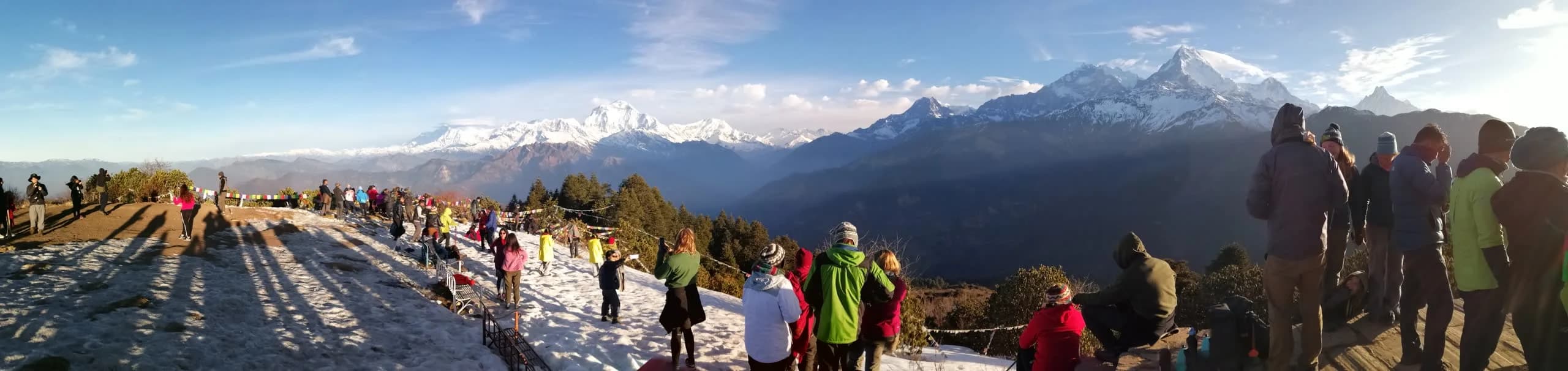
This is where the two treks part company most clearly. Ghorepani Poon Hill is one of the busiest short treks in Nepal, and in peak season the sunrise crowd at the viewing tower can be shoulder to shoulder. The reward is the view itself: a wide, open panorama across the Dhaulagiri and Annapurna ranges, lit up at dawn from a single high point. On a clear morning it is one of the great sunrises in the Himalayas.
Mardi Himal is the quieter trek by a wide margin. The forest ridge sees far fewer people, and the lodges are smaller and simpler. The views are different in character: rather than one big panorama, you get close, walk-with-you views of Machhapuchhre, the fishtail peak, rising almost directly above the trail, with Annapurna South alongside. It is less about a single photograph and more about being among the mountains for hours at a time.
The Poon Hill route is the more cultural of the two. It threads through established Gurung and Magar villages such as Ghandruk and Ghorepani, with the Poon Magar community giving the hill its name. These are settled, lived-in places with stone houses, terraced fields, and busy teahouses, and the trek is as much a village walk as a mountain one.
Mardi Himal is the quieter, wilder counterpart. Much of the route runs along a forested ridge above the main villages, with smaller, more seasonal camps rather than large settlements. You trade the village life of the Poon Hill trail for solitude and a closer line on the peaks. For more on the region as a whole, our Mardi Himal trek overview sets out the full route.
On paper the two treks cost much the same. Both sit inside the Annapurna Conservation Area, so both need the ACAP permit and a TIMS card, and since 1 April 2023 both require a licensed guide arranged through a registered agency. Independent solo trekking on these trails is no longer permitted for foreigners. Permit and guide costs are therefore broadly identical; the main difference in total price comes from trip length, with Mardi usually costing a little more for the extra day at altitude.
Poon Hill remains one of the cheapest treks in Nepal simply because it is short and the trail is densely served by lodges. Mardi is not far behind. Permit fees change from year to year, so we quote current rates at the time of booking rather than pinning a figure here.
Choose Poon Hill if this is your first trek in Nepal, if you are travelling with family or with anyone uneasy about altitude, and if a wide, classic sunrise from a famous hill is what you came for. It is the gentler, lower, more village-rich walk, and it is hard to beat as an introduction to the Annapurna region.
Choose Mardi Himal if you want to be close to the mountains rather than looking at them from a distance, if you would rather have a quiet ridge than a busy viewpoint, and if you are comfortable with a steeper climb to higher ground. And if you cannot decide, the two combine well into a single trip of a week or more, giving you both the sunrise and the ridge.
If you are still comparing options, it is worth reading how Mardi stacks up against its neighbours: see Annapurna Base Camp vs Mardi Himal for the longer classic, and Khopra Danda vs Mardi Himal for another quiet, high ridge alternative.
Yes, on balance. Poon Hill tops out at 3,210 m, low enough that altitude sickness is rarely a concern, and its trail mostly follows graded village paths. Mardi Himal climbs to viewpoints around 4,200 to 4,500 m on a steeper, more sustained ridge, so it asks more of your legs and lungs. The one hard stretch on the Poon Hill side is the long stone staircase up to Ulleri, often quoted at somewhere between 3,000 and 3,700 steps; those step counts are operator figures and vary by source, so treat them as approximate.
Yes. Mardi Himal is one of the more achievable higher-altitude treks in the Annapurna region, and fit first-timers complete it regularly. It is steeper than Poon Hill and reaches a higher altitude, so it helps to be comfortable with several hours of uphill walking and to allow a sensible pace. Our full breakdown is on the Mardi Himal difficulty and map page, and a typical short plan is the 3-day itinerary.
They offer different kinds of views. Poon Hill gives one wide sunrise panorama across the Dhaulagiri and Annapurna ranges from a single viewpoint, a classic photograph in good weather. Mardi Himal gives closer, more intimate views: you walk the ridge with Machhapuchhre and Annapurna South almost overhead for much of the upper trail. If you want one big sunrise, Poon Hill; if you want to be among the peaks for longer, Mardi.
Considerably. The Ghorepani Poon Hill trek is one of the busiest short routes in Nepal, and the sunrise viewing tower can be shoulder to shoulder in peak season. Mardi Himal follows a quieter forest ridge with far fewer trekkers and smaller, simpler lodges. If solitude matters to you, Mardi is the calmer choice.
Both treks sit inside the Annapurna Conservation Area, so both require the ACAP permit and a TIMS card. Since 1 April 2023, foreign trekkers must also hire a licensed guide arranged through a registered agency; independent solo trekking on these trails is no longer permitted. As an Annapurna operator we arrange the permits and the guide together.
Yes, and it is a popular pairing. A combined route usually starts with the Ghorepani Poon Hill loop, then crosses toward the Mardi ridge, giving you both the wide sunrise panorama and the close ridge views in a single trip of roughly a week or more. It is a good way to see the contrast between a busy classic and a quiet ridge without choosing one over the other.
They are close. Poon Hill is among the cheapest treks in Nepal because it is short and the trail is well served by lodges; Mardi Himal costs slightly more if you add a day for the extra altitude. The fixed costs are similar: the same ACAP and TIMS permits, a guide either way, and comparable teahouse rates. Day count and trip length drive most of the difference.
We run small-group trips from Pokhara every Saturday from September to May. We also run private trips any day. A $50 deposit holds your place. Pay the rest on arrival in cash or by card.