Spring season open · Mar 15 – Jun 25 places left · Classic 7d · May 03Rhododendron bloom reported at Forest Camp
Trail status: Open
The Annapurna massif above the Mardi Himal ridge
Trek comparison

A loop, or a ridge.

The Annapurna Circuit walks the whole way around the massif and over a 5,416 m pass. Mardi Himal climbs one valley to a ridge in a few days. Same mountains, two very different trips. Here is how they compare, and how to choose.

The two trips, in numbers.

Circuit route
~160 to 230 km loop
Mardi route
~4 to 5 day out-and-back
Circuit duration
~10 to 18 days
Mardi duration
4 to 7 days
Thorong La pass
5,416 m
Mardi high point
~4,200 to 4,500 m
Both need
ACAP permit
Circuit AMS risk
High at the pass

One walks around, one walks up.

The clearest difference is shape. The Annapurna Circuit is a loop, a long arc that traces roughly 160 to 230 km around the entire Annapurna massif, depending on which road sections you walk and which you skip. The Mardi Himal trek is an out-and-back: you walk up one forested valley to a high ridge, then come back down the same way, covering something in the order of 25 to 40 km in total.

That shape sets the clock. The classic Circuit once filled up to three weeks on foot. With roads now reaching far into both sides of the valley, most people complete it in around ten to eighteen days. Mardi fits comfortably into 4 to 7 days, and our day-by-day Mardi itinerary lays out exactly how those days fall. If you only have a long weekend plus a little more, Mardi is one of the few Himalayan treks that genuinely fits.

The table, head to head.

FactorMardi HimalAnnapurna Circuit
Route typeOut-and-back up one ridgeLoop around the whole massif
Distance~25 to 40 km~160 to 230 km
Duration4 to 7 days~10 to 18 days
Max altitude~4,200 to 4,500 m5,416 m (Thorong La)
AMS riskLow to moderateHigh on pass day
CostLower (shorter trip)Higher (more days)
PermitsACAP + TIMSACAP + TIMS
CrowdsQuieter, newer trailBusy, classic route

Figures are typical ranges, not fixed numbers. Distance and duration on the Circuit shift with how much road you walk versus drive, and the road extent changes year to year. Treat these as planning guides, not promises.

The pass that defines the loop.

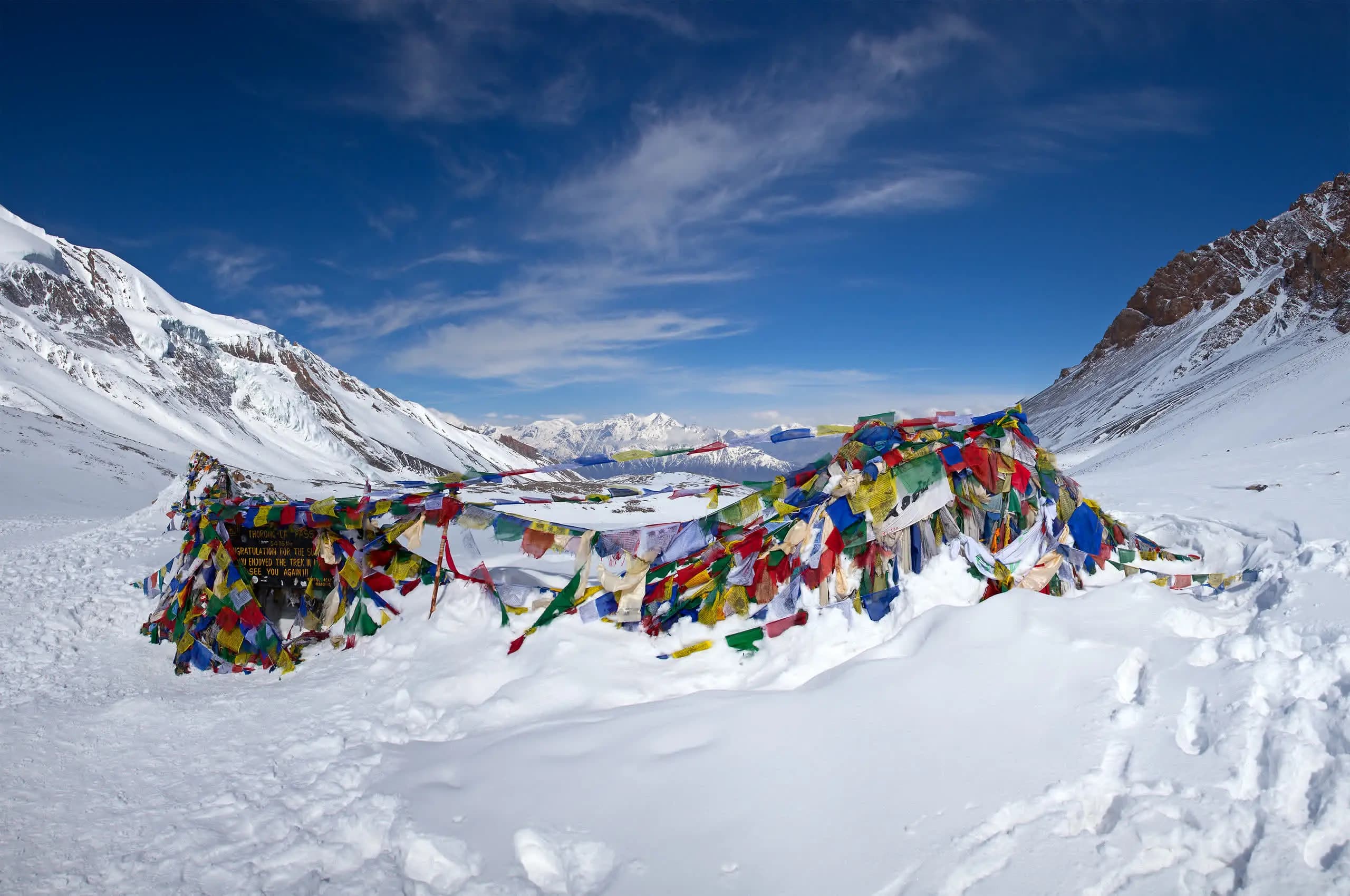
The Annapurna Circuit is built around one hard day: the crossing of the Thorong La pass at 5,416 m. It is a long, cold, pre-dawn climb to the highest point, and the day is where altitude sickness becomes a genuine concern. The whole eastern half of the trek is, in effect, a slow acclimatisation ramp toward that pass, which is why the Circuit cannot be safely rushed.

Mardi Himal sits much lower. Depending on how far you push above View Point, the high point of the trek lands somewhere around 4,200 to 4,500 m. That is high enough to feel the thinning air, but well below the Thorong La, and the climb is spread over enough days that most walkers acclimatise naturally. We go into the detail, and how to read the warning signs, on our altitude sickness page. For where the peak itself sits within the range, see Mardi Himal's position in the Annapurna massif.

Many worlds, or one valley.

The Circuit's great strength is variety. In a single trip you pass from warm, subtropical foothills through pine and the high, open Manang valley, then over the pass into the dry, trans-Himalayan country on the Mustang side, with the pilgrimage temple at Muktinath and the wind-scoured trail down through Jomsom and Kagbeni. It is a crossing between two climates and two cultures.

Mardi gives you one landscape, done well: a steep climb through rhododendron and oak forest that opens onto a high grassy ridge, with the rock wall of Machhapuchhre and the Annapurna peaks standing close and tall ahead of you. It trades the Circuit's breadth for a concentrated, intimate dose of high mountain scenery. The Mardi Himal trek overview walks through what each day actually looks like.

The practical ledger.

On cost, the maths is mostly about time. More days means more guide and porter wages, more nights in teahouses, and more transport, so the Circuit costs more simply because it is longer. Mardi is the lighter trip on the budget. On permits the two are close: both sit inside the Annapurna Conservation Area, so both need the ACAP permit, and both have historically required a TIMS card. The standard Circuit, including the lower Mustang stretch through Muktinath and Jomsom, needs only ACAP and not a Restricted Area Permit, which is reserved for the separate Upper Mustang trek. Permit rules and prices change, so confirm the current set before you travel.

On crowds, Mardi is the quieter option. It opened as an official route only in 2012, so it sees a fraction of the foot traffic of the Circuit, which has been a classic for decades. Both run on warm, well-developed teahouse hospitality, but Mardi's lodges are smaller and the ridge feels more private. For the seasonal picture on Mardi, including when the crowds and the views peak, see our best months to trek Mardi Himal guide.

So which one, for you?

Choose the Annapurna Circuit if you have two weeks or more and you want the full crossing: the changing climates, the high Manang valley, the Mustang side, Muktinath, and the satisfaction of topping the Thorong La. It is the bigger, more demanding adventure, and it rewards the time it asks for.

Choose Mardi Himal if you have under a week and want concentrated mountain views without a high pass to cross. You gain the ridge quickly, sleep close under the peaks, and walk a quieter trail. Both are genuinely good treks in the same great range, and we run trips across the Annapurna region, so we are happy to talk through either. The honest answer comes down to your calendar and your appetite for altitude.

Comparison questions.

How high does the Annapurna Circuit go, and how high is Mardi Himal?

The Annapurna Circuit tops out at the Thorong La pass at 5,416 m, the single highest point on the whole loop. Mardi Himal is far lower: most trekkers turn around at View Point, with sources placing the high point of the trek somewhere in the 4,200 to 4,500 m band, depending on whether you push up toward the Upper View Point and Base Camp. That gap of nearly a kilometre of vertical is the heart of the difference between the two trips.

How long is the Annapurna Circuit now that roads reach into the valley?

The classic loop ran roughly 160 to 230 km and once took up to three weeks on foot. Roads have since pushed up both sides of the valley, on the Besisahar to Manang side in the east and the Muktinath and Jomsom side in the west, so many trekkers now drive past the lower, dustier sections by jeep and walk the higher, scenic middle. That cuts the on-foot trip to around ten to eighteen days. To avoid walking the road itself, many people follow the Natural Annapurna Trekking Trail, a network of side paths off the road. The exact road extent keeps changing year to year, so confirm the current end-of-road points with your operator before you book.

Which trek is harder, the Circuit or Mardi Himal?

The Annapurna Circuit is the harder of the two by a clear margin. It is longer, climbs much higher, and its crux is the Thorong La crossing day, a long pre-dawn start to over 5,400 m where altitude sickness is a real risk. Mardi Himal is a steady forest-to-ridge climb that most reasonably fit walkers manage in a few days, with a lower ceiling and gentler altitude exposure. We cover the high-altitude side of Mardi on our altitude sickness page.

Do both treks need the same permits?

Both sit inside the Annapurna Conservation Area, so both need the ACAP permit, and both have historically required a TIMS card as well. The standard Annapurna Circuit, including the Muktinath, Jomsom, and Kagbeni section of lower Mustang, needs only ACAP, not a Restricted Area Permit. A Restricted Area Permit is required only if you extend into Upper Mustang, which is a separate trek. Permit rules and fees change, so check current requirements before you travel.

Is Mardi Himal a fair substitute for the Annapurna Circuit?

It depends on what you are after. The two are not really substitutes. The Circuit is a long, varied crossing through subtropical foothills, the high Manang valley, the trans-Himalayan dry country near Mustang, and the temple at Muktinath, ending with a big pass. Mardi is a concentrated burst of high mountain scenery in a single valley, gained quickly. If you have two weeks and want the full crossing, do the Circuit. If you have under a week and want to stand close under the peaks, do Mardi.

Which has fewer crowds?

Mardi Himal is the quieter trail. It opened as an official route only in 2012, so it carries a fraction of the traffic of the Circuit, which has been one of Nepal's signature treks for decades and draws large numbers in spring and autumn. The teahouse culture on both is warm and well established, but Mardi feels more intimate, with smaller lodges strung along the ridge.

Can I combine a short trek with the Annapurna region another way?

Yes. If your time is limited but you still want the region, Mardi Himal and Annapurna Base Camp are the two strongest short options out of Pokhara. We compare each of them to the alternatives on our Mardi versus ABC and Mardi versus Everest Base Camp pages, which sit alongside this one.

Read the mountain, then come walk it.

We run small-group trips from Pokhara every Saturday from September to May. We also run private trips any day. A $50 deposit holds your place. Pay the rest on arrival in cash or by card.