Everest Base Camp is one of the great walks on the planet. It also asks for two weeks, a flight to Lukla, and a hard look at the altitude. Here is what EBC actually takes, and what Mardi Himal gives you in a third of the time, out of Pokhara.
We only run trips on the Annapurna side, so take this as a guide written by people who love the mountains rather than a neutral referee. We have tried to be fair to both. The figures for Everest Base Camp are drawn from current operator and trekking sources for 2026 and should be checked against your chosen agency; the cost lines are indicative, not quotes.
| Factor | Mardi Himal | Everest Base Camp |
|---|---|---|
| Region | Annapurna, off Pokhara | Khumbu, off Lukla |
| Duration | 4 to 7 days | 12 to 14 days |
| Max altitude | ~4,200 to 4,500 m | 5,545 m (Kala Patthar) |
| AMS risk | Low, gradual climb | High, acclimatisation days required |
| Cost (indicative) | Budget-friendly | Significantly higher |
| Permits | ACAP + TIMS | Sagarmatha NP + Khumbu municipality |
| Access | Road, no flights | Lukla flight, weather-delay risk |
| Crowds | Quieter ridge | Busy in peak season |
Everest Base Camp lies in the Khumbu, in the far east of Nepal. The standard way in is a 25-minute mountain flight from Kathmandu to Lukla, a tiny airstrip at 2,860 m with a short sloped runway built into a hillside. In 2026, peak-season flights mostly leave not from Kathmandu but from Ramechhap, a four to five hour drive east, in pre-dawn convoys. The valley closes in fast, so cancellations and delays are a normal part of the EBC experience, and seasoned trekkers keep three to four buffer days in their plan to absorb them.
Mardi Himal sits on the Annapurna side, above Pokhara, and there is no flight involved at all. You drive from Pokhara to a trailhead such as Kande and start walking the same day. There is no airstrip to be grounded by cloud and no convoy to catch before dawn. The full mechanics are on our how to reach page, and the day-by-day shape of the walk is in our Mardi Himal itinerary.
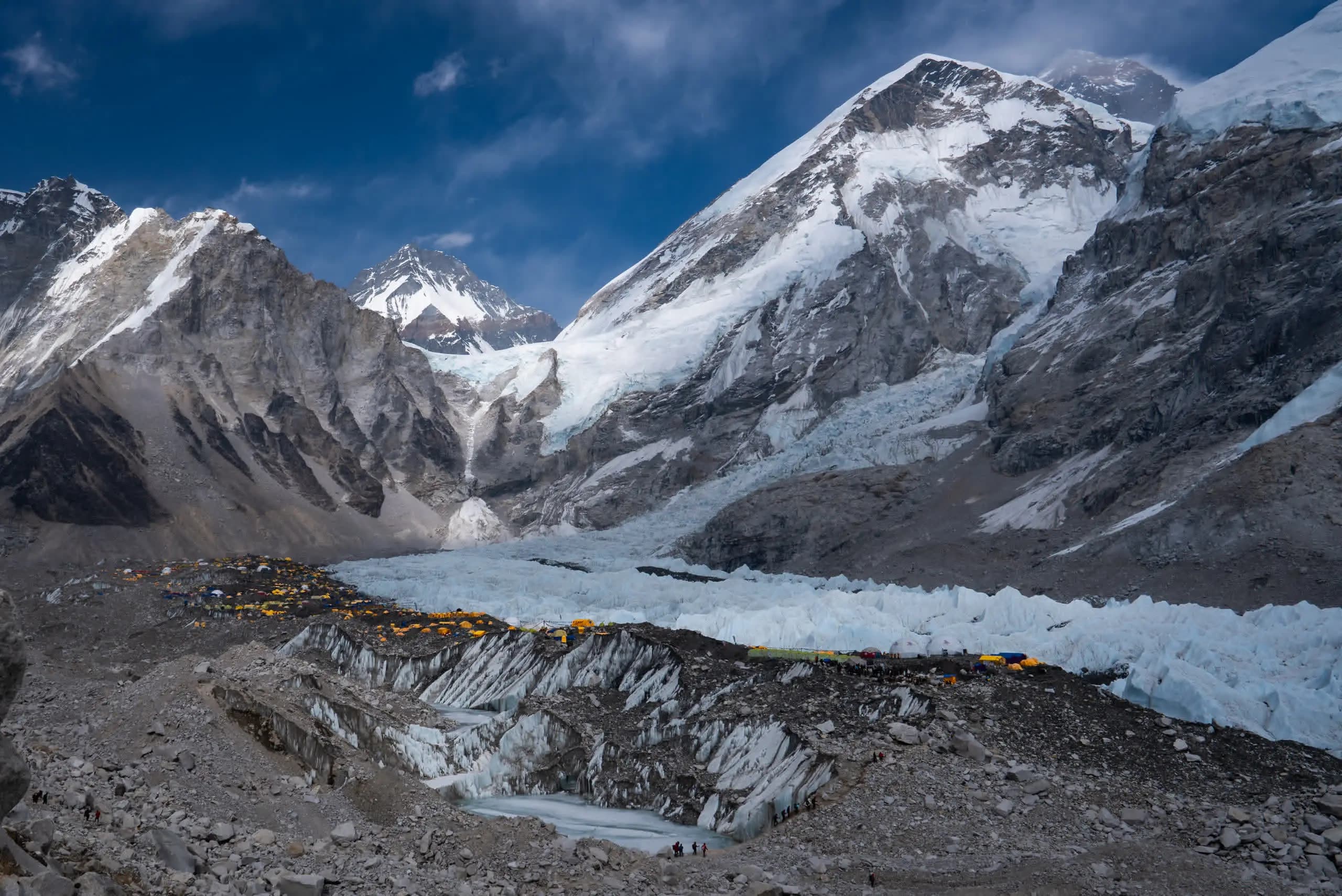
This is where the two treks separate most sharply. Everest Base Camp stands at 5,364 m, and the standard route adds the dawn climb to Kala Patthar at 5,545 m for the classic view of Everest. Getting there safely takes twelve to fourteen days, with mandatory acclimatisation stops at Namche Bazaar around 3,440 m and Dingboche around 4,410 m. Those rest days are not padding: above roughly 4,000 m the risk of acute mountain sickness becomes serious, and the schedule is built around letting your body adjust.
Mardi Himal reaches its high viewpoints at roughly 4,200 to 4,500 m, well over a kilometre lower than the EBC high point, and gets there in four to seven days with a gentler climb through forest and onto the upper ridge. The risk of altitude sickness is much lower, though never zero, and the standard itinerary does not need a dedicated acclimatisation day. If you want to understand the warning signs on either trek, read our altitude sickness guide before you go.
EBC is the more expensive trek, and the reasons are structural rather than anyone overcharging. The return flight to Lukla runs around USD 360, plus a ground transfer to Ramechhap in peak season; the trek runs roughly twice as many days as Mardi; and Khumbu teahouse prices climb the higher you go, because everything is carried or flown in. Published 2026 EBC packages commonly land between USD 1,400 and 2,000 per person and can run well beyond that with extra comfort or a helicopter return. Treat those numbers as indicative.
On permits, EBC needs the Sagarmatha National Park entry permit, quoted at NPR 3,000, plus the Khumbu Pasang Lhamu Rural Municipality fee, generally in the NPR 2,000 to 3,000 range. Mardi needs the Annapurna Conservation Area Permit at NPR 3,000 plus a TIMS card. Permit fees change, so confirm the current figures with your operator before you travel. Across the whole trip, fewer days, no flight and lower lodge prices make Mardi the budget-friendly option by a wide margin.
The views are not better or worse, just different. EBC puts you among the highest peaks on earth, with Everest, Lhotse and Nuptse rising over the Khumbu icefall, and there is nothing else quite like standing at the foot of the world's tallest mountain. The trade is crowds: in October, November, April and May the trail and the teahouses are busy. Mardi gives you a narrow ridge with Machhapuchhre almost overhead and the Annapurna massif filling the horizon, on a quieter path that most trekkers reach in under a week.
So the verdict is honest and simple. Choose Everest Base Camp if the name Everest is the point and you have two weeks or more, the fitness for sustained days at altitude, and the patience for Lukla's weather. Choose Mardi Himal if you want a real Himalayan ridge, lower risk, lower cost, and a trek you can finish in under a week from Pokhara. Picking your window matters on either side, so our guide to the best months is worth a read. If you are weighing nearby Annapurna options, see our comparisons of ABC vs Mardi and the Annapurna Circuit vs Mardi, and the full overview on our Mardi Himal trek page.
No. Everest Base Camp is the harder trek by a clear margin. EBC takes you to 5,545 m at Kala Patthar and 5,364 m at the base camp, climbs over twelve to fourteen days, and needs built-in acclimatisation days because the risk of altitude sickness is real above 4,000 m. Mardi Himal tops out around 4,200 to 4,500 m at its viewpoints, runs four to seven days, and gains height more gradually. Mardi is steep in places and far from a stroll, but on every measure that matters, distance, days, altitude and acute mountain sickness risk, EBC asks more of you.
A good deal cheaper, mostly because of the things EBC needs that Mardi does not. EBC requires a return flight to Lukla, which alone runs roughly USD 360 plus a ground transfer to Ramechhap in peak season, and it runs for around twice as many days, each adding food, lodging and guide costs at Khumbu prices, which are higher than the Annapurna side. Published 2026 EBC packages commonly sit between USD 1,400 and 2,000 per person, and can climb well beyond that. Mardi has no flights, fewer days and lower teahouse prices, so the total is a fraction of that. Exact figures depend on group size and style, so treat any single number as indicative.
Not in the formal sense that EBC requires. EBC builds in mandatory rest days at Namche Bazaar around 3,440 m and Dingboche around 4,410 m precisely because the altitude is high enough to make people ill. Mardi stays lower and climbs more gently, so a dedicated acclimatisation day is not part of the standard itinerary, though anyone feeling the height should still slow down. You can read more on the warning signs on our altitude sickness page.
Lukla sits at 2,860 m on a short sloped runway carved into a hillside, and the weather in the Khumbu turns fast. Flights are grounded whenever cloud closes the valley, and in 2026 most departures leave not from Kathmandu but from Ramechhap, a four to five hour drive east, in pre-dawn convoys. Delays of a day or more are common in the shoulder seasons, which is why experienced trekkers keep three to four buffer days in the plan. Mardi has no such problem: you simply drive out of Pokhara to the trailhead.
They are different rewards. EBC puts you face to face with Everest itself, plus Lhotse, Nuptse and the Khumbu icefall, the highest scenery on earth. Mardi gives you a high ridge with Machhapuchhre, the fishtail peak, standing almost directly overhead, and the Annapurna wall stretched across the skyline. If the name Everest is what you came for, EBC wins. If you want a dramatic Himalayan ridge close enough to feel, Mardi delivers in a third of the time.
You can, but they sit on opposite sides of the country and serve different purposes. EBC is a two-week commitment out of Lukla; Mardi is a short trek out of Pokhara. Some visitors do a long EBC expedition one year and a quick Mardi the next, or use Mardi as a warm-up the season before a bigger Himalayan goal. If your total time off is under two weeks, Mardi alone is the realistic choice.
We run small-group trips from Pokhara every Saturday from September to May. We also run private trips any day. A $50 deposit holds your place. Pay the rest on arrival in cash or by card.