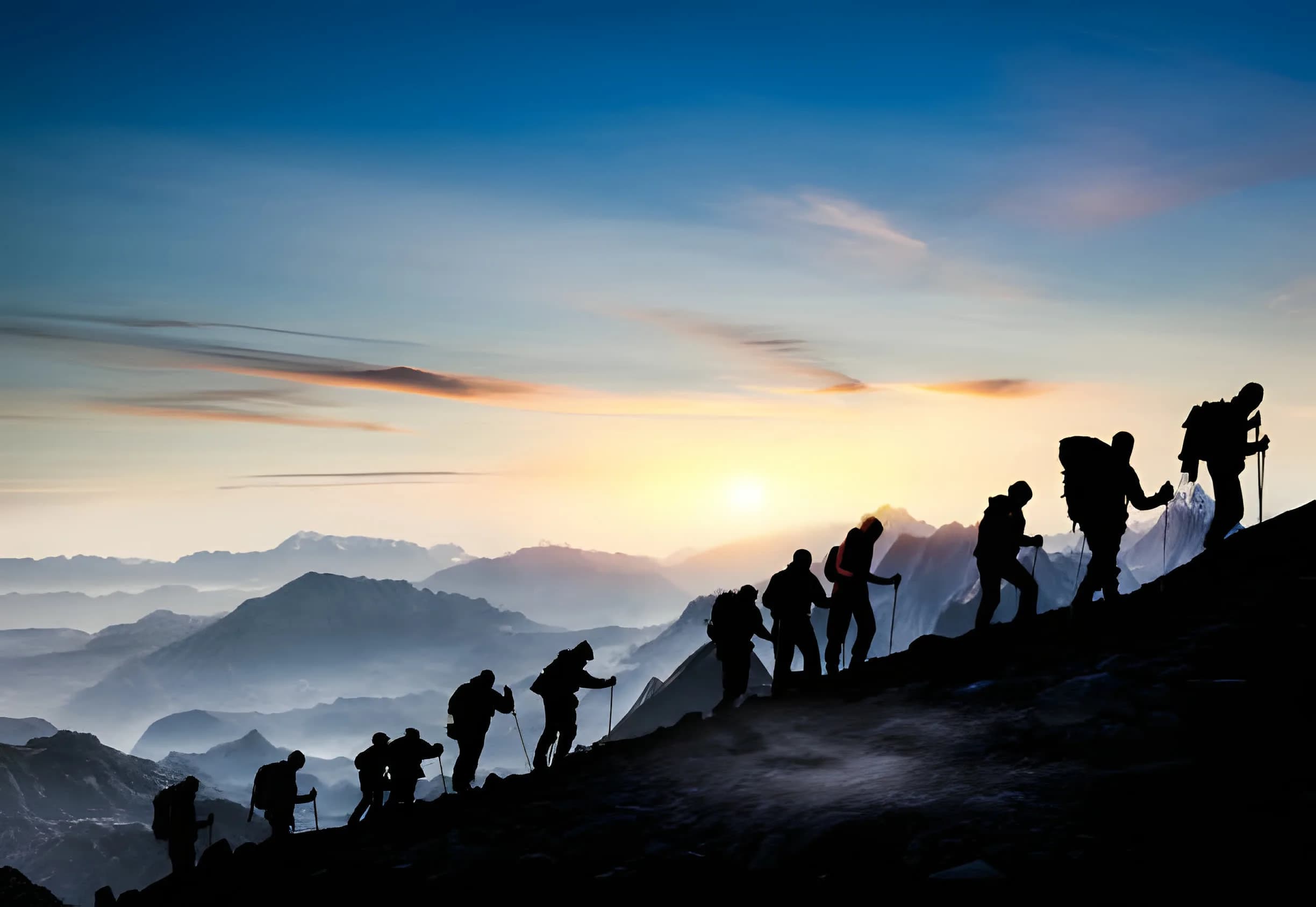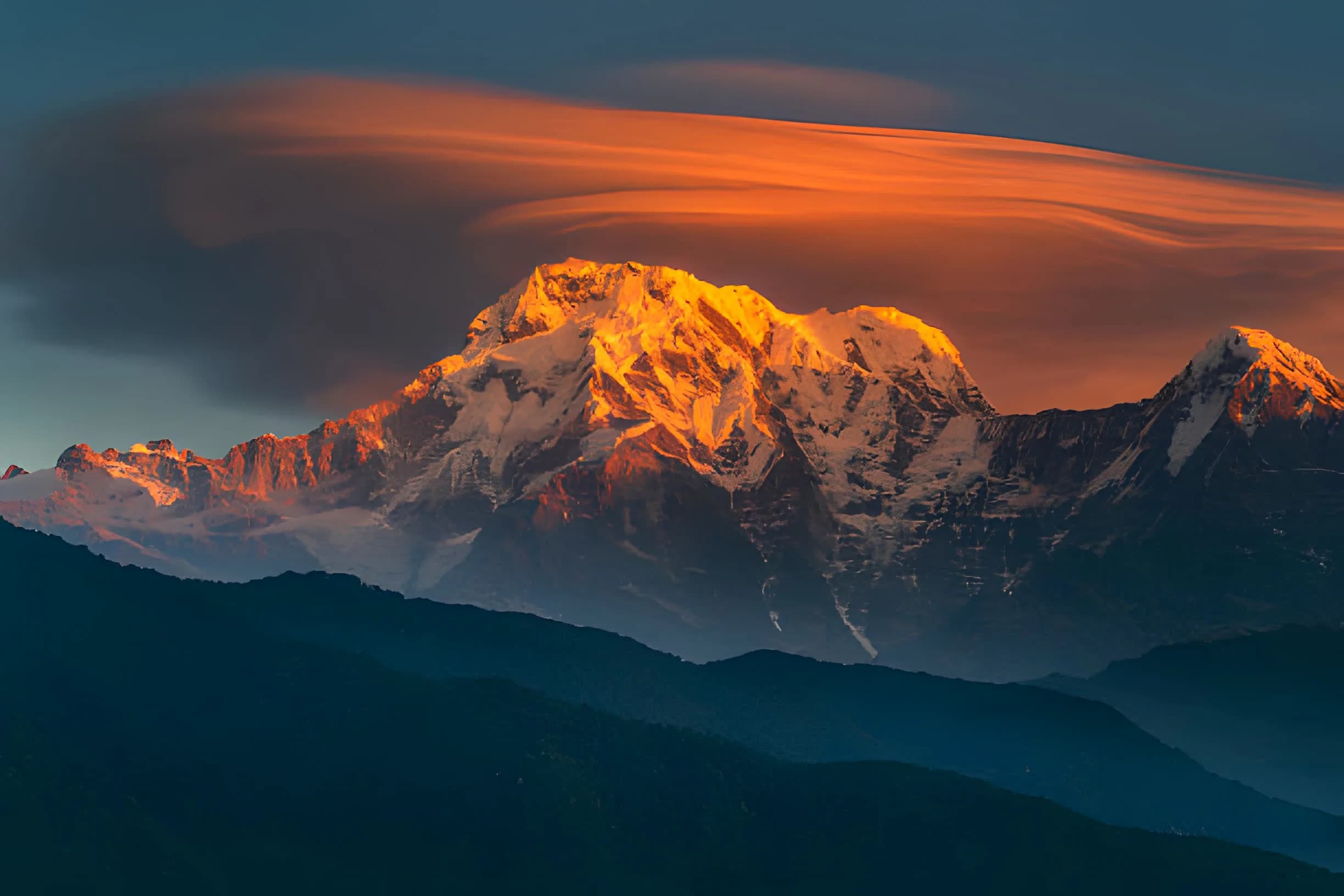
The ridge, then the Sanctuary.
The combined Mardi Himal and Annapurna Base Camp trek is the answer to a question we hear often: if you only have one trip in the Annapurna region, do you walk the quiet Mardi ridge or the famous Sanctuary? The honest answer, when you have ten days, is that you do not have to choose. The two routes sit on neighbouring valleys, so they link into a single continuous walk that climbs two separate high points without ever doubling back to Pokhara in the middle. You get the lonely ridge and the grand amphitheatre in one ten-day trip, with no arrival or rest buffer days padding out the itinerary.
We always run the Mardi side first, and there is a reason for the order. The ridge gives you the cleaner acclimatisation profile, a steady climb to High Camp at 3,580 metres and a dawn push to the Upper Viewpoint at 4,200 metres before you ever set foot on the Sanctuary trail. By the time you reach Annapurna Base Camp days later, your body has already done its high-altitude work. That is the quiet advantage of the combined trek over a fast standalone Annapurna Base Camp itinerary, where trekkers often hit 4,130 metres without the same build-up. If altitude is new to you, read our altitude sickness guide before you commit.
Between the two halves comes the reward. After the long descent off the Mardi ridge, the route drops to Jhinu Danda, where natural hot springs sit on the bank of the Modi Khola. You soak there once on the way into the Sanctuary, via Chhomrong and Sinuwa, and again on the way out, which makes Jhinu the hinge of the whole trek. Still deciding whether you even want both? See our honest ABC vs Mardi comparison, which weighs the two routes against each other. If ten days is more than you have, the standalone 5-day Mardi Himal trek covers the ridge alone.
The trek in numbers.
- Duration
- 10 days
- Grade
- Moderate – Strenuous
- First high point
- Mardi Upper Viewpoint 4,200 m
- Second high point
- Annapurna Base Camp 4,130 m
- Start / finish
- Pokhara
- Permits
- ACAP + TIMS (one set, both routes)
- Hot springs
- Jhinu Danda (twice)
- From
- USD 482 per person
Ten days, two base areas.
The route shape below is the standard staging from Pokhara: the Mardi ridge first, the hot springs at Jhinu in the middle, then the Annapurna Sanctuary, before the jeep back to Pokhara on the final day. There is no separate arrival or rest day; every day on this itinerary is on the trail. Exact overnight stops are tailored per group, since fitness, acclimatisation, and weather all shift the daily plan a little.
- Day 1
Pokhara → Kande → Pitam Deurali
- Drive
- 1.5 hrs (Pokhara to Kande)
- Trek
- 4 – 5 hrs
- Distance
- ~10 km
- Altitude
- Kande 1,770 m → Pitam Deurali 2,100 m
- Net change
- +330 m
We drive to the Kande trailhead and start straight up the stone steps to Australian Camp, where the first wide view of Annapurna South and Hiunchuli opens up. From there the trail runs on through Pothana, where the ACAP permit is checked, to Pitam Deurali at 2,100 m, the junction where the Mardi route leaves the busier Annapurna Base Camp path and turns onto its own quiet ridge.
It is a short first day on purpose, giving your body an easy introduction to the climb before the longer days ahead. We overnight in a simple teahouse at the junction.
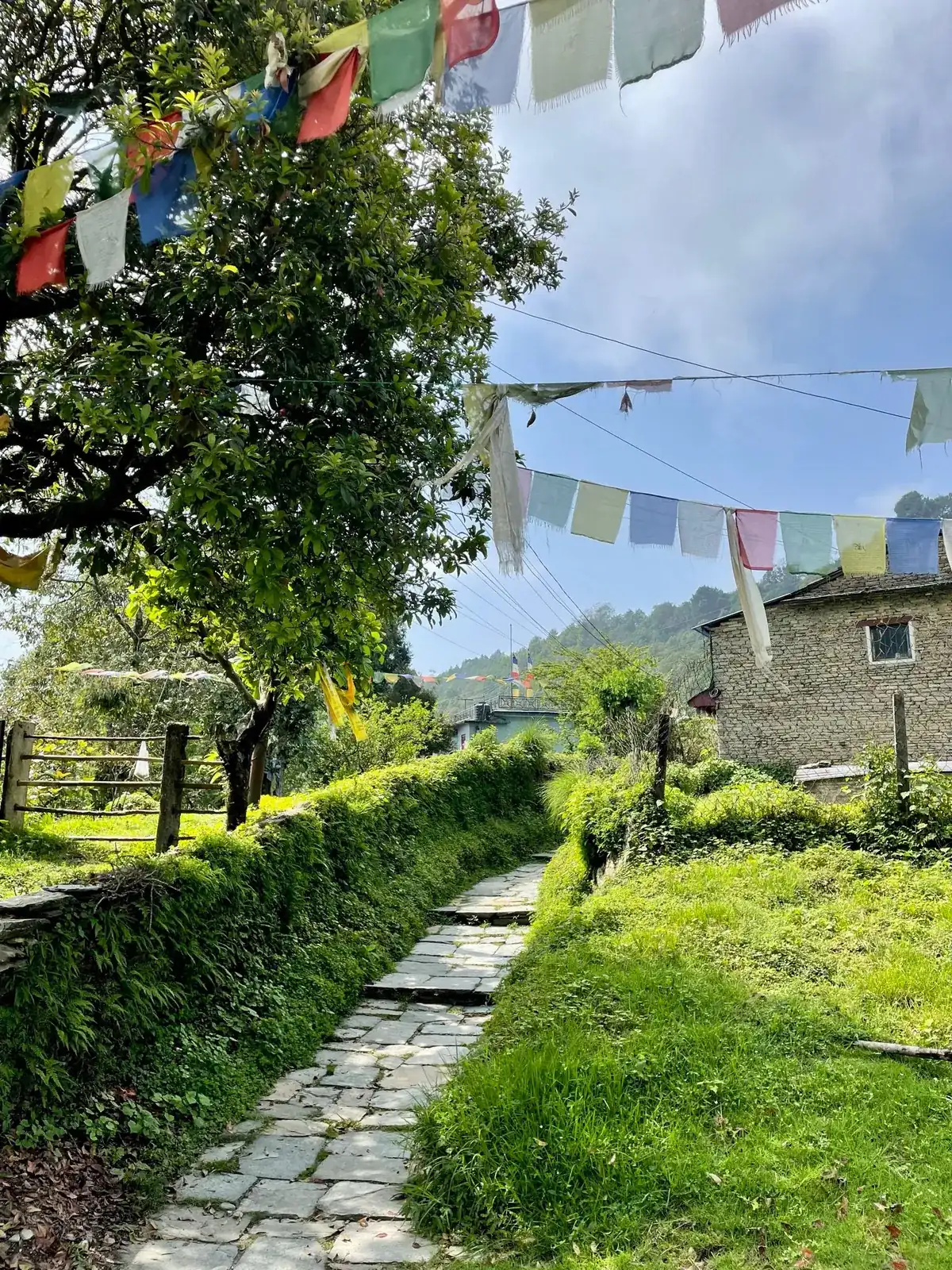
Kande 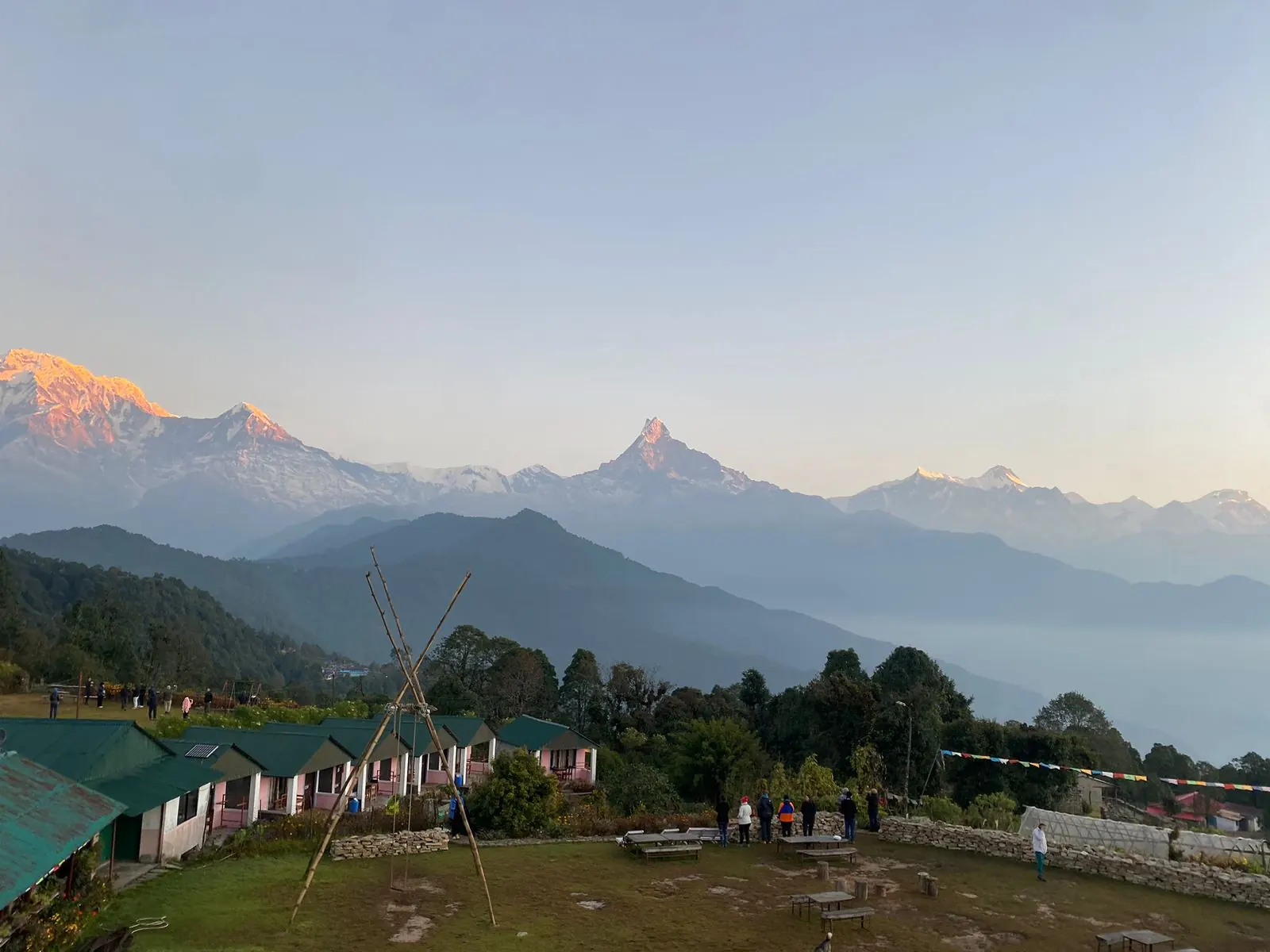
Australian Camp 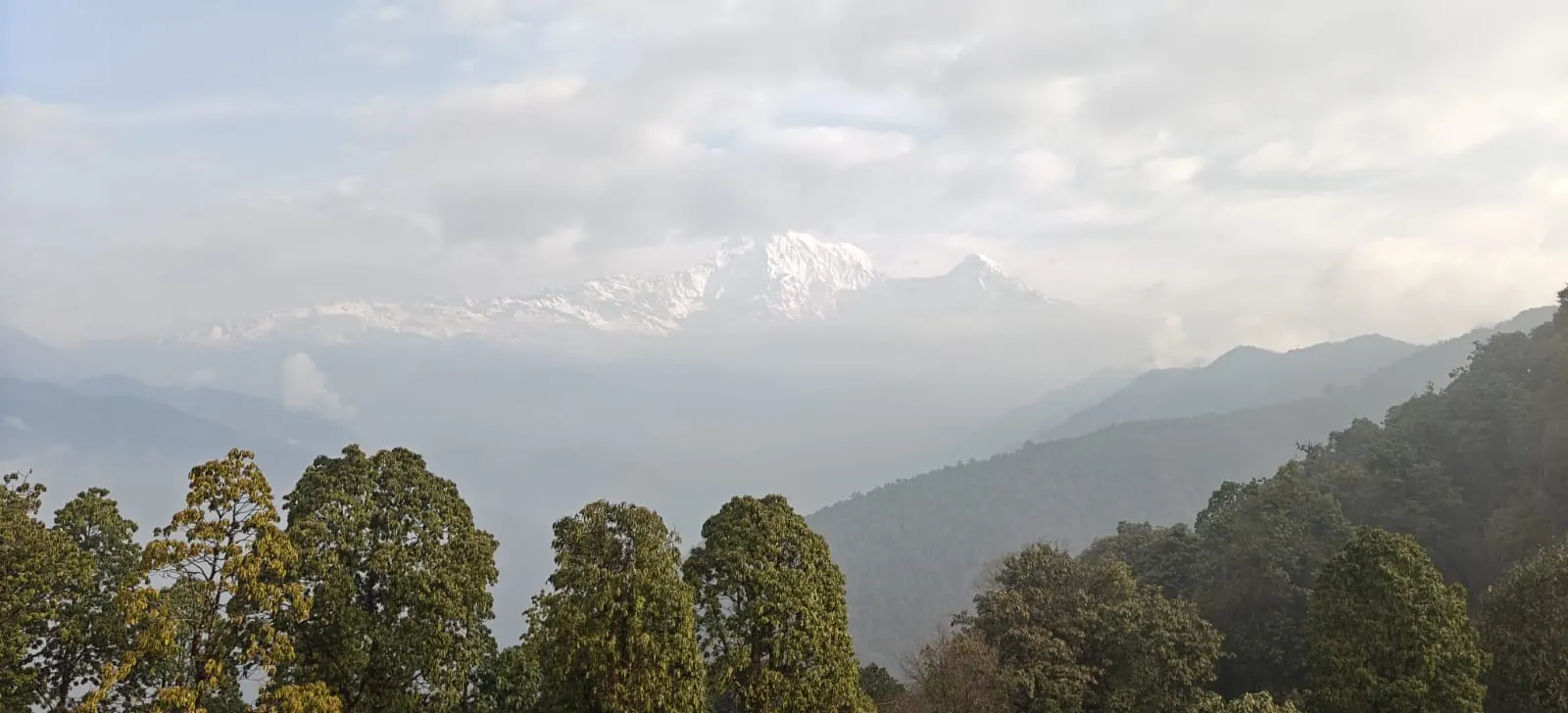
Pitam Deurali 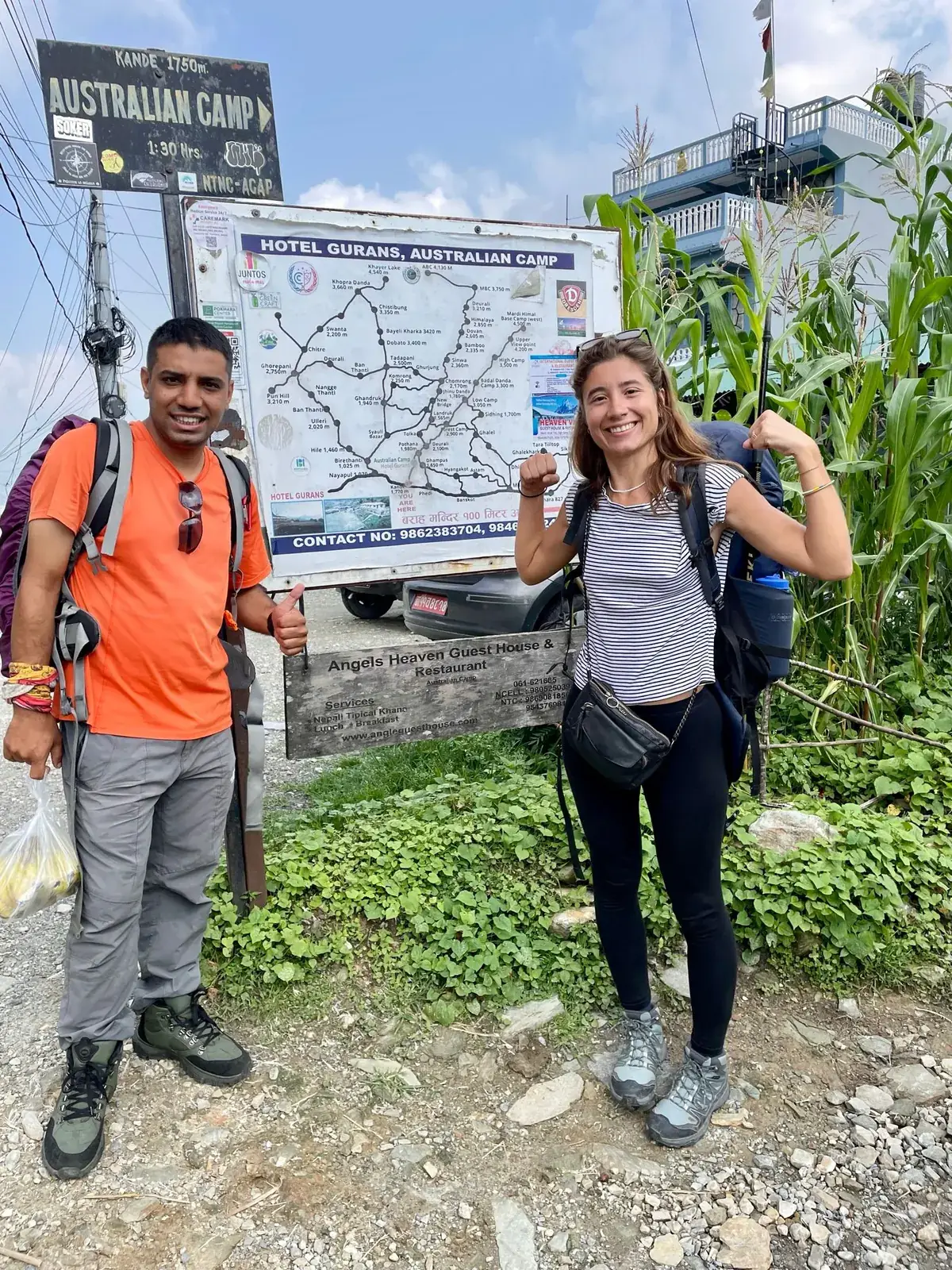
Kande 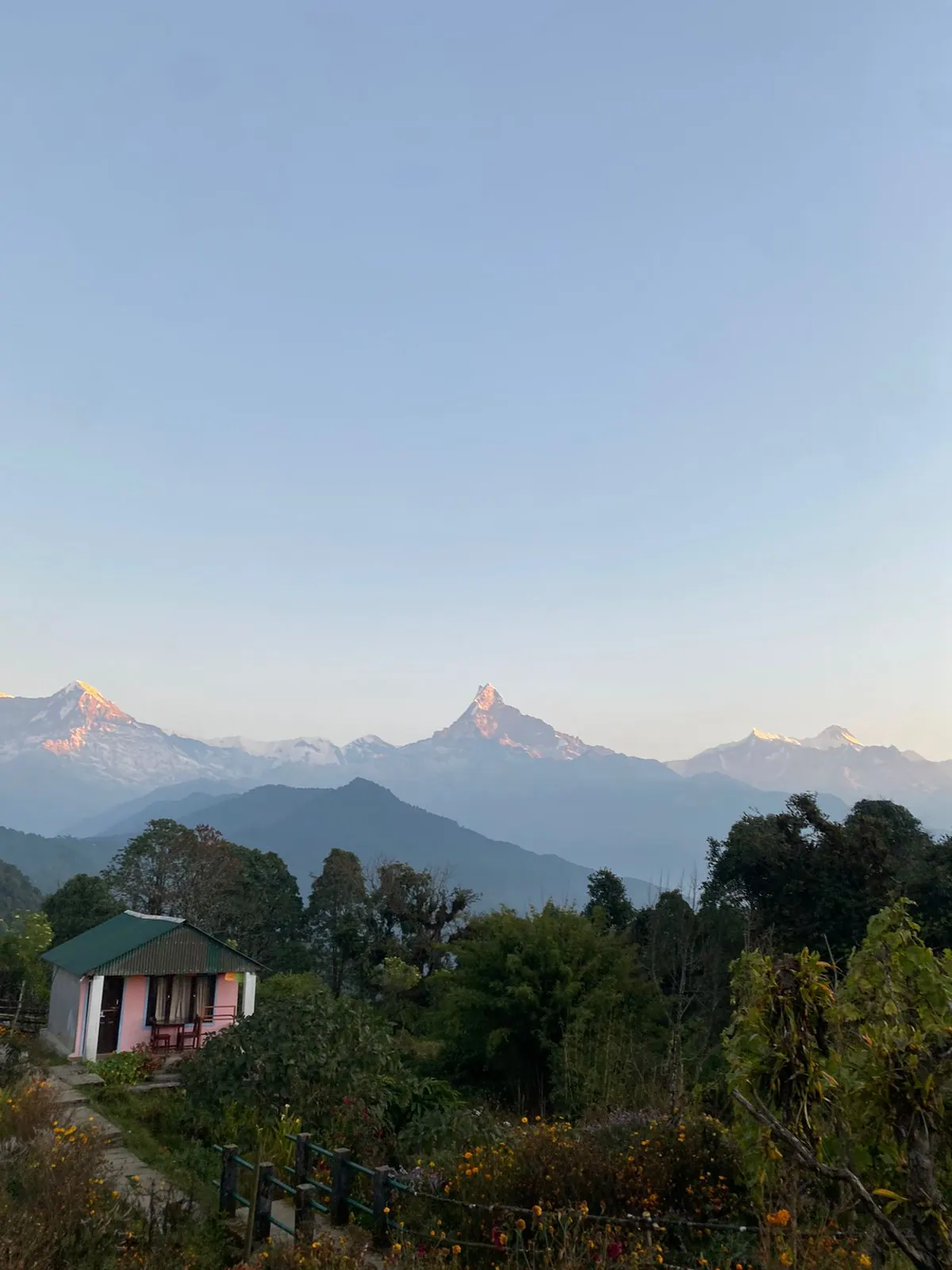
Australian Camp 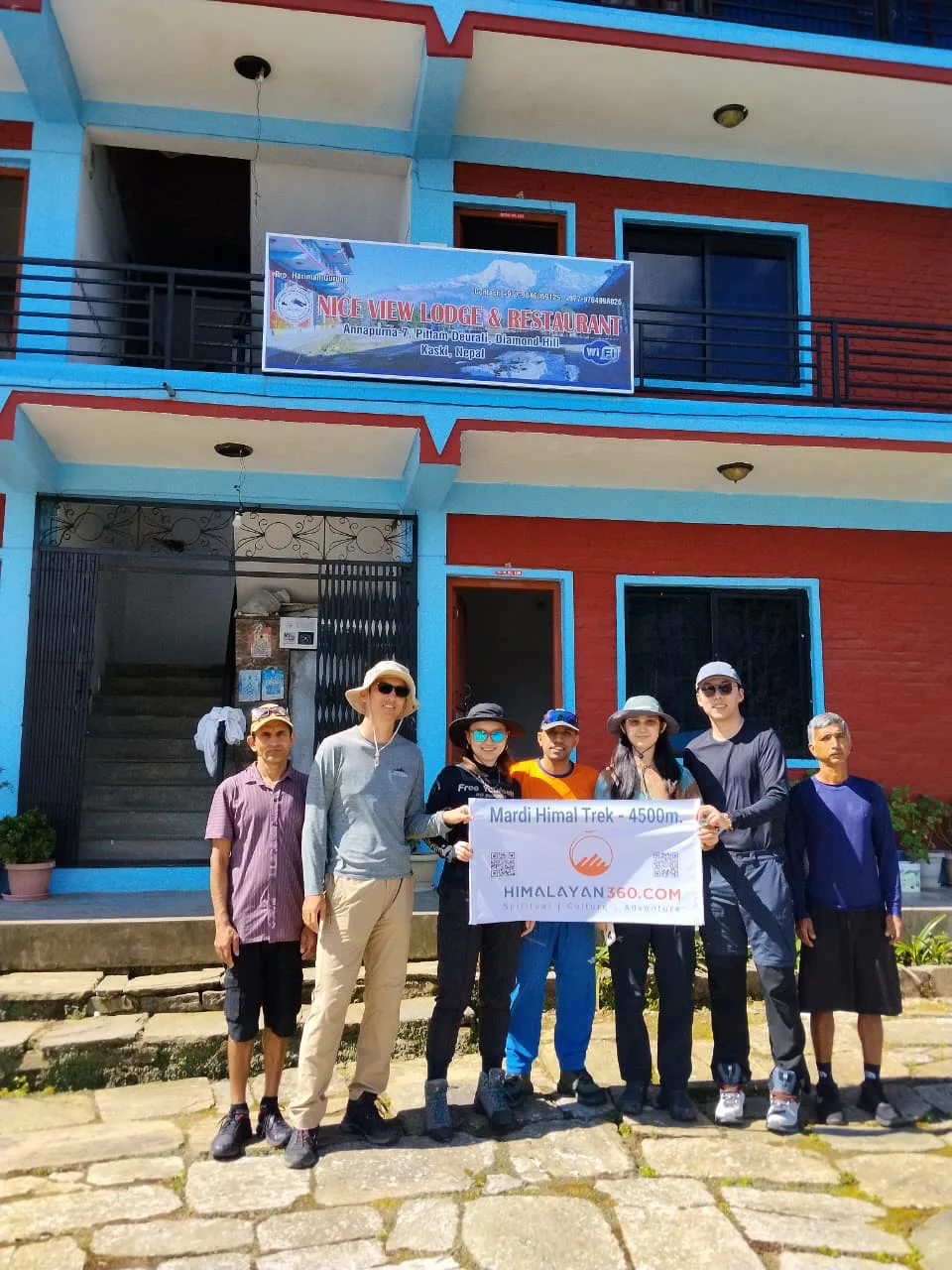
Pitam Deurali 6 photos from day 1, taken on the trail. - Day 2
Pitam Deurali → Forest Camp → Rest Camp
- Drive
- None
- Trek
- 5 – 6 hrs
- Distance
- ~9 km
- Altitude
- Pitam Deurali 2,100 m → Forest Camp 2,550 m → Rest Camp ~2,600 m
- Net change
- +500 m
The trail leaves the main junction and climbs through cloud forest of oak, maple, and rhododendron to Forest Camp at 2,550 m. Langur troops are common in the canopy on this stretch, and the ridge starts to narrow noticeably above the tree line ahead.
A further climb through thinning forest brings us to Rest Camp at roughly 2,600 m for the night, a cluster of eight or more teahouses that marks the start of the open ridge country.
Pitam Deurali 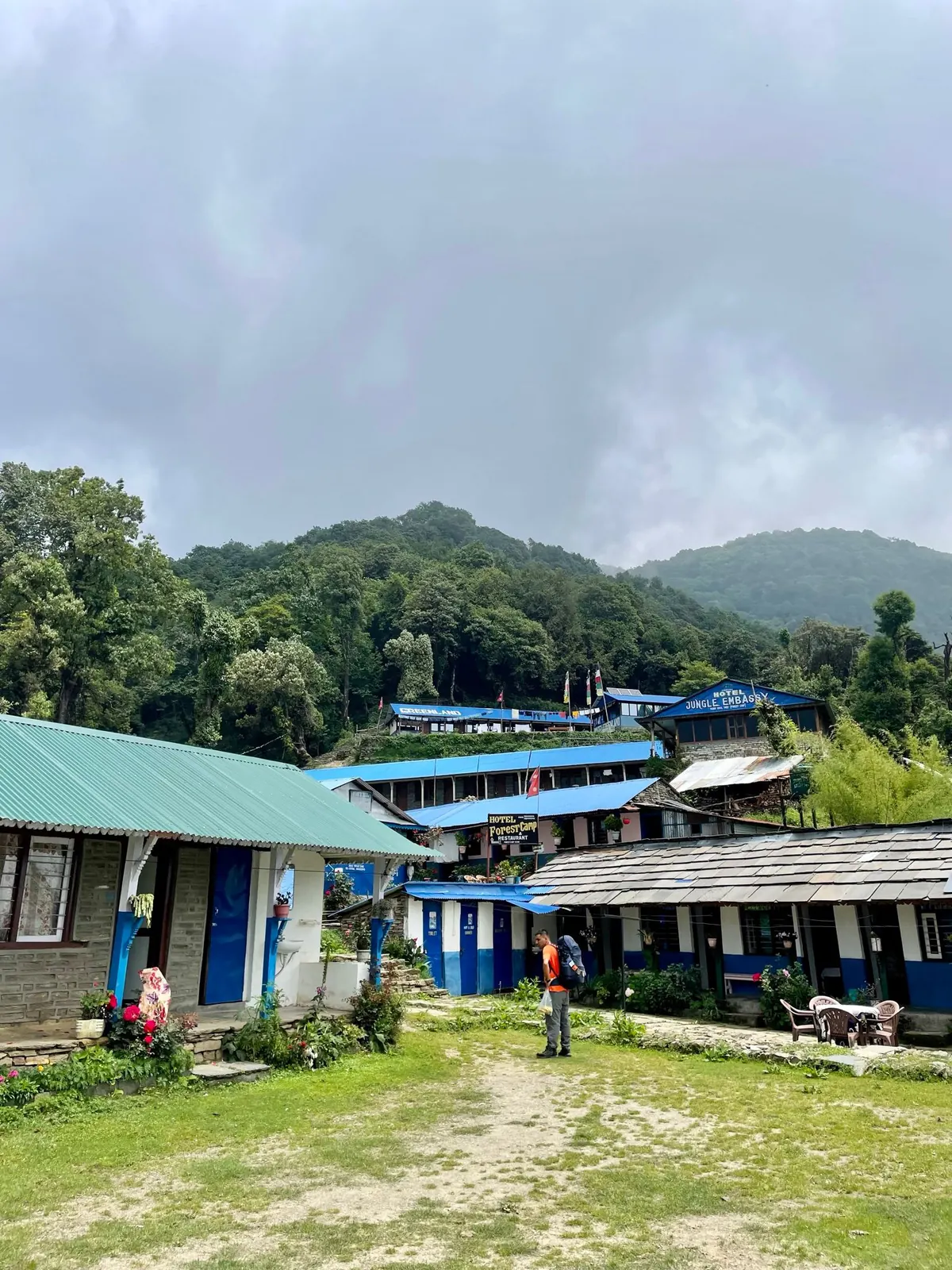
Forest Camp Pitam Deurali 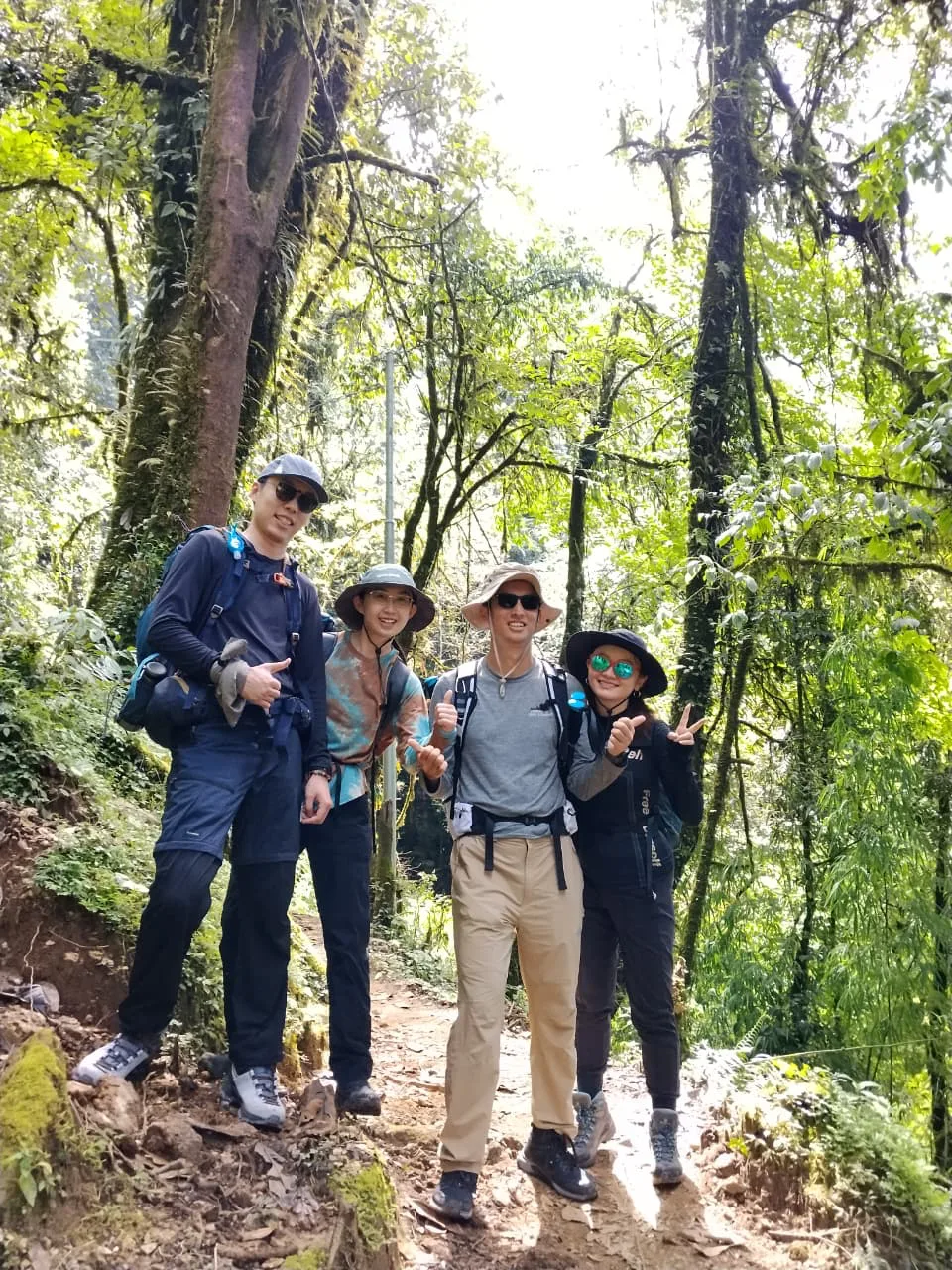
Trail to Forest Camp 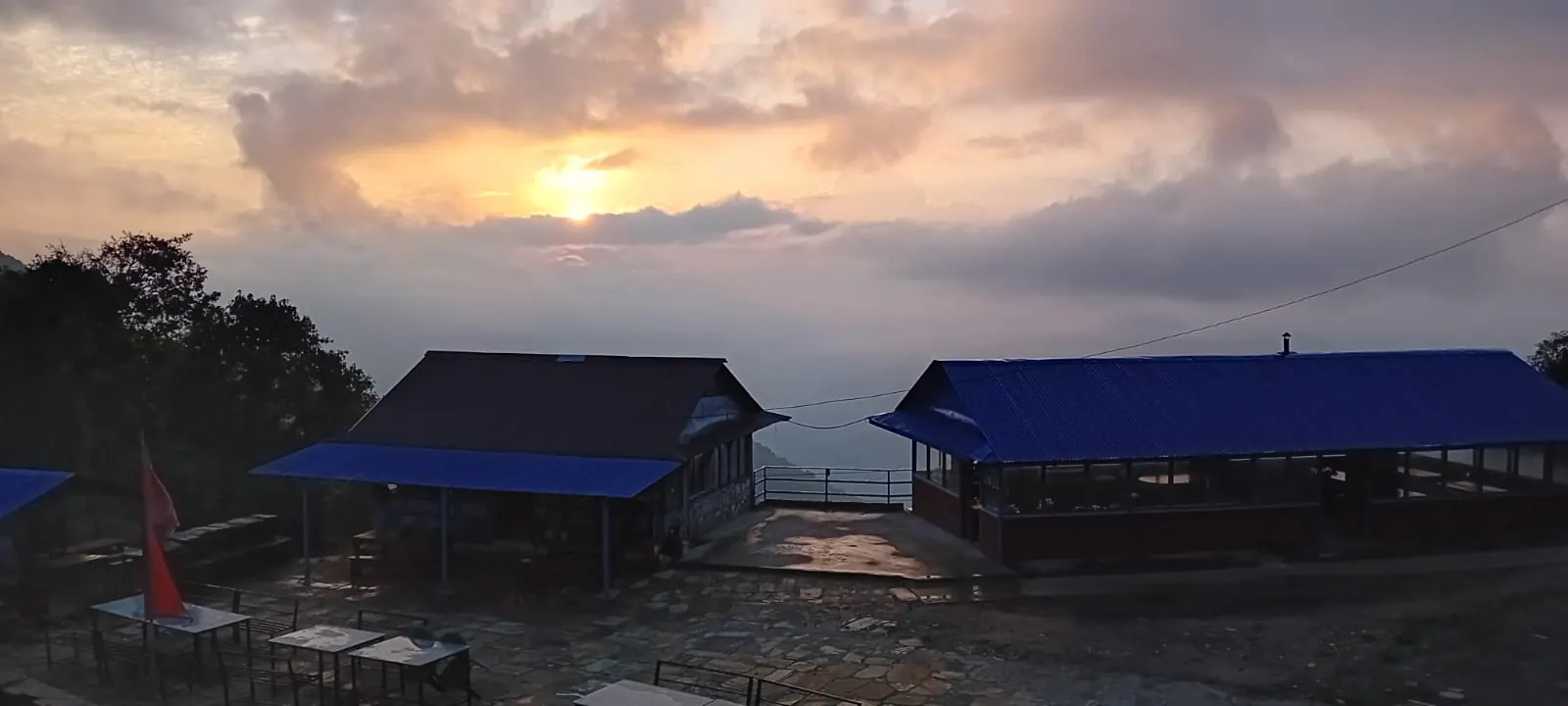
Pitam Deurali 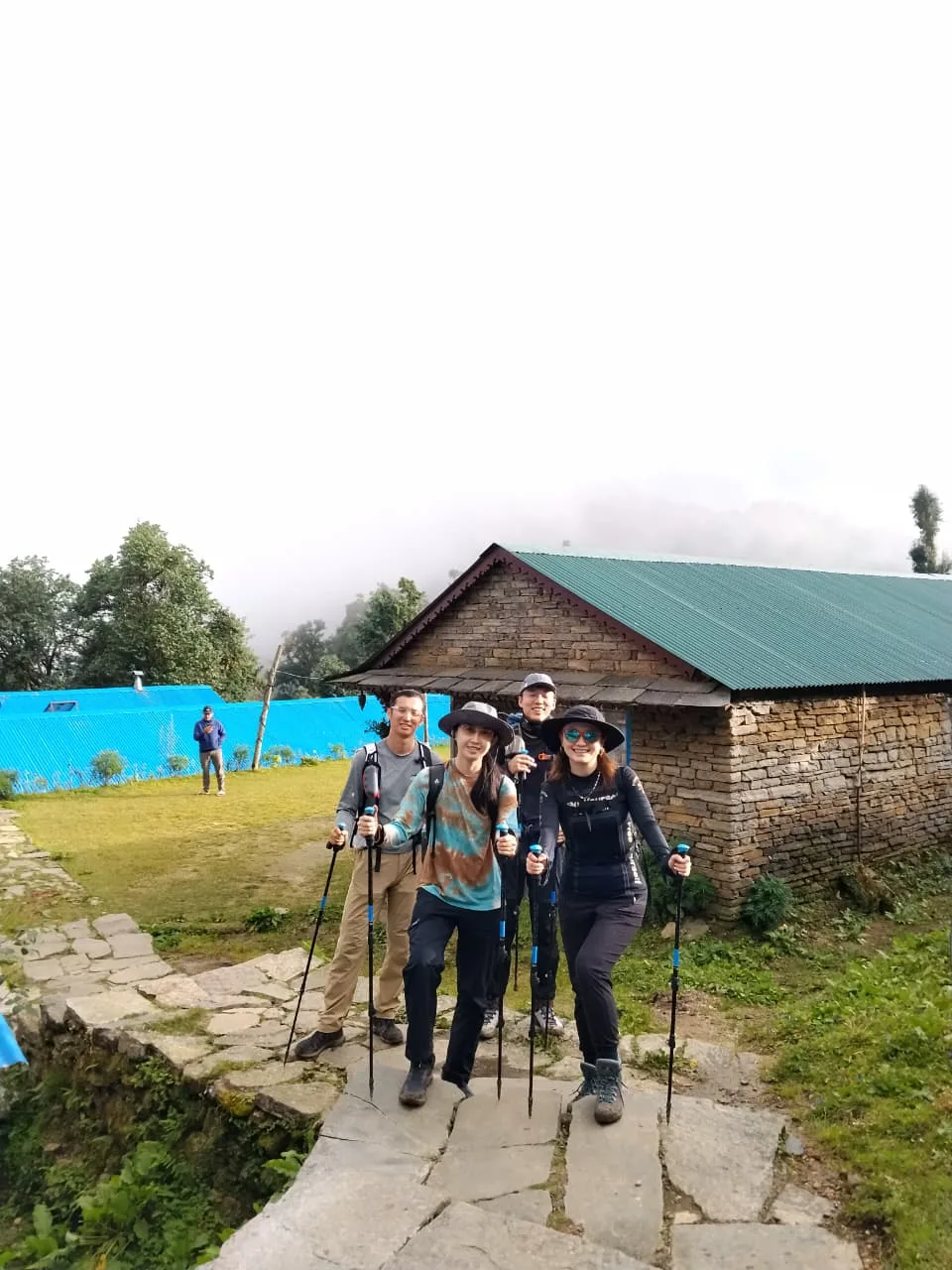
Trail to Forest Camp 6 photos from day 2, taken on the trail. - Day 3
Rest Camp → Low Camp → High Camp
- Drive
- None
- Trek
- 5 – 6 hrs
- Distance
- ~8 km
- Altitude
- Rest Camp 2,600 m → Low Camp 2,985 m → Badal Danda 3,210 m → High Camp 3,580 m
- Net change
- +980 m
The first big altitude day. The trail climbs steadily to Low Camp at 2,985 m, where the trees thin and the full Annapurna massif comes into view. We stop here for a pulse-oximetry check before continuing.
Above Low Camp the route breaks fully onto the open ridge, crosses Badal Danda at 3,210 m, and climbs to High Camp at 3,580 m. Machhapuchhre stands directly ahead across the valley, and the sunset from the dining hall is one of the moments most trekkers remember from the whole trip. Pace above Low Camp is deliberately slow, and anyone showing early symptoms is held lower for the night.
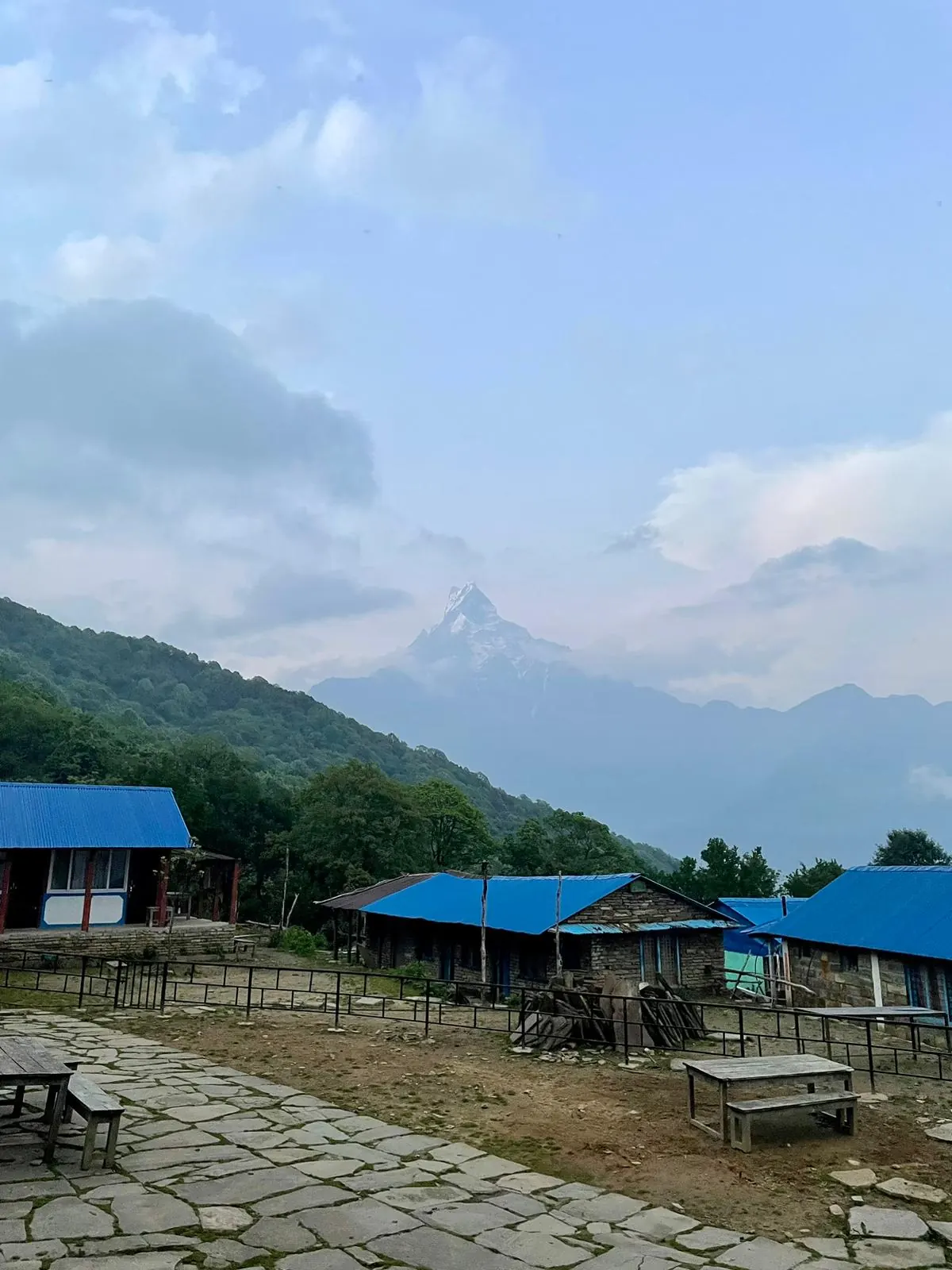
Low Camp 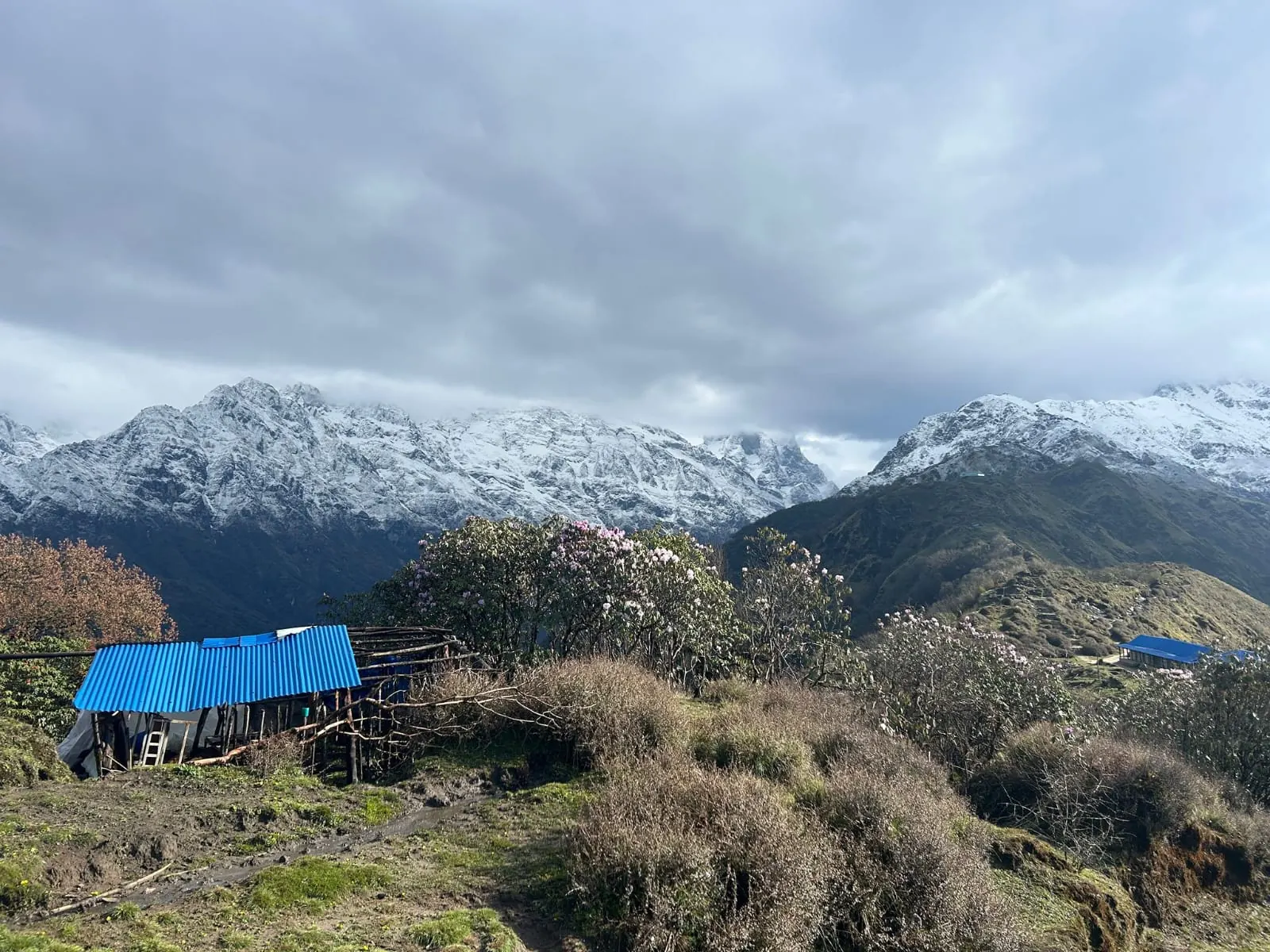
High Camp & Badal Danda 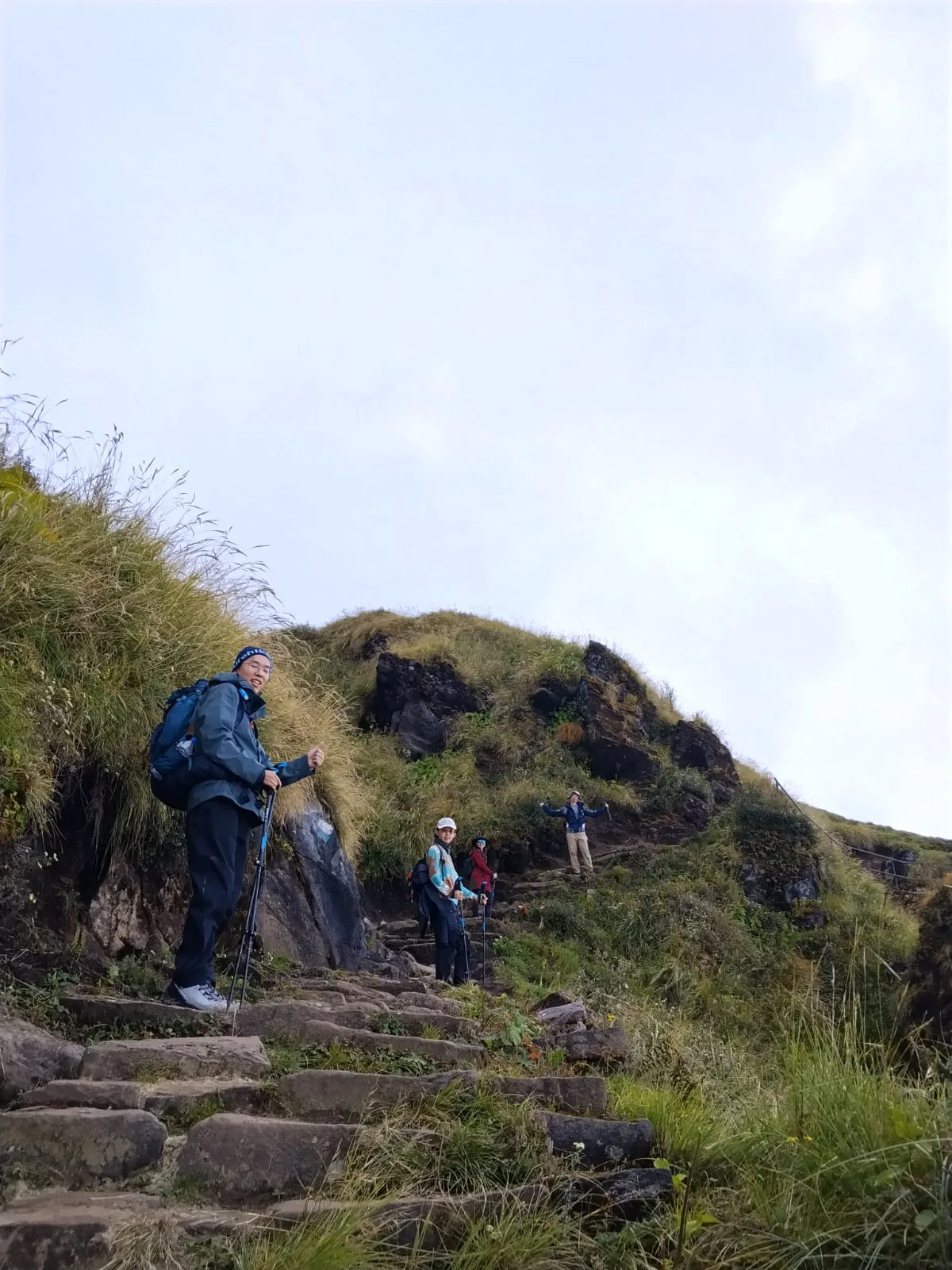
Trail to High Camp 
Low Camp 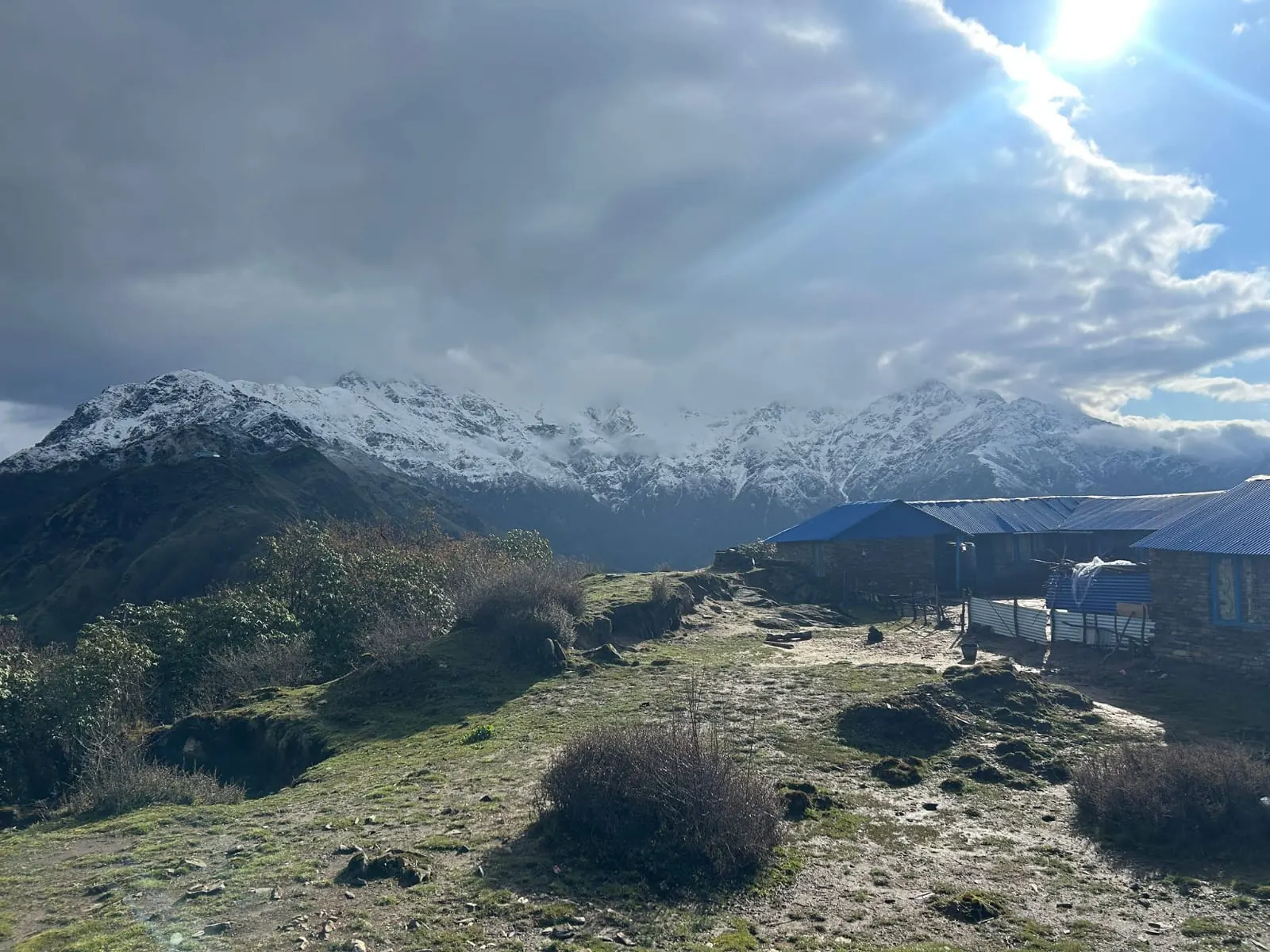
High Camp & Badal Danda 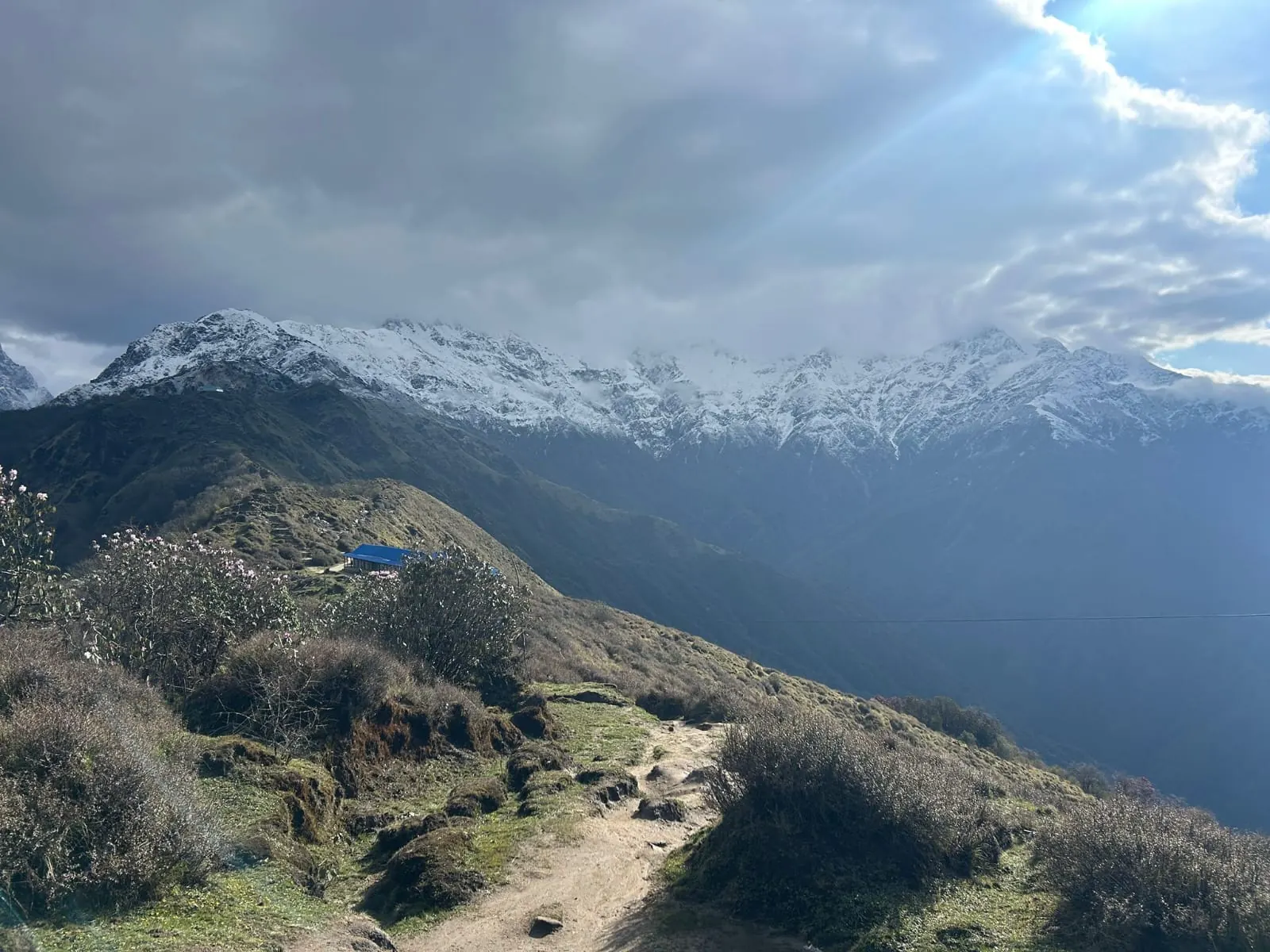
High Camp & Badal Danda 6 photos from day 3, taken on the trail. - Day 4
High Camp → Upper Viewpoint 4,200 m → Forest Camp
- Drive
- None
- Trek
- 6 – 7 hrs
- Distance
- ~13 km
- Altitude
- High Camp 3,580 m → Upper Viewpoint 4,200 m → Forest Camp 2,550 m
- Net change
- +620 m / -1,650 m
The Mardi summit morning. We leave High Camp around 04:30 with headtorches for the pre-dawn ridge climb to the Upper Viewpoint at 4,200 m. On a clear morning the sun lifts over the eastern peaks while Dhaulagiri sits far to the west and the Annapurna wall fills the sky in front of you. This is the first of the trek's two high points. Mardi Himal Base Camp at 4,500 m is about 1 hour 30 minutes further along the ridge. If you want to go on, ask your guide, and expect a longer day.
Back at High Camp for a proper breakfast, then the long descent begins, retracing yesterday's route down through Badal Danda and Low Camp to Forest Camp for the night. Trekking poles matter on this stretch; the descent is steep and the knees feel it.
High Camp & Badal Danda 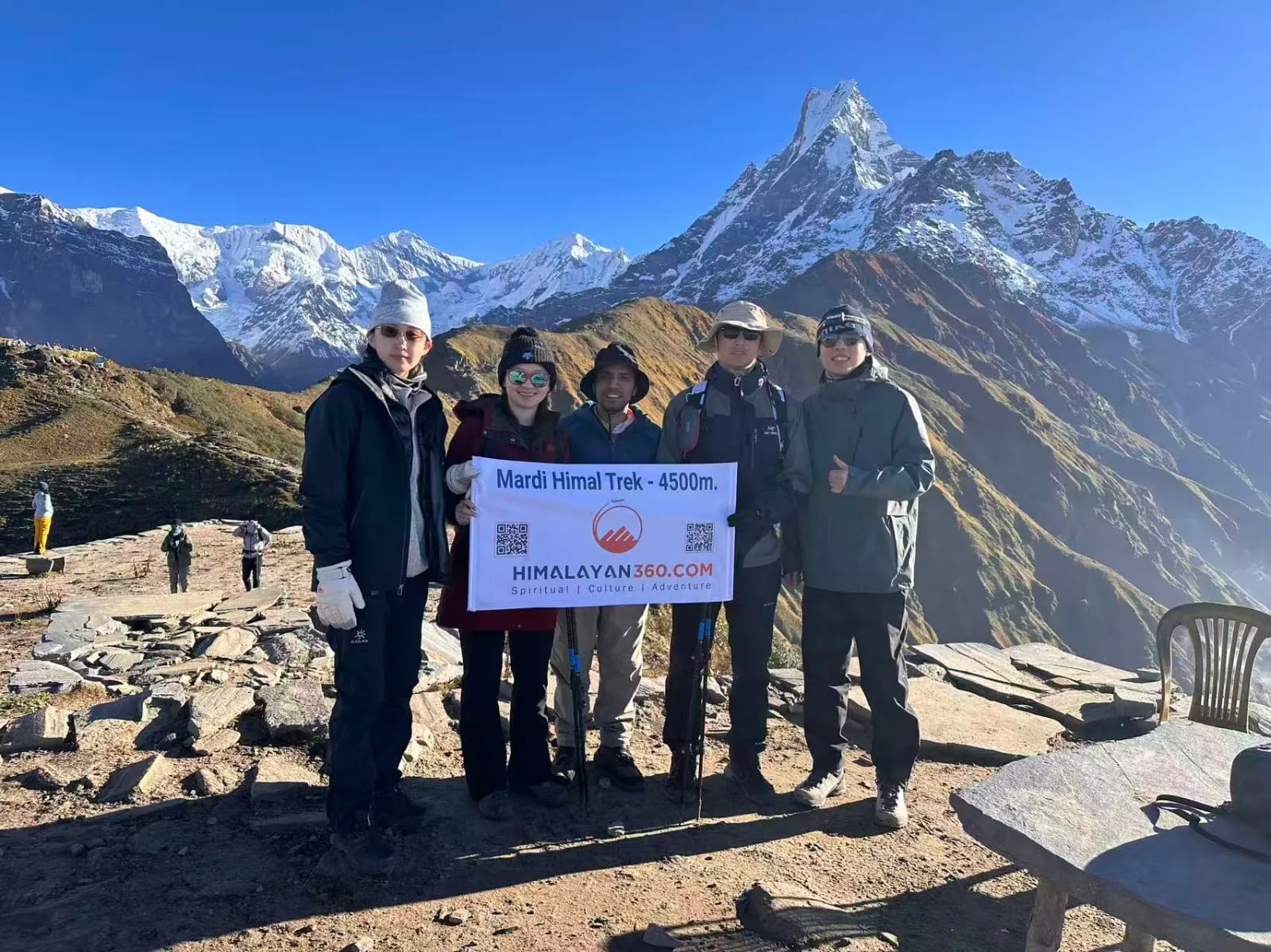
Upper Viewpoint High Camp & Badal Danda 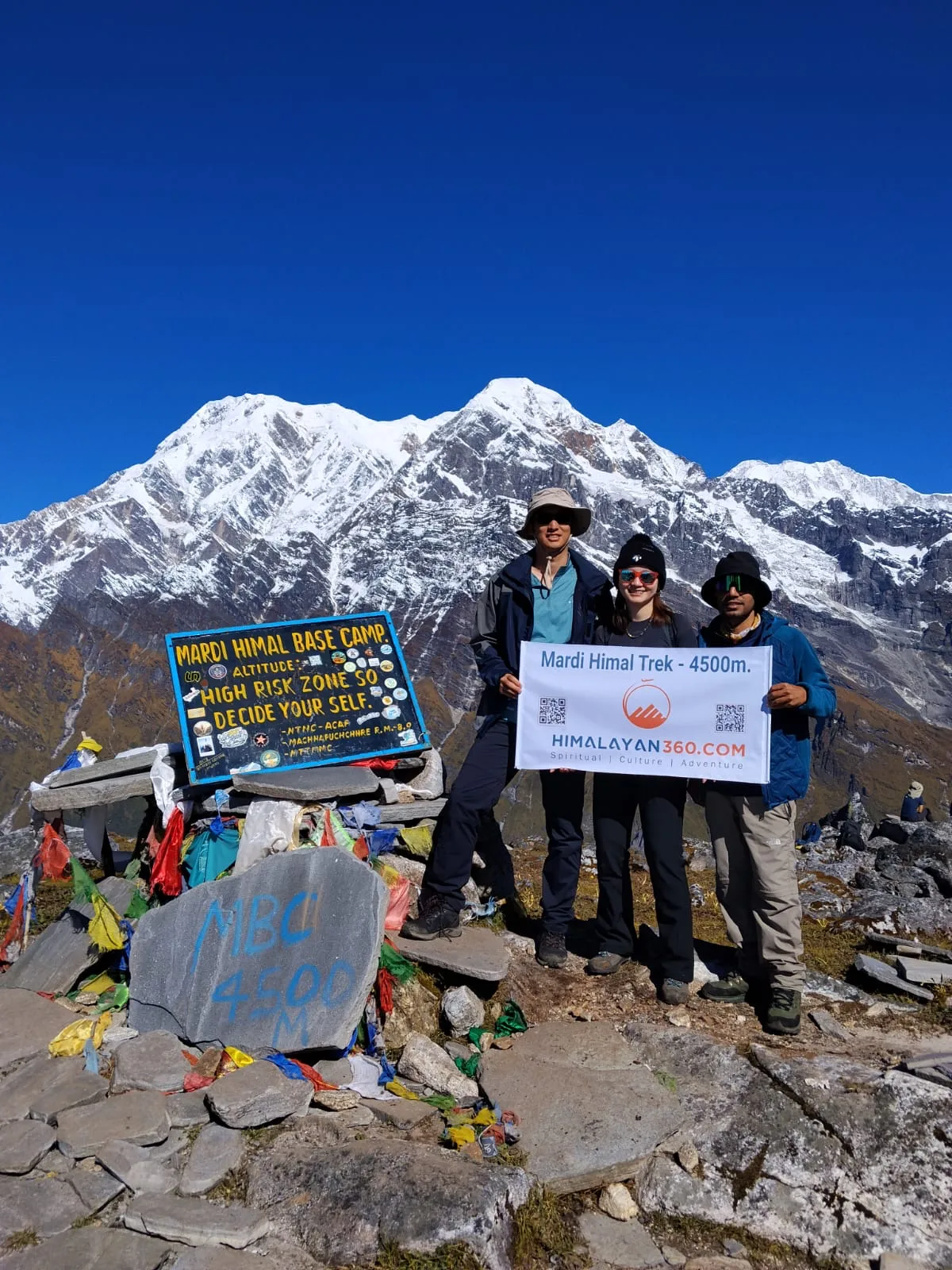
Mardi Himal Base Camp High Camp & Badal Danda 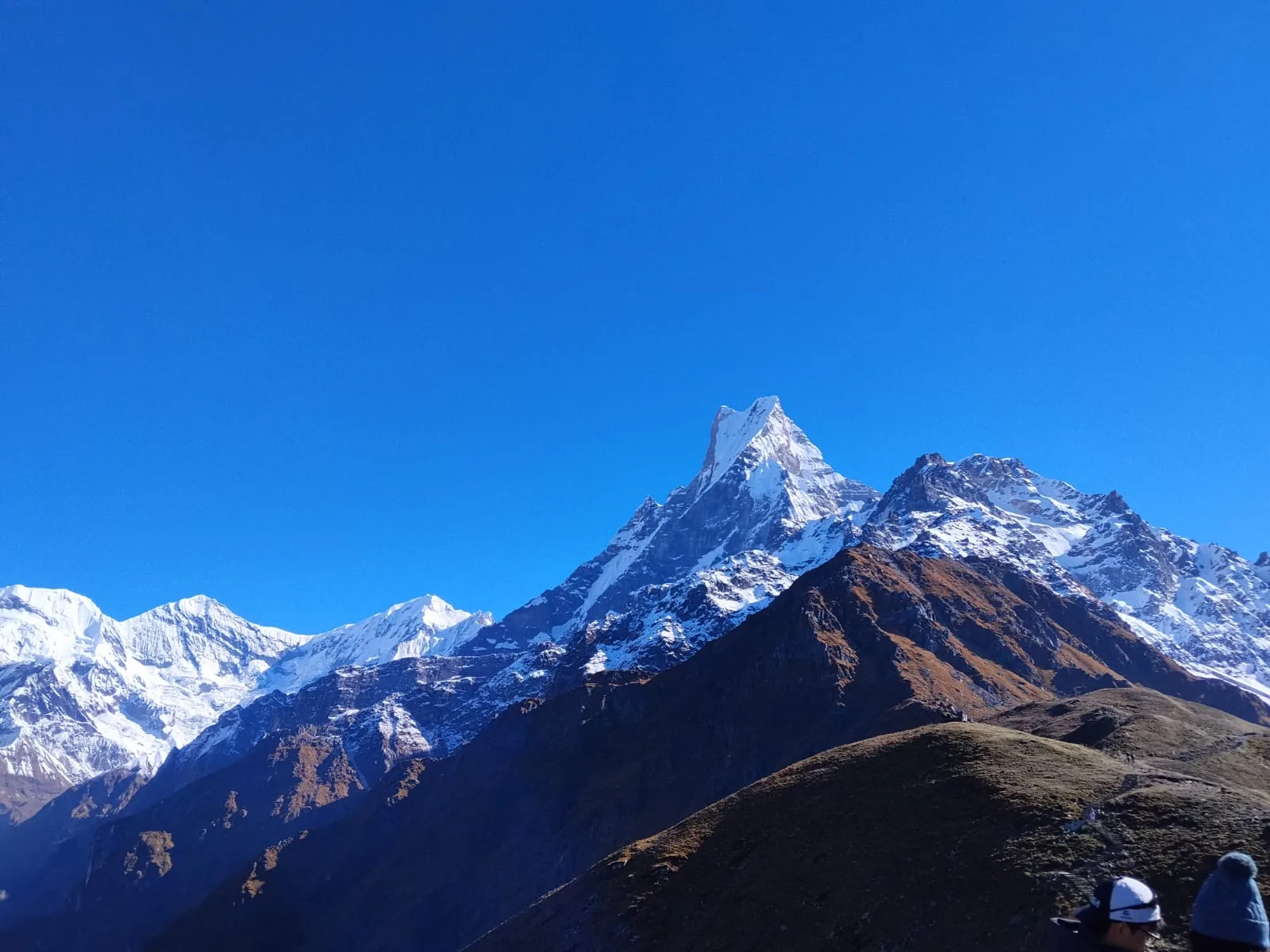
Trail to the Viewpoint 6 photos from day 4, taken on the trail. - Day 5
Forest Camp → Jhinu Danda (hot springs)
- Drive
- None
- Trek
- 6 – 7 hrs
- Distance
- ~15 km
- Altitude
- Forest Camp 2,550 m → Jhinu Danda 1,780 m
- Net change
- -770 m
The transition day. The trail drops off the Mardi ridge through forest and lower farmland, threading down past the villages that link the ridge to the Annapurna Sanctuary road, before reaching Jhinu Danda on the bank of the Modi Khola. This is where the second half of the trek properly begins.
Jhinu is the mid-trek reward. A short walk below the village brings you to natural hot springs, and a long soak after four days of climbing and descending is exactly what tired legs need before the push into the Sanctuary.
- Day 6
Jhinu Danda → Chhomrong → Sinuwa
- Drive
- None
- Trek
- 4 – 5 hrs
- Distance
- ~8 km
- Altitude
- Jhinu Danda 1,780 m → Chhomrong 2,170 m → Sinuwa 2,360 m
- Net change
- +580 m
A day of stone staircases. The climb up to Chhomrong at 2,170 m is the gateway village to the inner Sanctuary, with a long descent of steps on the far side down to the Chhomrong Khola, then back up to Sinuwa.
Sinuwa sits at the edge of the bamboo and rhododendron forest that leads into the gorge proper. The valley starts to narrow from here, and the sense of walking into an amphitheatre of peaks begins to build.
- Day 7
Sinuwa → Bamboo → Dovan → Deurali
- Drive
- None
- Trek
- 5 – 6 hrs
- Distance
- ~12 km
- Altitude
- Sinuwa 2,360 m → Bamboo 2,310 m → Dovan → Deurali 3,200 m
- Net change
- +840 m
The trail dips briefly to Bamboo at 2,310 m, then climbs steadily deeper into the gorge, following the Modi Khola through Dovan and on to Deurali at 3,200 m. The forest gives way to low scrub and the air starts to feel thinner.
Deurali (the ABC-side Deurali, distinct from Pitam Deurali on Day 1) is the last stop before the high base camps. We keep the day's finish deliberately early so you arrive with energy in reserve and stay acclimatised for the final climb. Another pulse-oximetry check happens here.
- Day 8
Deurali → Machhapuchhre Base Camp → Annapurna Base Camp 4,130 m
- Drive
- None
- Trek
- 5 – 6 hrs
- Distance
- ~9 km
- Altitude
- Deurali 3,200 m → Machhapuchhre Base Camp 3,700 m → Annapurna Base Camp 4,130 m
- Net change
- +930 m
The Sanctuary day. The trail climbs to Machhapuchhre Base Camp at 3,700 m, where the valley suddenly opens and you stand surrounded by Hiunchuli, Annapurna South, and the sheer fluted face of Machhapuchhre. We pause here before the final hour and a half up to Annapurna Base Camp.
Annapurna Base Camp sits at 4,130 m on the floor of a glacial amphitheatre ringed by peaks, with Annapurna I towering above. This is the trek's second high point and its emotional climax. We time the arrival for the afternoon, then aim to be up for both sunset and sunrise on the Annapurna wall.
- Day 9
ABC → Machhapuchhre Base Camp → Bamboo
- Drive
- None
- Trek
- 6 – 7 hrs
- Distance
- ~16 km
- Altitude
- ABC 4,130 m → Machhapuchhre Base Camp 3,700 m → Deurali 3,200 m → Bamboo 2,310 m
- Net change
- -1,820 m
Sunrise on the Annapurna wall, then the long descent. We retrace the inner Sanctuary route past Machhapuchhre Base Camp and Deurali, losing altitude fast and steadily back to Bamboo for the night.
Descending is easier on the lungs but harder on the knees. Poles and an unhurried pace keep the day comfortable, and the forest is a welcome change after the open glacier basin.
- Day 10
Bamboo → Jhinu Danda → drive to Pokhara
- Drive
- 2.5 to 3 hrs (Jhinu to Pokhara)
- Trek
- 4 – 5 hrs
- Distance
- ~10 km walking
- Altitude
- Bamboo 2,310 m → Chhomrong 2,170 m → Jhinu Danda 1,780 m → Pokhara 820 m
- Net change
- -530 m, then by road
Back over the Chhomrong staircase, then down to Jhinu Danda for a second soak at the hot springs, a fitting close to ten days of climbing and descending. From Jhinu a local jeep takes over for the road back to Pokhara at 820 m.
We reach the lakeside by mid to late afternoon. Hot shower, a real bed, and an evening free by Phewa Lake. After ten days on the trail the contrast is the whole point.
Ten days well spent, or one route at a time?
The combined trek is the richest option we run in the Annapurna region, but it is also the longest. Here is an honest read on who it suits and who is better off with a single route.
- You have a clear ten days in Nepal and want to fill them.
- You want both the quiet ridge and the grand Sanctuary.
- You are reasonably fit and used to back-to-back long days.
- You like the idea of acclimatising on Mardi before ABC.
- You have under a week and want a relaxed pace.
- This is your first Himalayan trek and you want to test it.
- You prefer one clear objective over a longer commitment.
- You are still weighing the two routes against each other.
Still deciding between them? See our full ABC vs Mardi comparison for the duration, altitude, difficulty, and cost trade-offs, or read about the Sanctuary itself on our base camp guide.
2026 price, per person, by group size.
All prices are per person in USD for the 10-day combined Mardi and Annapurna Base Camp trek departing from Pokhara, valid through 31 December 2026. A solo private trekker pays USD 806; groups of 11 to 20 pay from USD 482 per person. The bigger your group, the lower the per-person rate. Children under 12 receive 30% off.
Want it private, just your party with your own guide? Add 5% per person. Going private on your own, you pay the 1-person rate.
For the full fee breakdown, ACAP and TIMS permit costs, and optional add-ons such as a porter or domestic flight, see our permits and cost page. Fixed group departures with shared rates are listed on fixed departures.
Secure card payment. The balance is paid in Kathmandu before the trek. See the booking policy.
- ACAP entry permit and TIMS card (covers both routes)
- Licensed English-speaking local guide for all 10 days
- Pokhara to Kande private jeep transfer
- Jhinu to Pokhara local jeep transfer
- 9 nights teahouse accommodation across the full route
- 9 breakfast, 10 lunch, and 9 dinner, each with a cup of tea
- Trip success certificate
- Comprehensive first aid kit
- International flights to Kathmandu or Pokhara
- Pokhara hotel (Lakeside, USD 35 to 80 per night)
- Lunch and dinner in Pokhara on rest days
- Personal trekking gear and clothing
- Travel insurance (mandatory, must cover heli evacuation to 4,500 m)
- Tips for the guide (10% to 30% of package price)
Not sure what to pack for ten days that touch 4,200 metres? Our packing list covers layering, footwear, and the kit that matters at High Camp and Annapurna Base Camp alike.
Before you book.
- Can you combine Mardi Himal and Annapurna Base Camp in one trek?
- Yes, and it is one of the most rewarding ways to walk the Annapurna region. The two routes sit on adjacent valleys, so you climb the Mardi ridge first, descend to the hot springs at Jhinu Danda, then feed straight into the Annapurna Sanctuary trail via Chhomrong and Sinuwa. One continuous walk links two separate high points, the Mardi Upper Viewpoint at 4,200 m and Annapurna Base Camp at 4,130 m, without backtracking to Pokhara in between.
- How many days does the combined Mardi and ABC trek take?
- We run it as a 10-day trip from Pokhara, starting with the drive to Kande on Day 1 and ending with the drive back from Jhinu Danda on Day 10. There is no separate arrival day, no Pokhara rest day, and no Kathmandu transfer built in: every day is on the route. That covers the full climb of the Mardi ridge to the Upper Viewpoint at 4,200 m, the transition through Jhinu Danda, and the climb into the Annapurna Sanctuary to Base Camp at 4,130 m before the return descent. Ten days is a genuine commitment, which is the honest trade-off for seeing both the ridge and the Sanctuary in a single trip.
- What does the Mardi and ABC combined trek cost?
- The combined trek starts from USD 482 per person for a group of 11 to 20, and USD 516 for a group of 6 to 10. Smaller groups pay more: USD 806 for a solo private trekker, USD 616 for two, and USD 553 for three to five. The price covers the ACAP and TIMS permits, a licensed English-speaking guide for the full 10 days, the Pokhara to Kande private jeep and Jhinu to Pokhara local jeep, 9 nights of teahouse accommodation, and 9 breakfast, 10 lunch, and 9 dinner on the trail, each with a cup of tea. See our permits and cost page for the full breakdown. For a private trip, just your party with your own guide, add 5% per person; a solo trekker pays the 1-person rate.
- Is the combined trek harder than ABC alone?
- It is longer and asks more overall, but it is not necessarily harder day to day. Adding the Mardi ridge to the front of the trip means more days on your feet and a second high climb to 4,200 m. The upside is acclimatisation: by the time you reach the Annapurna Sanctuary you have already spent days above 3,000 m on the Mardi side, so the body is better prepared than it would be on a fast standalone ABC trek. We grade the combined trip Moderate to Strenuous. Reasonable hill fitness and a few back-to-back long days of training beforehand are what it takes.
- Do I need separate permits for each route?
- No. The whole trek sits inside the Annapurna Conservation Area, so a single ACAP entry permit and one TIMS card cover both the Mardi ridge and the Annapurna Sanctuary. There is no extra paperwork for crossing from one route to the other, and both are arranged for you and included in the trek price.
- How is altitude sickness managed on the combined trek?
- The combined profile is gentler than a rushed ABC trek because it spreads the climbing across more days and two separate ascents. We pace the high days deliberately, run pulse-oximetry checks at Low Camp and Deurali, carry a comprehensive first aid kit, and hold or descend anyone showing early symptoms rather than push on. The highest sleeping altitudes stay manageable, but 4,200 m and 4,130 m are real altitude. Read our altitude sickness guide before you book so you know the signs, and make sure your travel insurance covers helicopter evacuation up to 4,500 m.
- When is the best time for the Mardi and ABC combined trek?
- Spring, from March to May, and autumn, from late September to November, give the most stable weather and the clearest mountain views across both routes. Winter is colder and quieter with a real chance of snow at High Camp and on the approach to the Sanctuary. The monsoon, June to August, brings cloud, leeches in the lower forest, and obscured views.